






Rules of Badminton
Everything you need to play a proper game, in plain English: how a rally starts and ends, how the 21-point scoring works, where to serve from and where it has to land, what changes between singles and doubles, and the faults that cost a point. The printable diagrams are the illustrations.
The ten rules that cover almost every rally
- Rally point. Every rally is worth a point to whoever wins it, server or receiver. Games go to 21, win by two, capped at 30. Best of three games.
- The serve is underarm. The whole shuttle must be below 1.15 m when you hit it, your feet still and inside your service court.
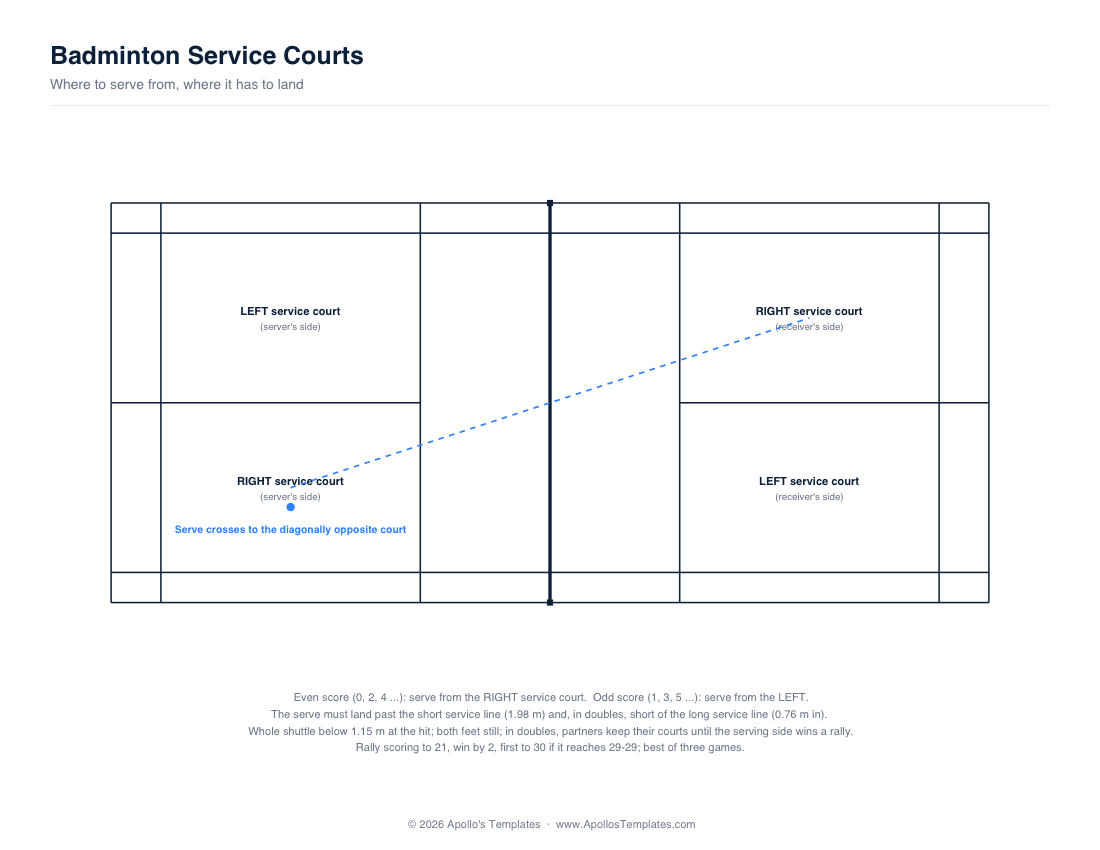
- Serve diagonally. From your right service court when your score is even, your left when it is odd, into the receiver’s opposite court.
- It must clear the short service line (1.98 m from the net) — and in doubles it must not pass the long service line 0.76 m inside the back boundary.
- One hit per side. Racket only; no double hits, no carries, and partners cannot both touch it.
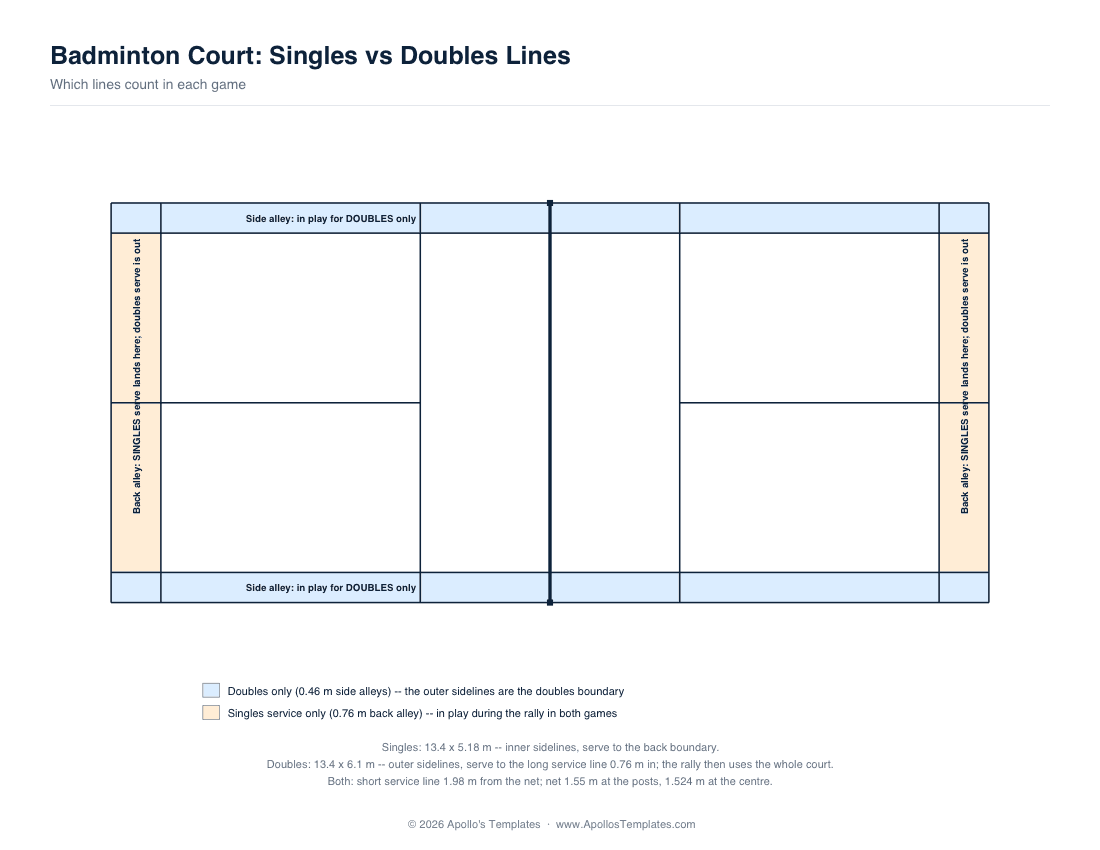
- Lines are in. A shuttle landing on a boundary line is good. Singles plays to the inner sidelines, doubles to the outer ones.
- Don’t touch the net. Racket, body or clothing on the net or posts during a rally is a fault; so is reaching over to hit a shuttle before it crosses.
- A net cord is good — if the shuttle clips the tape and drops in, play on, on the serve as well.
- A let replays the rally — receiver not ready, a stray shuttle, a shuttle caught on top of the net after crossing, or an umpire’s doubt.
- Winner serves next. Win the rally, win the serve. In doubles the serving pair swap courts when they win a point on their own serve; the receivers never rotate.
Serving: where you stand, where it lands
Look at your own score. Even — 0, 2, 4 and so on — and you serve from your right service court; odd and you serve from the left. The shuttle has to travel diagonally, over the net and past the short service line into the court directly opposite. In singles it may go all the way to the back boundary; in doubles anything beyond the long service line is out. Contact must be below 1.15 m, which is why the serve is underarm, and both feet stay on the floor until you have hit it.
Singles and doubles use different lines
Singles is the narrow game: the inner sidelines, 5.18 m apart, and a serve that may drop right on the back line. Doubles is the wide game: the outer sidelines, 6.1 m apart, but a short serving box — the serve must land short of the long service line 0.76 m inside the back boundary. The moment the serve is in, doubles rallies use the whole court, back alley included. Get those two facts straight and the court stops being confusing.
Scoring, in one paragraph
Twenty-one points wins a game, but you have to be two clear: 21–19 wins, 21–20 does not, and the game runs on until someone leads by two or reaches 30, which wins outright. Two games win the match. Players change ends after each game and, in a third game, when the leader reaches 11. Because every rally scores, a game between even players usually takes fifteen to twenty minutes; the serve simply passes to whoever won the last point.
For a PE class or a garden game
The rules above are the BWF Laws, which is what school and college programmes teach. For a class, the usual simplifications are shorter games (to 11 or 15), no let for a not-ready receiver, and calling the whole court in for the serve so nobody has to remember the long service line. The one rule worth keeping even in a garden is the underarm serve — an overhead serve turns every rally into a smash.
What are the 5 basic rules of badminton?
How do you serve in badminton?
How does scoring work — does the serve matter?
What is the difference between singles and doubles rules?
What counts as a fault?
What is a let?
Based on the BWF Laws of Badminton. Updated through September 2026.