





Bocce Ball Court Dimensions
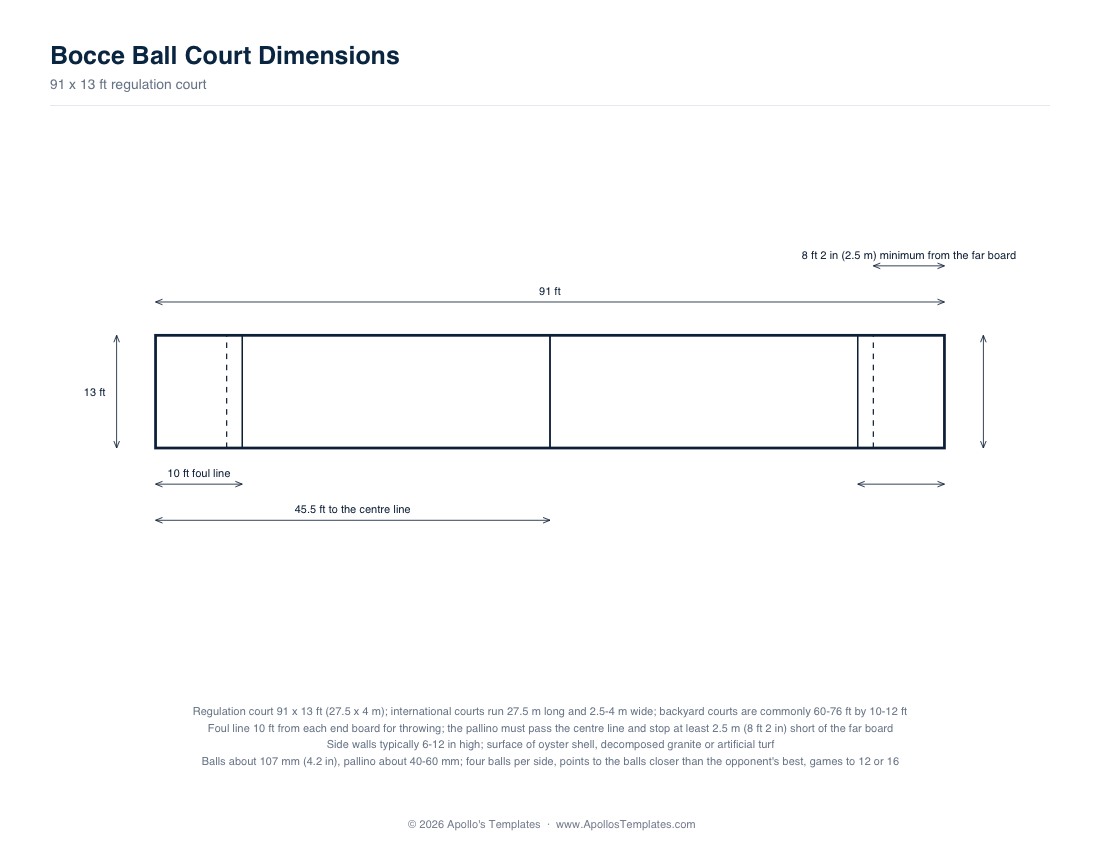
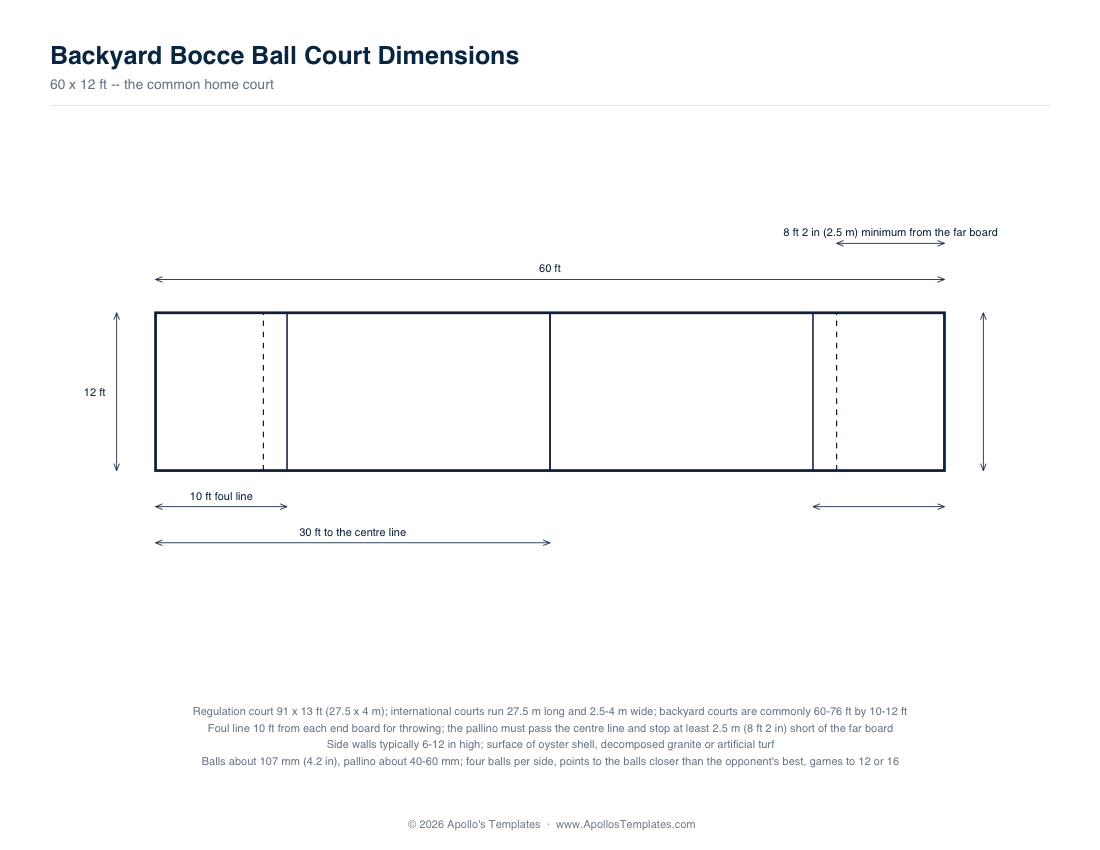
Two courts, both measured: the 91 × 13 ft regulation court the US Bocce Federation plays on, and the 60 × 12 ft court most people actually build. Foul lines, centre line and the pallino rule are drawn on each, with the walls, surface and yard space you need underneath.
Three sheets, two courts.
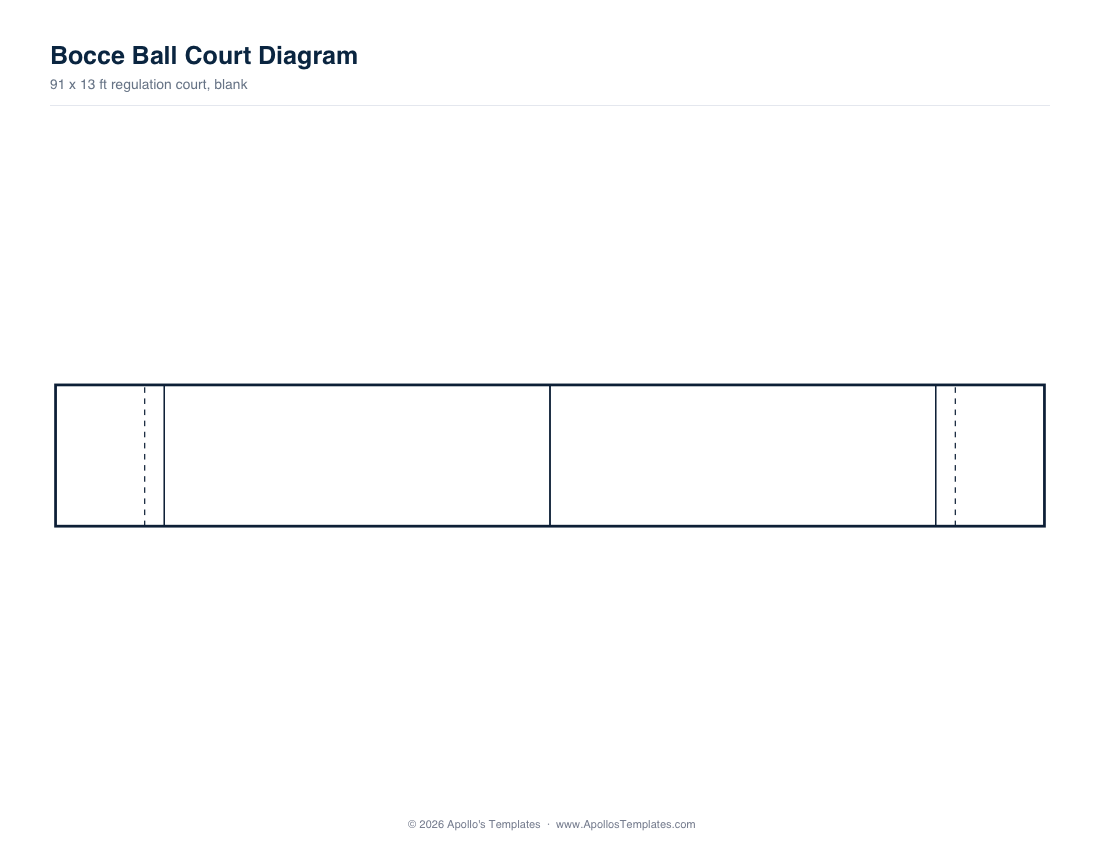
Regulation for clubs, backyard for the rest of us, and a blank you can name.
Bocce court numbers
Regulation first, backyard in brackets.
| Measurement | Value |
|---|---|
| Length | 91 ft regulation (27.5 m international); backyard 60–76 ft |
| Width | 13 ft regulation (2.5–4 m international); backyard 10–12 ft |
| Foul line | 10 ft from each end board |
| Centre line | Halfway — 45½ ft on a 91-ft court, 30 ft on a 60-ft court |
| Pallino | Must pass the centre line and stop at least 8 ft 2 in (2.5 m) from the far board |
| Walls | Typically 6–12 in high; end boards taller to stop hard throws |
| Surface | Crushed oyster shell, decomposed granite or turf over a compacted base |
| Balls | About 107 mm (4.2 in), four per side; pallino 40–60 mm |
How much yard a bocce court really needs
A regulation court is 91 feet long — longer than most suburban lots are wide — which is why the backyard standard settled at 60 feet. The game does not change: the foul line stays 10 feet from each end, the pallino still has to cross the centre and stay off the far wall, and 12 feet of width leaves room for a ball to be knocked without leaving the court.
Whatever length you choose, the walls matter more than the lines. Six to twelve inches of timber or stone keeps the balls in and gives you bank shots; the end boards take the hardest hits, so build them taller and back them with a bumper. The surface should be firm and level enough that a slow-rolled ball runs straight — oyster shell and decomposed granite are the classic choices, artificial turf the low-maintenance one.
What size is a regulation bocce court?
What size is a backyard bocce court?
Where are the lines on a bocce court?
How high should bocce court walls be?
What is the best surface for a bocce court?
Can I fit a bocce court next to a pool or on a slope?
Court figures from the US Bocce Federation and the international rules as summarised by Wikipedia. Updated through September 2026.