




Bocce Ball Rules
Bocce takes two minutes to learn and a summer to get good at. This is the two minutes: how a frame starts, what you are trying to do with each ball, how the frame is scored, and the handful of lines on the court that the rules actually use.
The rules of bocce in ten lines
- Two sides, four balls each. Singles, doubles or teams of four; each side plays one colour. One small target ball — the pallino.
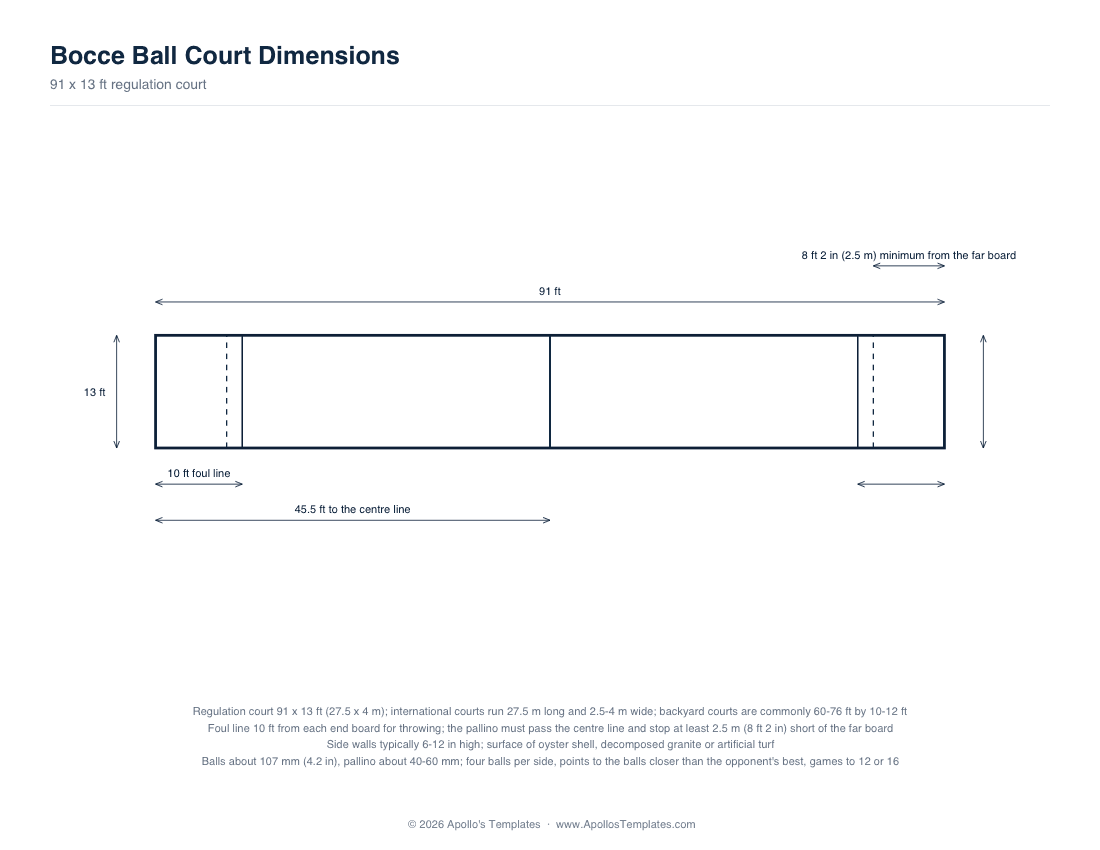
- Throw the pallino first. The side that wins the toss throws it from behind the foul line; it must pass the centre line and stop short of the far wall (at least 2.5 m under international rules). Miss and the other side throws it.
- Then the first ball. The side that threw the pallino plays the first ball, trying to get as close to it as possible.
- The side that is not closest throws next. Always. You keep throwing until you get a ball closer than your opponent’s best, or run out of balls; then they throw.
- Stay behind the foul line. Ten feet from your end board. Cross it before the ball leaves your hand and the throw is void.
- Point or hit. Roll a ball in to lie close (pointing), or throw hard to knock an opponent’s ball, or the pallino, away (hitting). Both are legal; walls and bank shots are in play.
- The frame ends when all eight balls are thrown. Then measure.
- Scoring a frame. The side with the ball closest to the pallino scores one point for each of its balls that is closer than the opponent’s closest ball. Only one side scores per frame.
- Next frame from the other end. The side that scored throws the pallino.
- Play to 12 or 16. Twelve is the common recreational game and many leagues play to 16; some play 15 or 21. Agree before the first frame.
Pointing, hitting and measuring
Most of bocce is pointing — the slow roll that stops a hand’s breadth from the pallino. Hitting is the answer to a good point: a hard throw, sometimes on the fly, that removes the opponent’s ball or moves the pallino somewhere friendlier. Both are legal in every rule set, and both can use the side walls; a ball that hits the end board without touching the pallino or another ball first is usually dead and removed.
Measuring settles anything the eye cannot. Measure from the near edge of the pallino to the near edge of each ball; a tie between the two sides’ closest balls means neither scores for it, and if the two closest are a dead heat the frame can end with no score at all.
Backyard and club variations
Open rules — the everyday game — let you throw the pallino anywhere past centre and play to 12. Volo and punto-raffa-volo, the codified Italian styles, restrict how a hit may be played and require calling your shot. Most American leagues play open rules with the USBF court and score to 16. None of it changes the rhythm: the side that is behind always throws next.
How do you score in bocce?
Who throws next in bocce?
Where does the pallino have to land?
Can you hit the other team's ball?
How many people play bocce?
What is the foul line in bocce?
Based on US Bocce Federation open rules and the international rules. Updated through September 2026.