





Cornhole Rules and Scoring
The whole game in a page: how a frame works, how points cancel, when a bag counts as in, what a foul is, and the few places the official ACA and ACL rules differ from the way most backyards play.
The rules of cornhole in ten lines
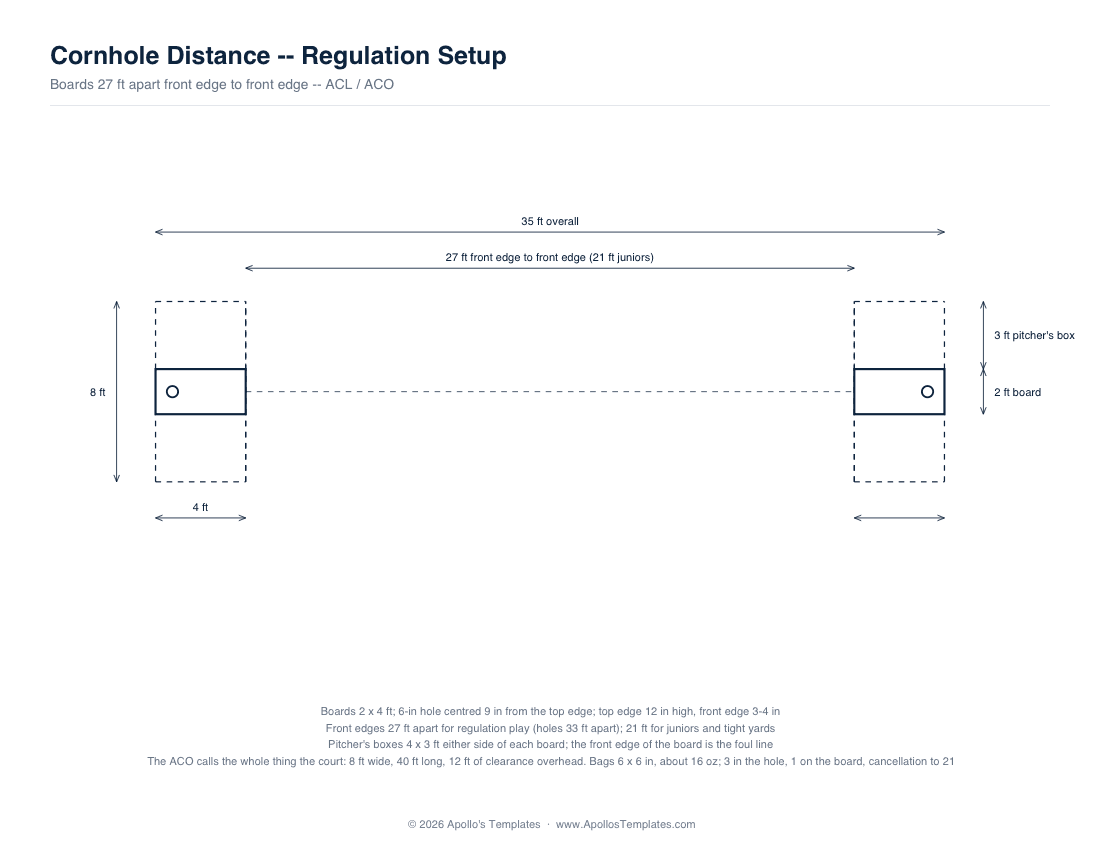
- Two boards, 27 feet apart. Front edge to front edge; 21 feet for juniors. Players (or partners in doubles) stand at opposite boards.
- Four bags each. Opponents alternate throws from the pitcher’s box beside their board until all eight bags are thrown; that is a frame (or inning).
- Stay behind the foul line. The front edge of the board is the line. Release before your foot crosses it, or the bag is a foul and comes off.
- Scoring a bag. In the hole: 3 points. On the board when the frame ends: 1 point. On the ground, or touching the ground and the board: nothing — and it is removed.
- Cancellation scoring. Add each side’s points for the frame; only the difference counts, to the side with more. 7 to 4 scores 3 for the leader.
- Knock-ins and knock-offs count. A bag pushed into the hole by another bag is 3; a bag knocked off the board scores nothing, whoever threw it.
- The winner of the frame throws first. If the frame was a wash, the side that threw first last frame throws first again.
- Play to 21. First side to reach or pass 21 at the end of a frame wins. Official rules do not require winning by two, and there is no bust for going over — those are house rules.
- Doubles. Partners stand at opposite boards and throw the frames alternately; singles players walk to the other board each frame.
- Keep it fair. No leaning past the box, no distracting the thrower, and bags must be thrown underhand.
How scoring actually works
Every frame is scored by cancellation. Count each side’s bags — 3 for each one in the hole, 1 for each one still on the board — then subtract the smaller total from the larger. Only the winning side scores, and only the difference. If you put two in the hole and one on the board (7) and your opponent puts one in and two on (5), you score 2 for the frame. A frame where both sides score the same is a wash: nobody scores and the same player throws first again.
That is why cornhole games swing. A side that is behind 18–9 can still win in a frame or two, because a strong frame wipes out the opponent’s bags before adding to the total.
What counts as in, on and off
In the hole is 3 points: the bag has passed through the hole, whether it went straight in, slid in, or was knocked in by another bag. On the board is 1 point: the bag is resting on the playing surface and not touching the ground. A bag that touches the ground and the board at once — the ’hanger’ off the front edge — is a foul bag and is removed before it can affect other bags. Bags knocked off the board by a later throw score nothing; bags knocked in score 3, no matter whose they were.
House rules the official rules don’t have
Most backyards play that you must win by two, or that going over 21 ’busts’ you back to 15 or 11. Neither is in the ACA or ACL rulebook: officially the first side to reach or exceed 21 at the end of a frame wins outright. Play them if you like — just agree before the first throw. The same goes for ’skunk’ rules and calling a score of exactly 21 required.
Distance is the other common divergence. Regulation is 27 feet front edge to front edge; many yards throw from 33 feet because that was the older hole-to-hole standard, and juniors throw from 21. Whatever you choose, keep both boards the same and mark the foul line at the front edge.
How do you score in cornhole?
Do you have to win by 2 in cornhole?
What is a foul in cornhole?
What happens if a bag is knocked into the hole?
How far apart should the boards be for kids?
Who throws first?
Based on the American Cornhole Association and American Cornhole League rules. Updated through September 2026.