





Cornhole Board Dimensions
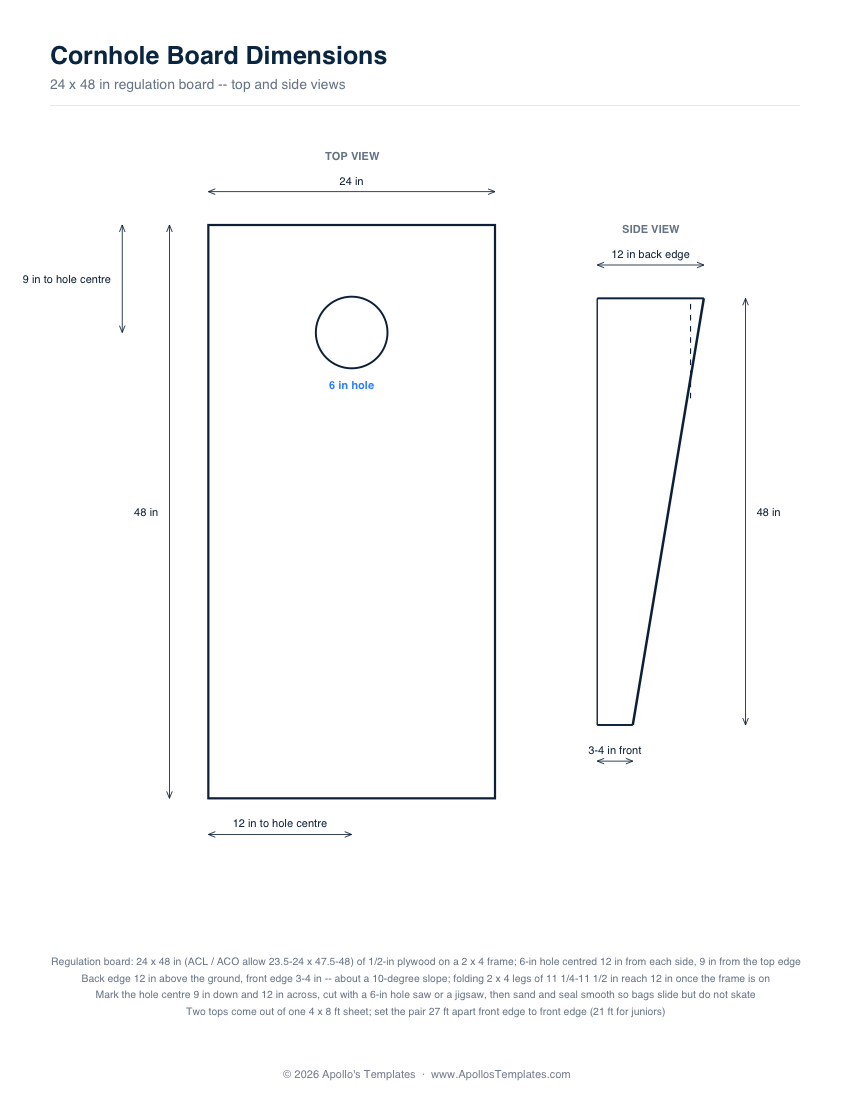
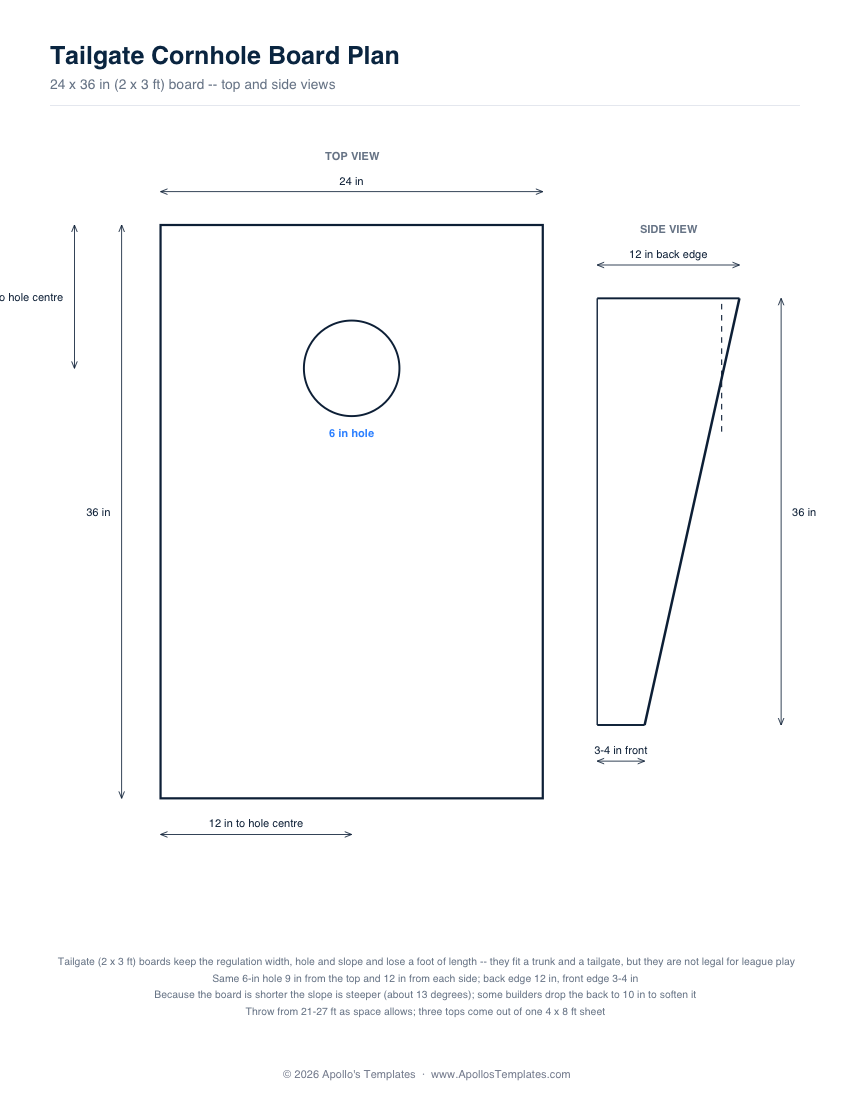
The regulation cornhole board is 24 × 48 inches with a 6-inch hole 9 inches from the top, 12 inches high at the back and 3 to 4 inches at the front — the same numbers in the ACL and ACO rulebooks. This page has that board as a printable plan, the materials and cut list to build a pair, the leg detail, and the tailgate and mini sizes people actually build when a full board will not fit.
Four sheets: the board, the plans, two smaller boards.
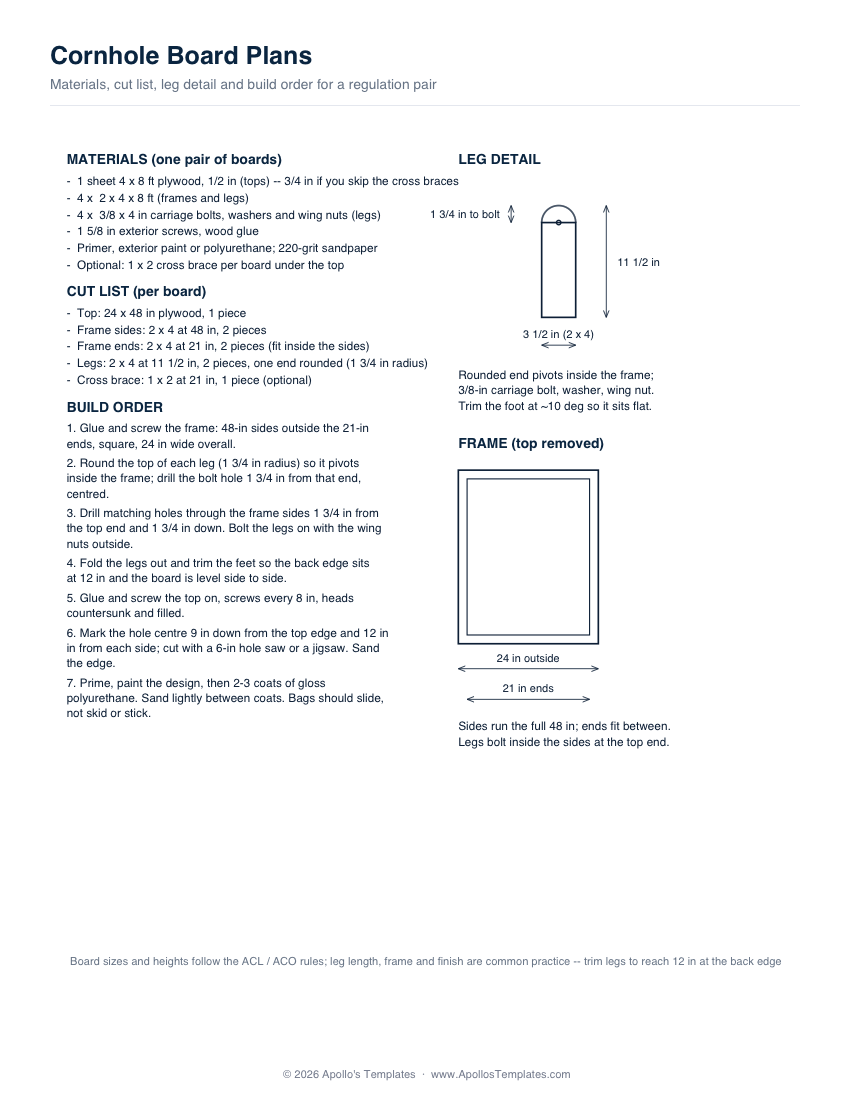
The board plan is the drawing; the plans sheet is the shopping list, cut list and build order. Tailgate and mini boards are drawn to the same conventions.
Regulation board, measurement by measurement
ACL and ACO agree on every one of these; the legs and frame are the standard way to get there, not a rule.
| Measurement | Value |
|---|---|
| Length | 48 in (ACL / ACO tolerance 47½–48 in) |
| Width | 24 in (23½–24 in) |
| Playing surface | ½-in plywood with cross bracing, or ¾-in without; sanded smooth and finished gloss so bags slide |
| Hole | 6 in diameter, centred 9 in from the top edge and 12 in from each side |
| Back edge height | 12 in off the ground |
| Front edge height | 3–4 in off the ground |
| Slope | About 10° (rise of 8–9 in over 48 in) |
| Frame | 2 × 4 (or 1 × 4 for a lighter board); 48-in sides, 21-in ends |
| Legs | 2 × 4, about 11½ in with a 1¾-in rounded pivot end — common practice, trimmed so the back edge reaches 12 in |
| Metric | 610 × 1220 mm; 152 mm hole, centre 229 mm from the top; back 305 mm, front 76–102 mm |
Regulation, tailgate and mini boards
Only the first row is legal in a league. The other two are what people build for a truck bed or a tabletop, drawn to the same proportions.
| Board | Size | Hole | Heights | Notes |
|---|---|---|---|---|
| Regulation | 24 × 48 in | 6 in, 9 in from the top | 12 in back, 3–4 in front | ACL, ACO and every sanctioned league |
| Tailgate (2 × 3) | 24 × 36 in | 6 in, 9 in from the top | 12 in back, 3–4 in front | Fits a trunk; steeper slope; not league-legal |
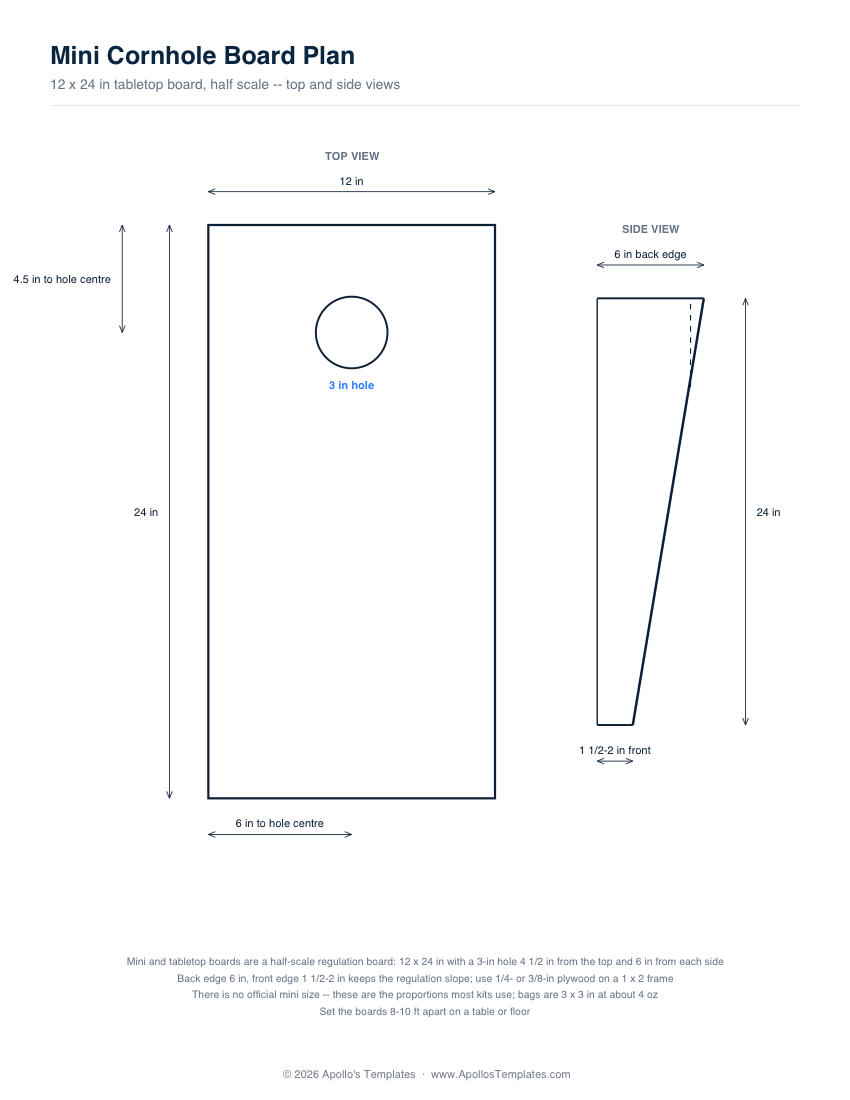
| Mini / tabletop | 12 × 24 in | 3 in, 4½ in from the top | 6 in back, 1½–2 in front | Half scale; no official standard; 3-in bags |
Why the board is shaped the way it is
The hole sits 9 inches from the top so a bag that lands on the front half has 30 inches of board to slide up before it drops, and the 12-inch back edge gives the top its 10° slope — the number that decides whether a bag slides or sticks. Move the hole lower or flatten the board and the game changes: short bags stop dead and blockers stop working. That is also why the finish matters as much as the cut. Sand to 220, seal, and use a gloss polyurethane or a hard latex; rubbery or chalky paints grab the bag.
Build the frame first and square, then the top, then the hole. Two carriage bolts hold the legs, and the last job is trimming the feet until a tape held at the back edge reads 12 inches on level ground. A pair built this way weighs about 25 pounds each and lasts for years outdoors if you seal the underside too.
What are the regulation cornhole board dimensions?
Are ACL and ACO board dimensions different?
How big is the hole on a cornhole board, and why do some plans say 4 inches?
What angle is a cornhole board?
How long should the legs be?
What plywood do I use, and how many boards come out of a sheet?
Are 2 × 3 tailgate boards legal?
What size is a mini or tabletop cornhole board?
What are cornhole board dimensions in mm?
How far apart do the boards go once they are built?
Board figures from the American Cornhole League and American Cornhole Organization rules; frame, leg and finish details are common builders’ practice. Updated through September 2026.