





How to Play Darts — 501, Cricket, Baseball and the Rest
One board, a dozen games. This page starts with how the board scores, then gives 501 and 301 the way the professionals play them, cricket the way American bars play it, baseball darts for a mixed crowd, and the party games — around the clock, killer, Shanghai — that need no arithmetic at all. The score sheets for 501, cricket and baseball print from here.
How the board scores
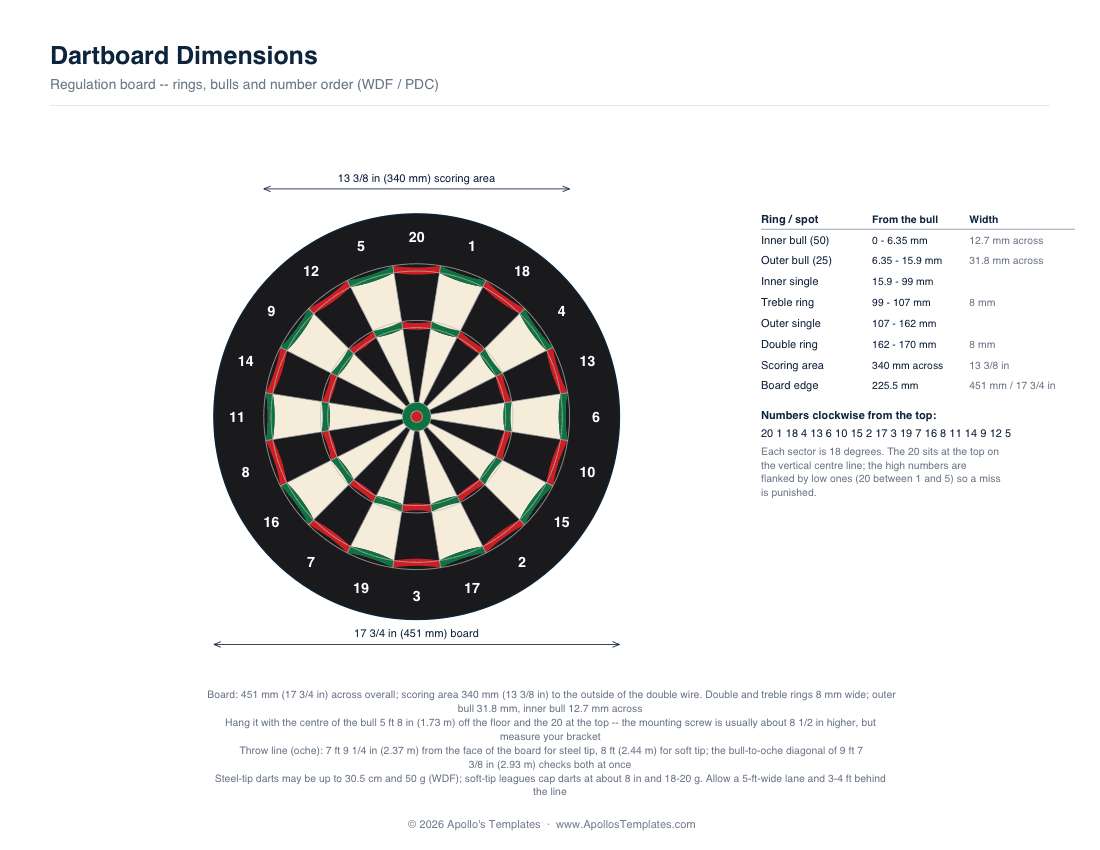
- The segment number is the score. Twenty wedges, 1 to 20, arranged so the big numbers sit between small ones.
- The thin outer ring doubles it; the thin inner ring trebles it. Treble 20 is 60, the most a single dart can score.
- The bull is two rings: the outer bull scores 25, the inner bull 50 — and the inner bull counts as a double for finishing.
- Three darts a turn, thrown one at a time from behind the line. A dart that bounces out, falls off or misses the board scores nothing and is not rethrown.
- A dart scores where its point is — if it is in the board when the turn ends. Darts that land in another dart’s flight do not count.
- Both feet behind the line. You may lean as far as you like as long as your feet stay behind it.
The games, side by side
Same board and darts for all of them; what changes is what you aim at and how you win.
| Game | Players | Object | Scoring | Finish | Notes |
|---|---|---|---|---|---|
| 501 | 2, or 2 teams | Take 501 down to exactly zero | Every dart subtracts its value; three darts a turn | Last dart must be a double or the bull (double out). Going below zero, to 1, or to zero without a double is a bust -- the turn does not count | The professional game (PDC, WDF). Legs, sets and matches |
| 301 | 2, or 2 teams | Take 301 down to exactly zero | Same as 501 | Double out; many leagues also require a double to start scoring (double in) | Faster; the American league staple |
| Cricket | 2-4 or teams | Close 20, 19, 18, 17, 16, 15 and the bull before your opponent, with equal or more points | Three marks close a number (single 1, double 2, treble 3). Extra hits on a number you have closed but they have not score points | Close everything and lead on points | The American bar game. Cut-throat: points go to the opponent instead |
| Baseball | Any number | Most runs over 9 innings | Inning 1 you throw three darts at the 1, inning 2 at the 2 ... single 1 run, double 2, treble 3 | After the 9th; extra innings for a tie | Great with kids and mixed groups; also played on the baseball dartboard |
| Around the clock | Any number | Hit 1 through 20 in order, then the bull | One dart at a time; doubles and trebles count as the number (or skip ahead, house rules) | First to the bull wins | The learning game |
| Killer | 3+ | Be the last player with lives | Each player owns a number (throw for it). Hit your own double to become a killer; then hit others' doubles to take lives | Last one standing | Party game; usually 3 lives each |
| Shanghai | Any number | Most points after 7 (or 20) rounds | Round 1 throw at the 1, round 2 at the 2 ... singles, doubles and trebles count | A single, double and treble of the round's number in one turn -- a Shanghai -- wins outright | Quick; good for a crowd |
501 and 301: the counting games
Everyone starts on 501 and subtracts what they score, three darts a turn, and the first to reach exactly zero wins the leg — but the dart that gets you there has to be a double, or the inner bull. That one rule makes the game. A player on 40 wants double 20; a player on 41 needs a single first (single 9 leaves 32, double 16) because 41 cannot be finished with one dart. Leaving an even number is the whole art of the endgame, and the reason 32 and 40 are the favourite numbers to leave: miss the double and hit the single, and you still have a double left. The checkout chart on the printable score sheet gives the standard three-dart routes for every finish from 170 down to 61; below that you can work it out.
The bust rule keeps people honest. If a turn takes you below zero, to exactly 1, or to zero without a double, the turn never happened — you go back to the number you started on and the next player throws. 301 is the same game from a lower start, quicker and the usual American league format, often with a double required to start scoring as well as to finish. Deciding who throws first is done by throwing one dart each at the bull, closest starts; in later legs the start alternates, and in a deciding leg you throw for the bull again.
Cricket: marks and points
Cricket ignores fourteen of the twenty numbers. Only 20, 19, 18, 17, 16, 15 and the bull count, and the job is to close each of them with three marks — a single is one mark, a double two, a treble three — before your opponent does. The scoring twist is that a number you have closed and your opponent has not is open for points: every further hit scores its value for you (20 a mark on the 20, 25 a mark on the bull) until they close it, at which point it is dead for everyone. You win when you have closed all seven and have at least as many points as anyone else; if you close out while behind on points you keep throwing at open numbers for points, and your opponent gets to keep closing. Score it the chalkboard way: a slash for one mark, a cross for two, a circled cross for closed, points written beside your name. Cut-throat cricket reverses the points — hits on your open numbers are added to your opponents’ totals, and lowest wins.
Baseball, and the games for a crowd
Baseball darts is nine innings of everyone aiming at the same number: the 1 in the first inning, the 2 in the second, through the 9. A single is one run, a double two, a treble three, anything else an out that scores nothing, and the most runs after nine wins with extra innings at the 10 and 11 for a tie. It works for any number of players and children can keep the score, which is why it outlasts fancier games at a party. Around the clock — hit 1 to 20 in order, then the bull, one dart at a time — is how people learn the board. Killer gives each player a number, makes them hit its double to become a killer, and then lets them hunt everyone else’s doubles to take lives. Shanghai runs seven rounds at the 1 through 7, singles, doubles and trebles all counting, and a single, double and treble of the round’s number in one turn wins on the spot.
How do you play darts for beginners?
How do you play 501?
How do you play cricket in darts?
How do you play baseball darts?
What is a bust in darts?
What does double out mean?
What is the highest score with three darts, and the highest checkout?
How do you play darts with kids?
501 and 301 as played under WDF and PDC rules; cricket and baseball as played in American leagues, where house variants are common. Updated through September 2026.