





8-Ball Pool Rules — and Where the Rulebooks Differ
Everyone knows 8-ball; almost nobody plays it by the same rules. This page gives the game in ten lines, then the four places the rulebooks split — call shots, the 8 on the break, what a scratch costs and what loses the game — across the WPA world rules, the APA and BCA leagues, and the bar. 9-ball and racking are at the end.
8-ball in ten lines
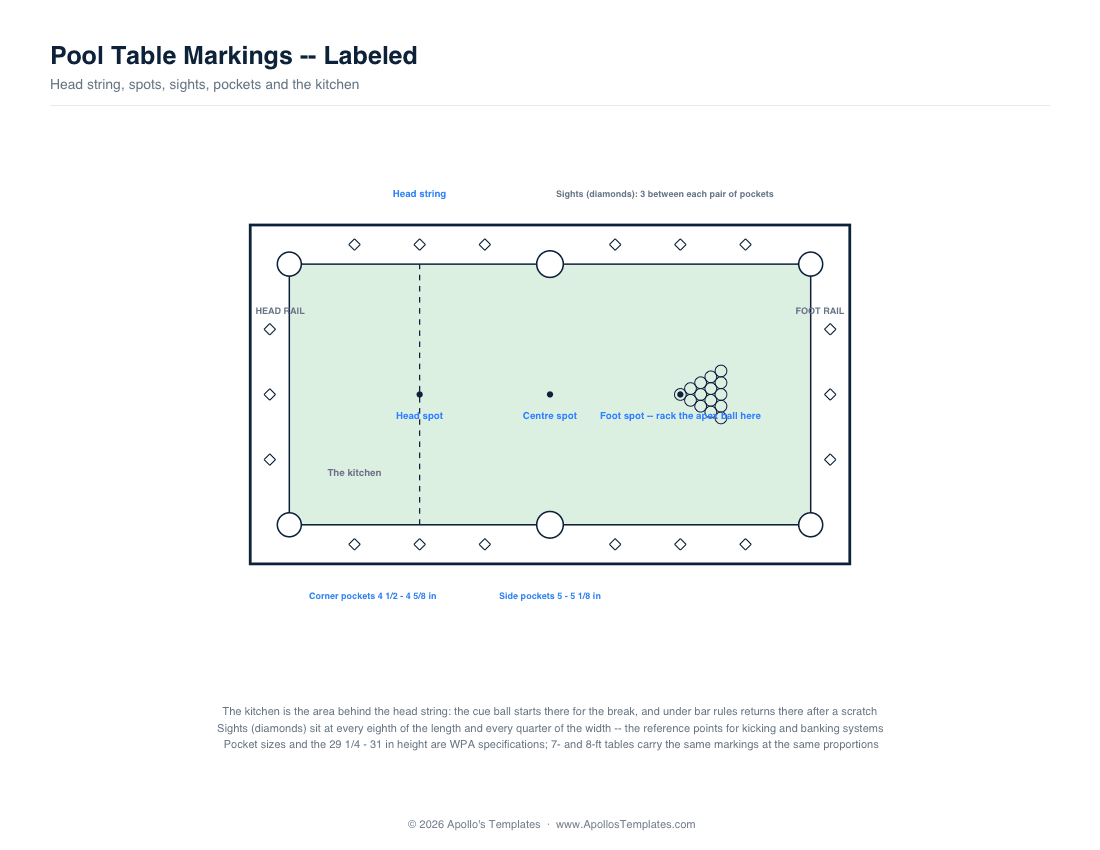
- Rack fifteen. Triangle on the foot spot, 8 in the middle, a stripe and a solid in the back corners.
- Break from the kitchen. Cue ball behind the head string; pocket a ball or send four to a cushion, or the break is illegal.
- The table is open. Nobody owns a group until a ball is legally pocketed after the break; then the shooter has that group.
- Hit your own ball first. Then a ball must be pocketed or some ball must reach a cushion, or it is a foul.
- Keep shooting while you make balls. Miss, and the other player shoots.
- Fouls give ball in hand. Scratch, wrong ball first, no rail, ball off the table, double hit: the opponent places the cue ball anywhere under league rules.
- Clear your group, then call the 8. Name the pocket; the 8 must go there and only there.
- The 8 loses if it goes early. Pocketing the 8 before your group is gone, on a foul, in the wrong pocket, or with a scratch, ends the game against you.
- Three fouls in a row lose under WPA rules; leagues vary.
- Winner breaks next in most leagues; alternate breaks in many tournaments.
Where the rulebooks differ
Same balls, same table, four rulebooks. These are the differences that start arguments.
| Rulebook | Call shots? | 8 on the break | After a foul | Legal break | You lose if |
|---|---|---|---|---|---|
| WPA / World Standardized Rules | Yes -- ball and pocket; obvious shots need not be stated | Not a win: breaker re-racks and breaks again, or spots the 8 and keeps shooting | Ball in hand anywhere on the table (behind the head string only after a scratch on the break) | Pocket a ball or drive four balls to a cushion, or the opponent may re-break or accept | 8 pocketed early, on a foul, in an uncalled pocket, or with a scratch; three consecutive fouls |
| BCA Pool League (CSI) | Yes -- ball and pocket | Breaker wins the rack | Ball in hand anywhere | Pocket a ball or four balls to a cushion | 8 early, on a foul, in the wrong pocket, or with a scratch |
| APA (American Poolplayers Association) | Only the 8-ball; every other ball counts however it drops | Breaker wins (a scratch while making it is a loss) | Ball in hand anywhere | Pocket a ball or four balls to a cushion | 8 early, on a foul, in the wrong pocket, or with a scratch; handicapped races decide the match |
| Typical bar / house rules | Usually everything, including banks and kisses | House choice: win, or re-rack | Cue ball behind the head string, shooting out of the kitchen | Rarely enforced | 8 early or with a scratch; often 'last pocket' variants |
Ball in hand, and why bar rules feel different
The biggest gap between league pool and bar pool is what a foul costs. Under the WPA, BCA and APA a foul hands the opponent the cue ball to place anywhere — ball in hand — which makes a scratch nearly a lost rack against a good player and turns safety play into the heart of the game. Traditional bar rules only send the cue ball behind the head string, and you have to shoot out toward a ball past it; that is gentler on the fouler and produces the long lags and lucky kicks that bar pool is known for. If you learn one thing before a league night, learn that ball in hand is real.
Call shot, slop and the 8
The WPA and BCA make you call the ball and the pocket for every shot, though the WPA lets an obvious shot go unspoken; a ball that drops somewhere else is spotted or simply does not count and your turn ends. The APA takes the opposite view for its handicapped leagues — slop counts on every ball but the 8. Every rulebook agrees on the 8: it must be called, it must go in the called pocket, and making it early, on a foul or with a scratch loses the game outright. The one thing they cannot agree on is the 8 on the break, so the table above is worth a look before money changes hands.
9-ball in a paragraph
Nine balls in a diamond, 1 on the foot spot, 9 in the middle. The lowest-numbered ball on the table must be struck first, but any ball that drops off a legal hit counts, and the 9 wins whenever it is pocketed legally — off the break included, in most events. No call shots. Ball in hand anywhere after any foul, a push-out is allowed immediately after the break, and three consecutive fouls lose the rack. It is the professional game because it is fast and because every rack is a fresh puzzle laid out in order.
What are the basic rules of 8-ball?
Is the 8-ball on the break a win?
What happens after a scratch in pool?
Do you have to call your shots?
What is a legal break?
What is a foul in pool?
How is 9-ball different?
How do you rack for 8-ball?
Based on the WPA World Standardized Rules, the APA Official Team Manual and the CSI / BCA Pool League rulebook; leagues revise these, so check the current edition before a match. Updated through September 2026.