
Apollo's Templates
HomeSportsSports CardsGymnasticsNormal Size Gymnastics Card
Gymnastics

Normal Size Gymnastics Card

Loading the editor…
Did you know?
We make sport card templates for every sport — all 26 of them
Softball, soccer, hockey, swimming, dance, karate, pickleball, and more — same five designs, same free maker, no signup.
Open

Beam, vault, floor, bars — print one card per athlete or use the team sheet to print the full roster. Photos with the athlete in their leotard, mid-pose, photograph best. This page builds the standard 2.5″ × 3.5″ size — the trading-card dimensions used by Topps, Bowman, and Pokémon. Prints four identical cards on one US Letter sheet so you can keep one and hand three away. The Classic design is the most printer-friendly of the three — sharp banner colors, no large dark fills.

The five Gymnastics card designs

Each one takes the same photo and details — you can switch between them in the maker above without retyping anything. Every design prints at 2.5 × 3.5 inches — the standard trading-card size, the same as Topps, Bowman and Pokémon cards — four to a US Letter sheet.
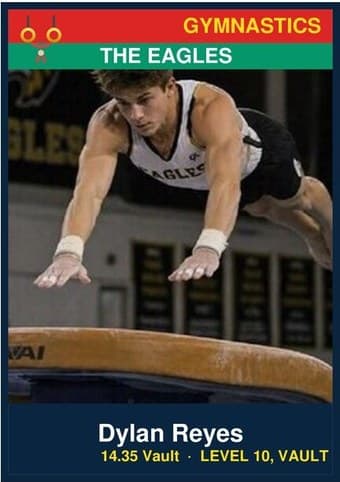
Gymnastics card in the Classic design — a color banner across the top, the photo below it, and the name and details on a dark footer bar

Classic

The one most people picture when they picture a trading card: banner up top, photo in the middle, name on a dark bar. At 2.5 × 3.5 it slides into a penny sleeve or binder pocket right next to the store-bought cards.
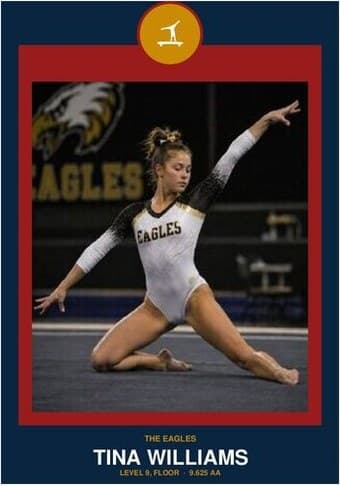
Gymnastics card in the Circle Badge design — a round sport badge centered at the top, the photo in a bordered frame below, and the name and position centered underneath

Circle Badge

A round badge sits at the top edge like a team crest, over an inner frame around the photo. The most formal of the five — it reads as much like an award as a trading card.

Gymnastics card in the Split Halves design — a border split into two colors top and bottom, the photo centered between them, and the name and details on a white footer

Split Halves

The border changes color halfway down, so the frame carries two team colors at once. The pick for clubs with a genuine two-color identity rather than one dominant color.
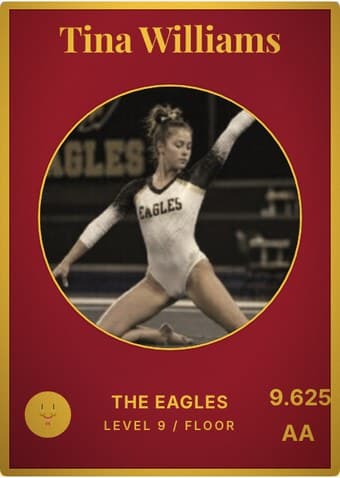
Gymnastics card in the Vintage Card design — an aged photo in a gold-ringed circular window on a deep crimson card, with the name in a serif face arched across the top

Vintage Card

A vintage trading card without imitating any real brand: the photo ages to a warm sepia (switchable off), sits in a gold-ringed circle, and the name arcs across the top in a serif face.

Gymnastics card in the Triple Split design — three stacked color bands down the left edge, the photo on a white field, and the name and details across the footer

Triple Split

Three color bands run down one edge against a clean white field. The boldest border of the set — the card that still reads from across the table during a trade.

The download is a print-ready PDF. There is no account to create, no watermark, and no design software to install — no Photoshop, no Word template, no Canva login.

Practical pointers

  • Use a high-quality photo. Beam, vault, or floor — a mid-skill photo reads stronger than a posed standing shot. Leotard against a contrasting backdrop photographs cleanest.
  • Cut along the gutter. The four cards are arranged 2×2 on a US Letter sheet with a thin gutter. A paper cutter is faster than scissors; a craft knife and metal ruler give the cleanest edges.
  • Card stock, not printer paper.60–100 lb cardstock holds up in a binder sleeve or a player’s pocket. Printer paper bends inside the first day.
  • Print four cards, keep one. The 4-up sheet is designed for the team-card-swap workflow: print, cut, keep one for yourself, hand three away.
  • Drag and zoom to crop. The photo frame shows exactly what ends up on the card. Center the face in the middle third — that’s the area readers’ eyes land on first.

Common questions

What's the standard trading-card size?
2.5 × 3.5 inches — the size used by Topps, Bowman, Pokémon, Magic: The Gathering, and most baseball / basketball / football trading cards since the 1970s.
How many cards print per sheet?
Four identical cards print on one US Letter (8.5 × 11″) sheet, arranged 2×2 with a thin gutter for cutting.
Do these fit standard binder sleeves?
Yes — 2.5 × 3.5″ is the size every 9-pocket trading-card binder sleeve is built for. The cards slide in just like a Topps or Bowman card.
Do I need an account or login to use this?
No. The generator runs entirely in your browser — nothing gets uploaded to a server. You can use it anonymously, no signup, no Adobe Acrobat, no watermark.
What paper should I use?
60–100 lb cardstock for cards you'll handle a lot (binders, pockets). Standard printer paper bends and curls within a day. Glossy photo paper works for keepsake prints if your printer supports it.
Can I edit the PDF after I download it?
The PDF is flat — re-edit by coming back to this page and regenerating with new inputs. Re-uploading the photo and re-typing names is faster than fighting an Acrobat editor.
Can I print scores on the back of these cards?
Yes — the card-back builder makes a matching reverse side and you type the column headings yourself. Gymnastics needs that differently from most sports here: nothing is counted, everything is scored out of 10, and the columns are fixed by the sport — vault, bars, beam, floor, all-around. What varies is the meet, so the natural shape is one row per meet across the season. It uses the same four card positions as this sheet, so print the fronts, re-feed the page, print the backs, and the sides line up. Open the card-back builder