




Hockey Rink Dimensions
There are two rinks in the world: the NHL's 200 × 85 ft sheet, which the AHL, ECHL, NCAA and USA Hockey all share, and the IIHF's 60 × 30 m Olympic sheet. Both are measured here line by line — goal lines, blue lines, circles, crease, goal, trapezoid — with a table of how the leagues differ on the ice and in the rulebook.
Three sheets, two rinks.
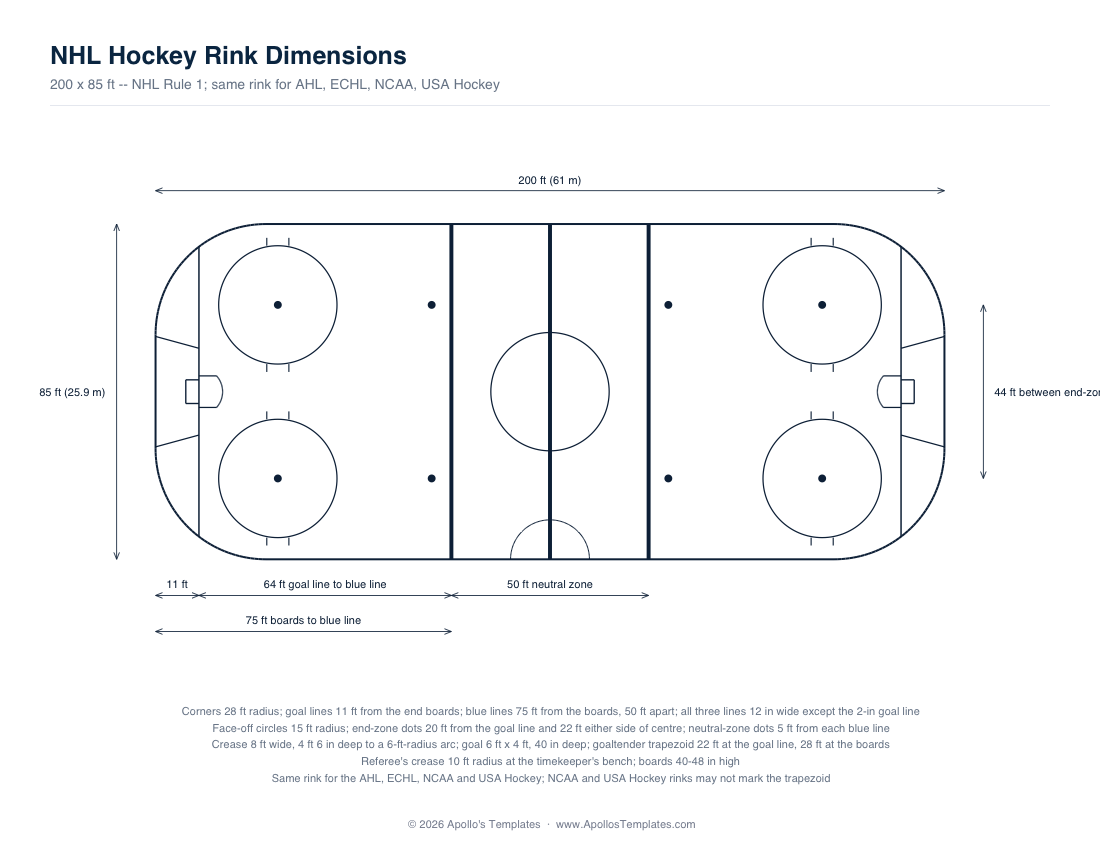
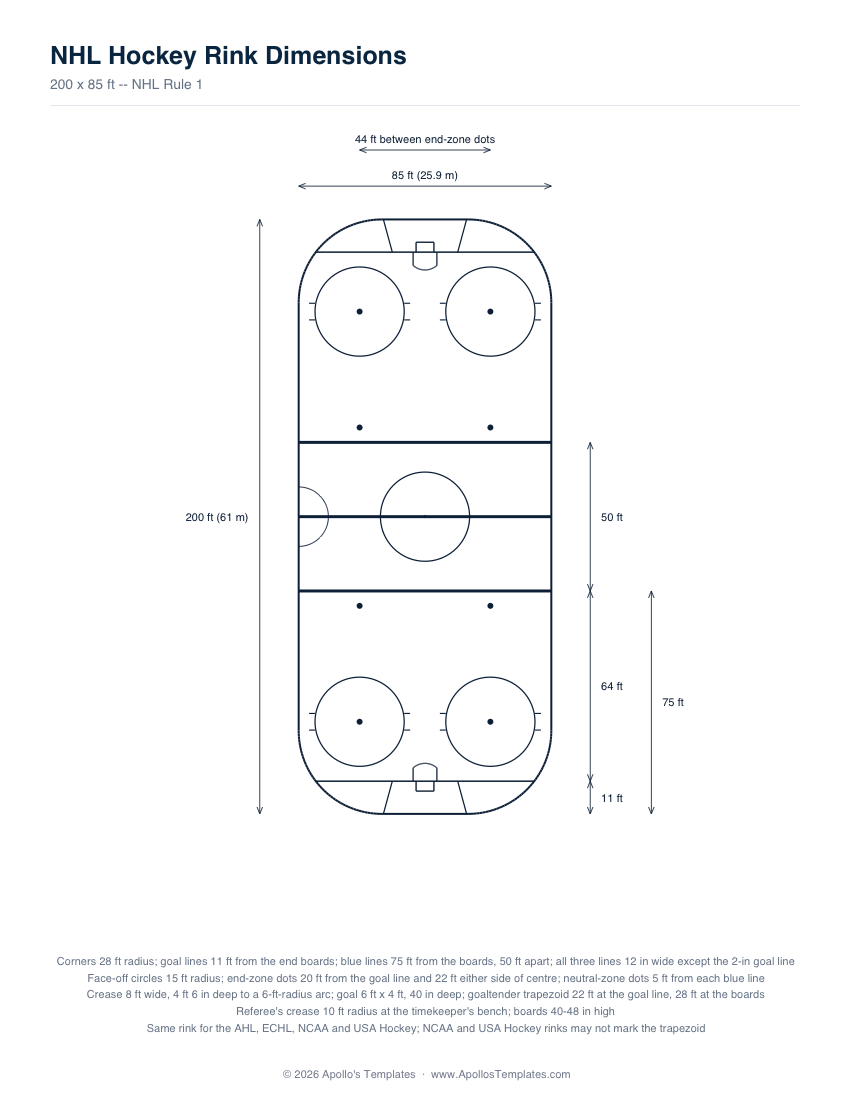
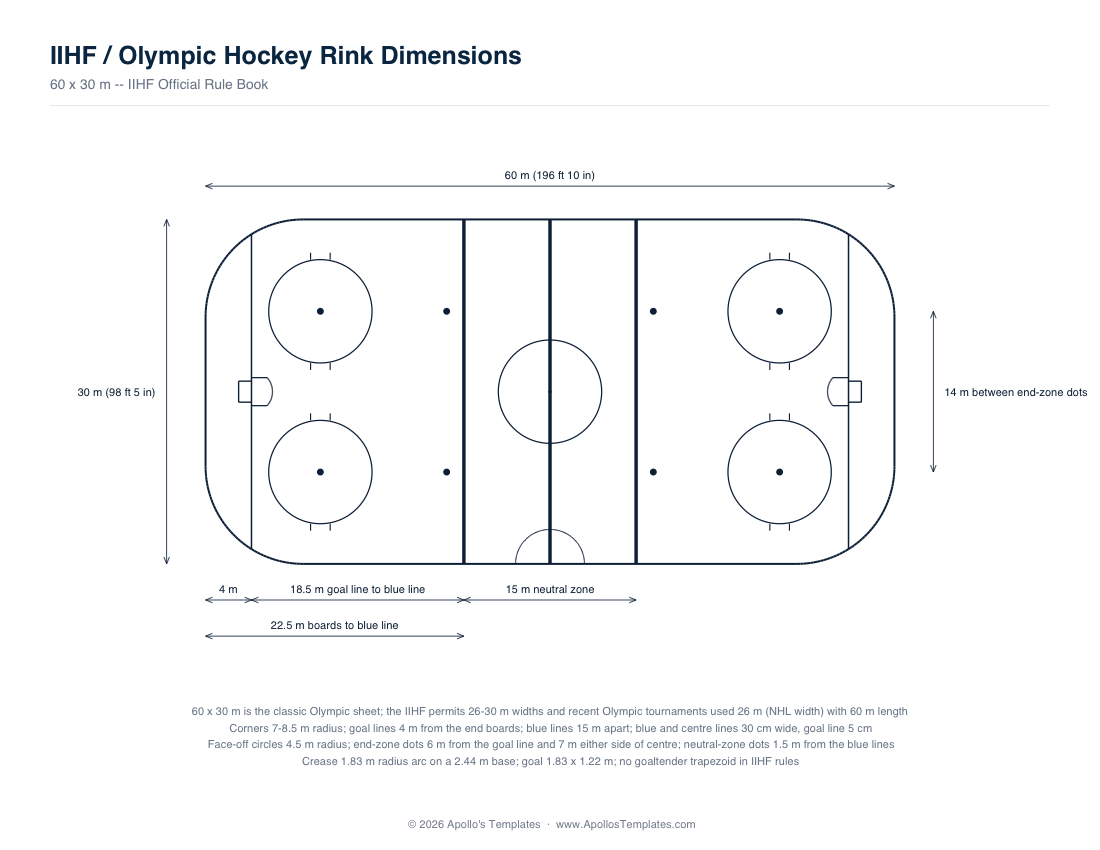
The NHL rink in both orientations and the IIHF sheet. Every number is on the diagram or in the facts under it.
NHL vs. IIHF / Olympic rink
Same length, thirteen more feet of width, and one missing trapezoid.
| Measurement | NHL (also AHL, ECHL, NCAA, USA Hockey) | IIHF / Olympic |
|---|---|---|
| Rink size | 200 × 85 ft (61 × 25.9 m) | 60 × 30 m (196 ft 10 in × 98 ft 5 in); 26–30 m permitted |
| Corner radius | 28 ft | 7–8.5 m |
| Goal line from end boards | 11 ft | 4 m (13 ft 1 in) |
| Blue lines | 75 ft from the boards, 50 ft apart | 15 m apart (22.5 m from the boards on a 60 m rink) |
| Face-off circles | 15 ft radius; end dots 20 ft off the goal line, 44 ft apart | 4.5 m radius; end dots 6 m off the goal line, 14 m apart |
| Crease | 8 ft wide, 4 ft 6 in deep, 6-ft arc | 2.44 m wide, 1.83 m arc |
| Goal | 6 × 4 ft, 40 in deep | 1.83 × 1.22 m |
| Goaltender trapezoid | 22 ft at goal line, 28 ft at boards | None |
Rinks and rules, league by league
The ice is nearly identical from the NHL down to 14U; the rules played on it are not. Icing, overtime, fighting and body checking are the four that catch parents and new coaches out — the rules page explains each.
| League | Rink | Icing | Overtime | Fighting | Body checking |
|---|---|---|---|---|---|
| NHL | 200 x 85 ft, trapezoid | Hybrid (since 2013–14) | 5 min 3-on-3, then 3-round shootout; playoffs 20-min 5-on-5 periods | 5-minute major, players stay in the game | Full body checking |
| AHL / ECHL | 200 x 85 ft, trapezoid | Hybrid | 5 min 3-on-3, then shootout | 5-minute major | Full body checking |
| IIHF / Olympics | 60 x 26–30 m, no trapezoid | Hybrid (since 2014; no-touch before) | 3-on-3: 5 min preliminary, 10 min knockout, 20 min final (no shootout in the final) | Match penalty — ejection | Men: yes. Women: no body checking |
| NCAA | NHL size; a few 200 x 100 ft sheets | Hybrid | 5 min 3-on-3 in the regular season (ties stand in NCAA records); tournament games play 20-min 5-on-5 periods | Game disqualification | Men: yes. Women: no body checking |
| USA Hockey (youth) | NHL size; 8U cross-ice, 10U half-ice option | Automatic (no-touch); short-handed teams are NOT exempt at 14U and under | Set by the league or tournament | Game misconduct | Not until 14U (since 2011–12) |
Reading the ice
Two blue lines split the rink into three zones, and almost every rule hangs on them: the puck has to cross the blue line before the attackers do, and a puck shot from your own side of centre that crosses the far goal line untouched is icing. The five face-off circles are where every stoppage restarts — one at centre, two in each end 20 feet out from the goal line — and the hash marks on the end-zone circles fix where the wingers stand.
The goal sits 11 feet out from the boards on purpose. That strip behind the net is live ice, and the trapezoid drawn on it is the only part a goaltender may play the puck in — an NHL invention from 2005 that the international game never adopted, which is the easiest way to tell the two rinks apart from the stands.
What are the dimensions of an NHL hockey rink?
How is an Olympic rink different from an NHL rink?
What rink do college and youth teams use?
How big is a hockey goal and crease?
What is the trapezoid behind the net?
How far apart are the blue lines, and how big is each zone?
What size is a backyard ice rink?
Are the rink dimensions the same in every NHL arena?
Measurements from NHL Rule 1 and the IIHF Official Rule Book, section 1. Updated through September 2026.