



Icing in Hockey — and the Rules That Change by League
Hockey is played on nearly the same rink from the NHL down to 14U, but not by the same rules. This page explains the calls people ask about most — icing first, then offside, the trapezoid, overtime, fighting and body checking — and shows where the NHL, AHL, IIHF, NCAA and USA Hockey differ.
What is icing?
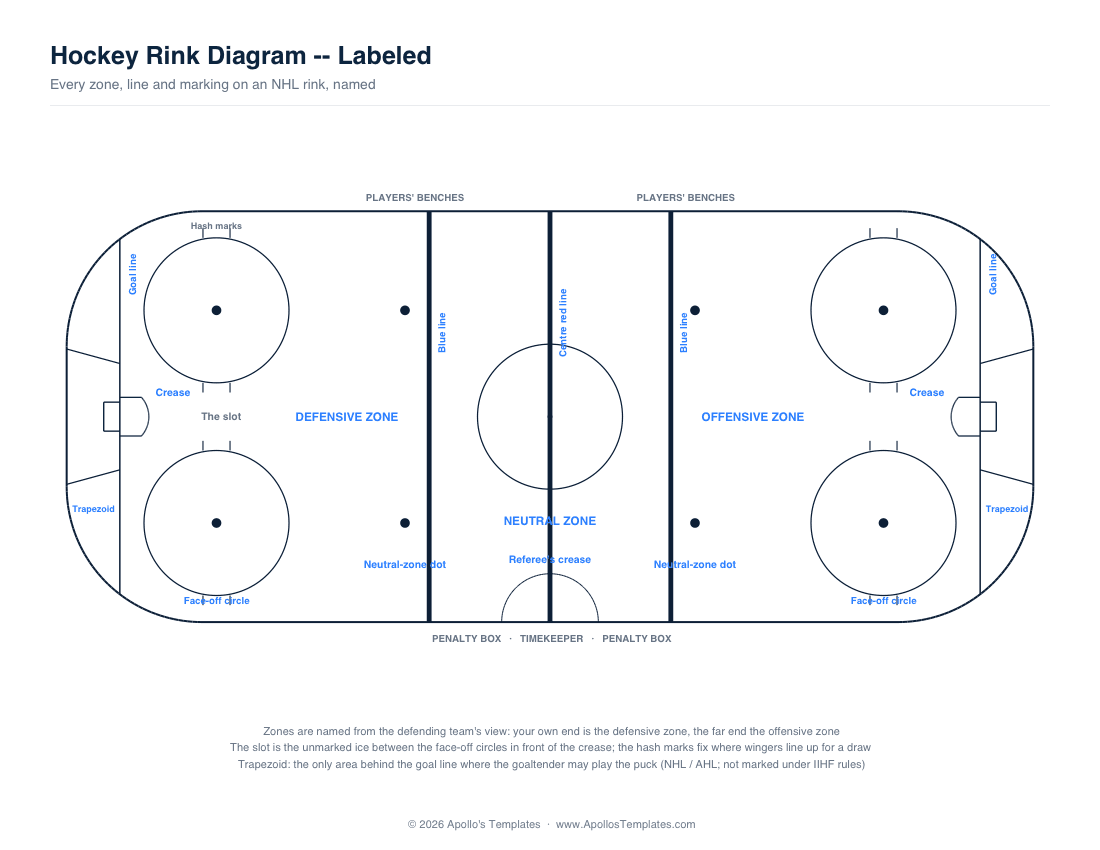
Icing is the rule against clearing the puck the length of the ice. If a player sends the puck from their own side of the centre red line and it crosses the far goal line untouched — not into the net, not off a defender, not played by the goalie — the whistle goes and the face-off comes all the way back into the offending team’s zone. Since 2005 the NHL adds a sting: the team that iced it cannot change its skaters before the draw, so a tired line stays out against fresh legs.
The whole argument between leagues is when the whistle goes. Under old-fashioned touch icing a defender had to reach the puck first, which sent two players racing into the end boards at full speed. No-touch (automatic) icing blows the play dead as soon as the puck crosses the goal line. Hybrid icing — now the standard in every professional league — has the linesman judge the race at the face-off dots: if the defender would win it, icing is called and nobody has to finish the sprint.
The rules, league by league
One rink, five rulebooks. These are the differences that decide what a parent sees from the stands.
| League | Rink | Icing | Overtime | Fighting | Body checking |
|---|---|---|---|---|---|
| NHL | 200 x 85 ft, trapezoid | Hybrid (since 2013–14) | 5 min 3-on-3, then 3-round shootout; playoffs 20-min 5-on-5 periods | 5-minute major, players stay in the game | Full body checking |
| AHL / ECHL | 200 x 85 ft, trapezoid | Hybrid | 5 min 3-on-3, then shootout | 5-minute major | Full body checking |
| IIHF / Olympics | 60 x 26–30 m, no trapezoid | Hybrid (since 2014; no-touch before) | 3-on-3: 5 min preliminary, 10 min knockout, 20 min final (no shootout in the final) | Match penalty — ejection | Men: yes. Women: no body checking |
| NCAA | NHL size; a few 200 x 100 ft sheets | Hybrid | 5 min 3-on-3 in the regular season (ties stand in NCAA records); tournament games play 20-min 5-on-5 periods | Game disqualification | Men: yes. Women: no body checking |
| USA Hockey (youth) | NHL size; 8U cross-ice, 10U half-ice option | Automatic (no-touch); short-handed teams are NOT exempt at 14U and under | Set by the league or tournament | Game misconduct | Not until 14U (since 2011–12) |
Offside
The puck must cross the attacking blue line before any attacking player does — skates, not stick. A player with one skate still on or above the line is onside; since 2020–21 the NHL counts a skate in the air above the line, not only one touching it. If an attacker is already in the zone when the puck enters, the play is offside; if the puck comes back out, or the attackers all clear the zone before touching it, a delayed offside is washed out and play continues. Every league on the table uses the same rule.
The trapezoid
Behind each NHL goal a trapezoid is painted from the goal line to the end boards — 22 feet wide at the goal line, 28 at the boards. It is the only part of the ice behind the goal line where the goaltender may play the puck; handle it in the corners and it is a two-minute delay-of-game penalty. The NHL introduced it in 2005 to stop goaltenders from killing every dump-in, the AHL uses it, and the international game never adopted it — which is why an Olympic rink has no trapezoid.
Overtime and shootouts
The NHL settles regular-season ties with five minutes of 3-on-3 and then a three-round shootout, and settles playoff games with full twenty-minute 5-on-5 periods until somebody scores. The IIHF scales its overtime to the stakes — five minutes 3-on-3 in the preliminary round, ten in the knockout rounds, twenty in the gold-medal game, with no shootout for the medal. The AHL copies the NHL regular season. The NCAA plays five minutes of 3-on-3 and then lets a tie stand in the national record, though conferences may run a shootout for their own points; tournament games go to full periods.
Fighting and body checking
Fighting is where the rulebooks split hardest. In the NHL and AHL it is a five-minute major and both players return to the game; instigating or a third fight adds more. In IIHF play a fight is a match penalty — out of the game — and the NCAA hands out a game disqualification that carries a suspension. Body checking has an age, not a penalty: USA Hockey allows it from 14U (raised from 12U in 2011–12), Hockey Canada from U15, and women’s hockey at the IIHF and NCAA level does not allow it at any age.
What is icing in hockey?
What is the difference between hybrid, touch and no-touch icing?
Can a short-handed team ice the puck?
What happens after icing?
How does overtime work in each league?
When is body checking allowed in youth hockey?
Based on the NHL, IIHF, NCAA and USA Hockey rule books. Updated through September 2026.