




Apollo's Templates
HomeSportsCourts & FieldsRugby Field Diagrams
Rugby · pitch and positions diagrams

Rugby Field Diagram

Free printable rugby field diagrams drawn to scale from World Rugby Law 1 and the rugby league laws — the union pitch in landscape or vertical, a half pitch for set pieces, the league field with its numbered lines, four pitches to a page for drill cards, a labeled pitch that names every line, and positions diagrams for the XV, the XIII and the sevens seven. Or build a custom one with your crest and your players' names.

Blank · print and draw on

Nine sheets, two fields, three codes.

Union pitch three ways, the league field, drill cards, the labeled pitch, and a positions diagram for each code. All to scale.
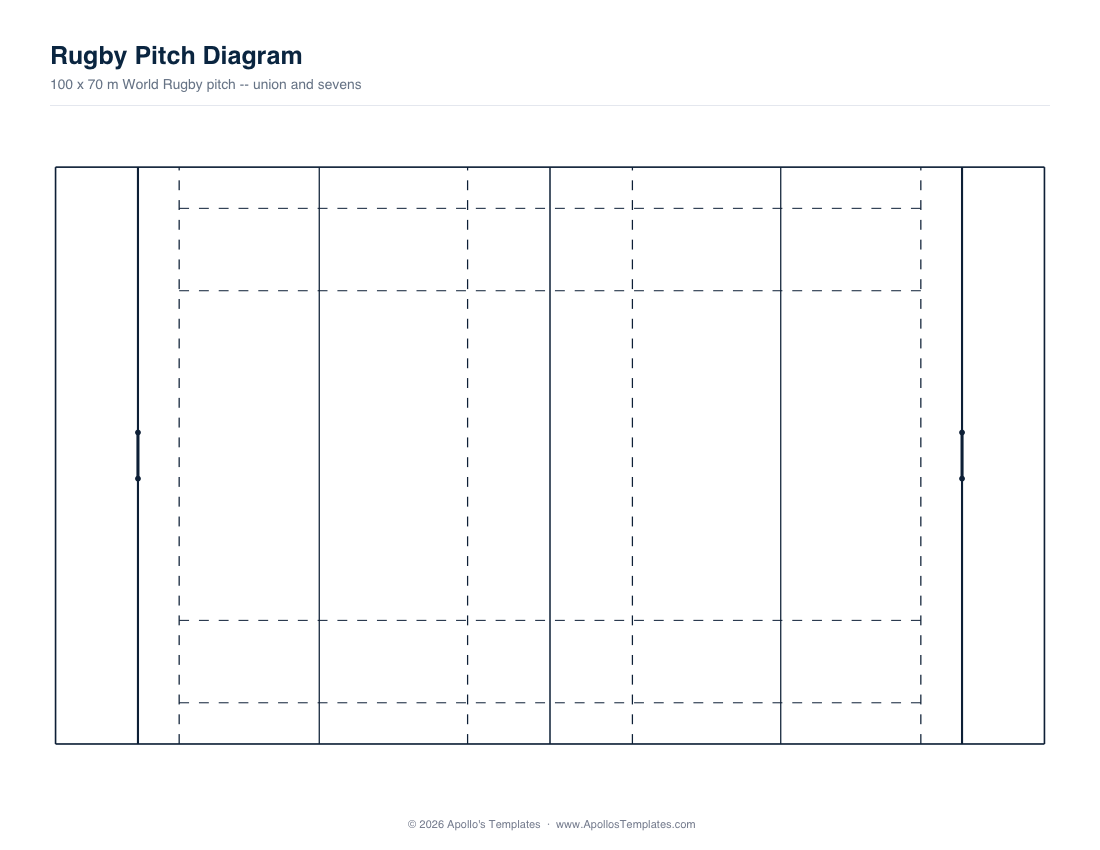
Blank rugby union pitch diagram drawn wide — in-goals, goal lines, dashed 5-metre lines, solid 22-metre lines, dashed 10-metre lines, halfway, the 5 m and 15 m dash lines and goal posts
NewPDF

Union Pitch — Landscape

The 100 × 70 m World Rugby pitch with every line and no text. Build Custom places the XV in a scrum formation, numbered 1–15 with names, and adds your crest.
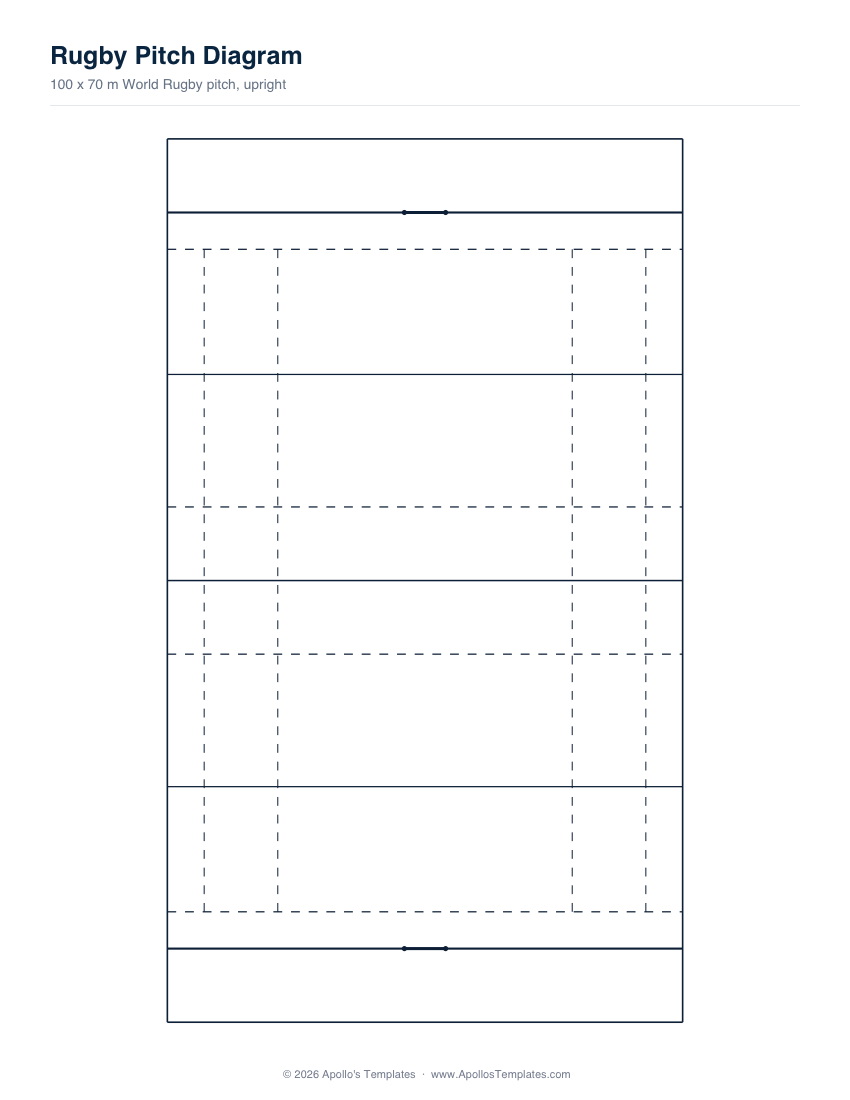
Blank rugby union pitch diagram in upright orientation, goals top and bottom, with the 22s, 10-metre lines and dash lines marked
PDF

Union Pitch — Vertical

Same pitch upright, for a clipboard or the whiteboard photo. Build Custom labels the positions with your team sheet.
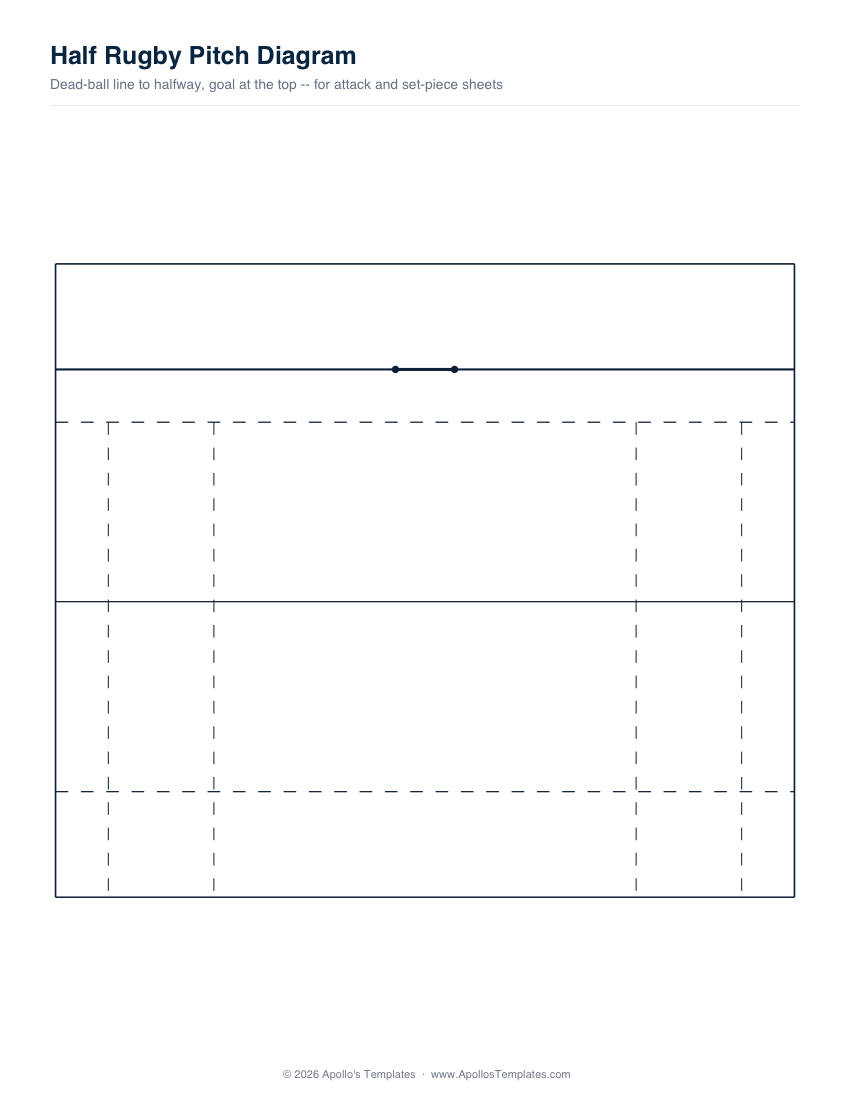
Blank half rugby pitch diagram — dead-ball line and goal at the top down to the halfway line at the bottom, at large scale, with the 22 and the 10-metre line
PDF

Half Pitch — Attack & Set-Piece Sheet

One half at twice the scale, goal at the top. The sheet for lineout moves, scrum plays, 22 exits and attacking shapes. Build Custom sets an attacking scrum on the 22.
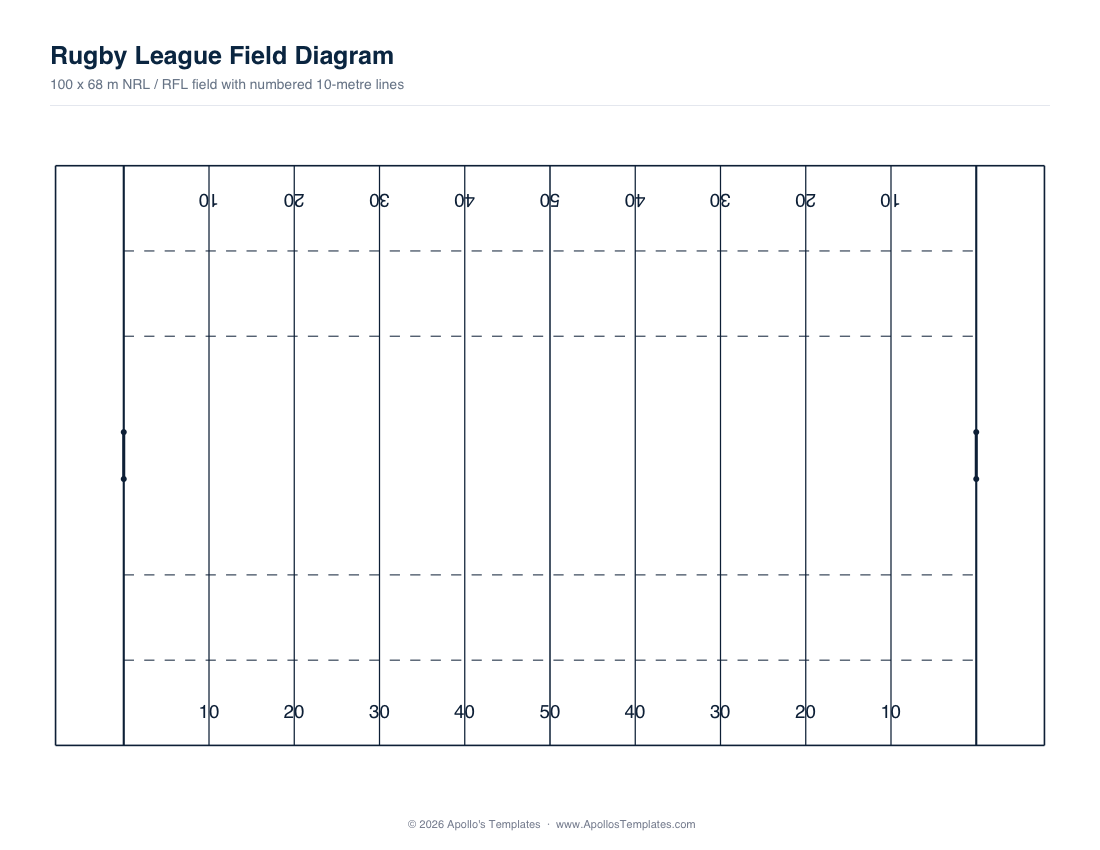
Blank rugby league field diagram — 100 by 68 metres with numbered lines every 10 metres, broken lines 10 m and 20 m in from touch, in-goals and posts
PDF

Rugby League Field

The 13-a-side field with its numbered ten-metre lines and 40-metre lines. Build Custom places the XIII — fullback to lock — with names.
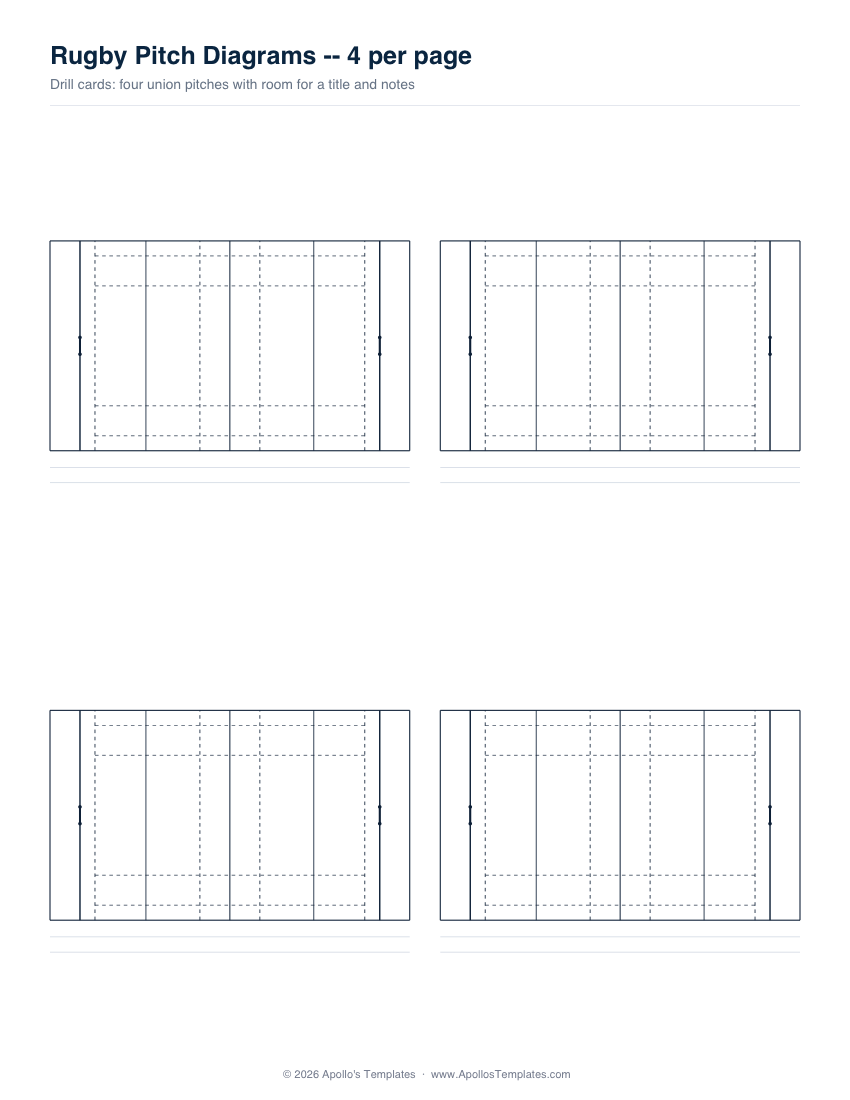
Four small blank rugby union pitches on one letter page, each with two ruled lines beneath for a drill name and notes
PDF

Four Pitches per Page — Drill Cards

Four full pitches on one sheet with ruled lines under each. Sketch a drill on each and the session plan fits in a pocket.
Download PDF
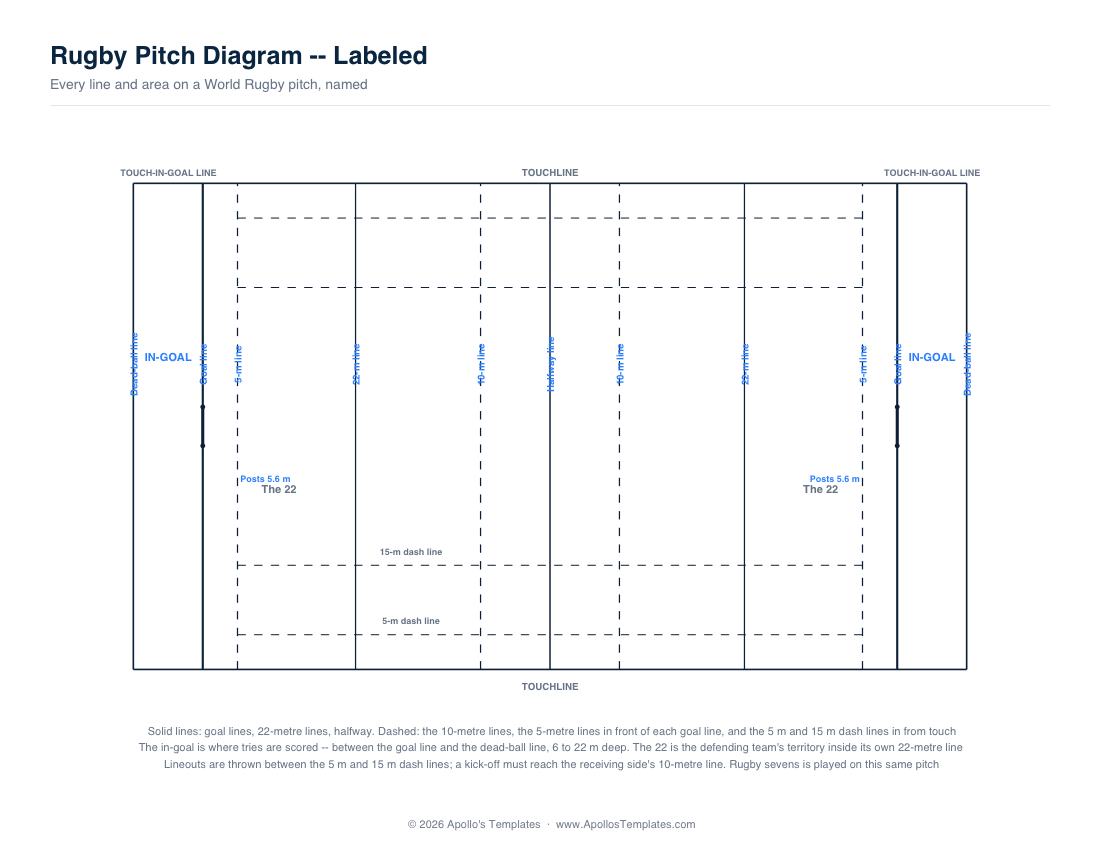
Labeled rugby pitch diagram naming the dead-ball lines, goal lines, 5-metre lines, 22-metre lines, 10-metre lines, halfway, touchlines, touch-in-goal lines, the in-goals, the 22 and the 5 m and 15 m dash lines
PDF

Labeled Pitch — Every Line Named

Dead-ball line to halfway, every line and area named where it sits, with notes on what each one is for. The handout for a first-season parent or a new player.
Download PDF
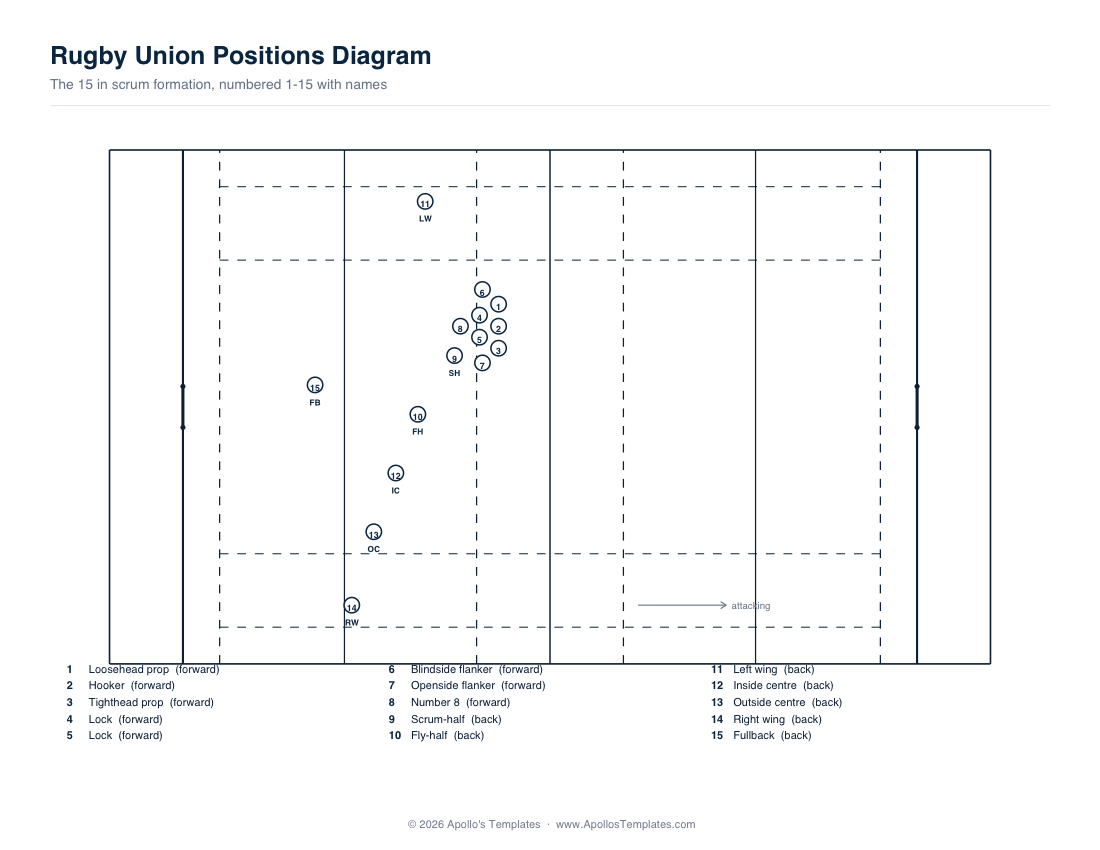
Rugby union positions diagram — the fifteen in scrum formation numbered 1 to 15 with a legend naming loosehead prop, hooker, tighthead prop, locks, flankers, number 8, scrum-half, fly-half, centres, wings and fullback
PDF

Union Positions — the XV

All fifteen in a scrum formation, numbered by jersey, with a legend from 1 (loosehead prop) to 15 (fullback). Build Custom swaps the numbers for your players' names.
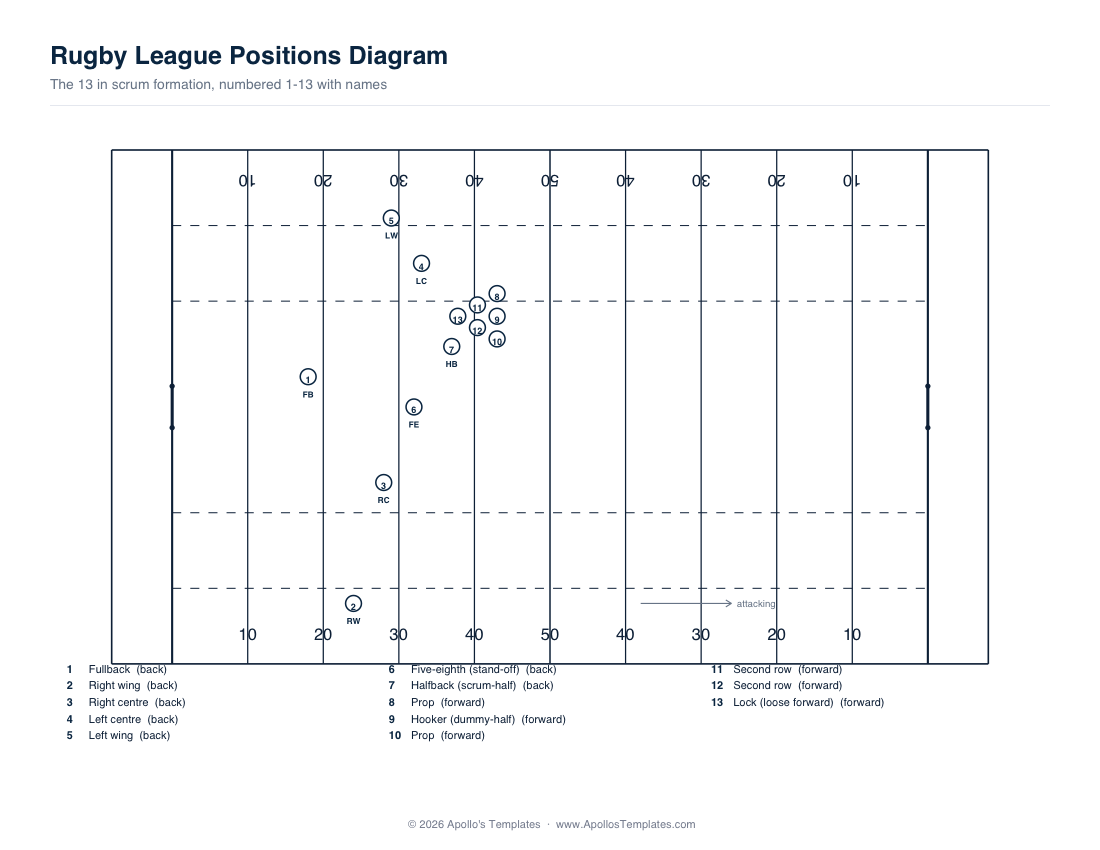
Rugby league positions diagram — the thirteen in scrum formation numbered 1 to 13 with a legend from fullback to lock
PDF

League Positions — the XIII

The thirteen numbered the league way — 1 fullback through 13 lock — with the halfback and five-eighth off the base of a six-man scrum.
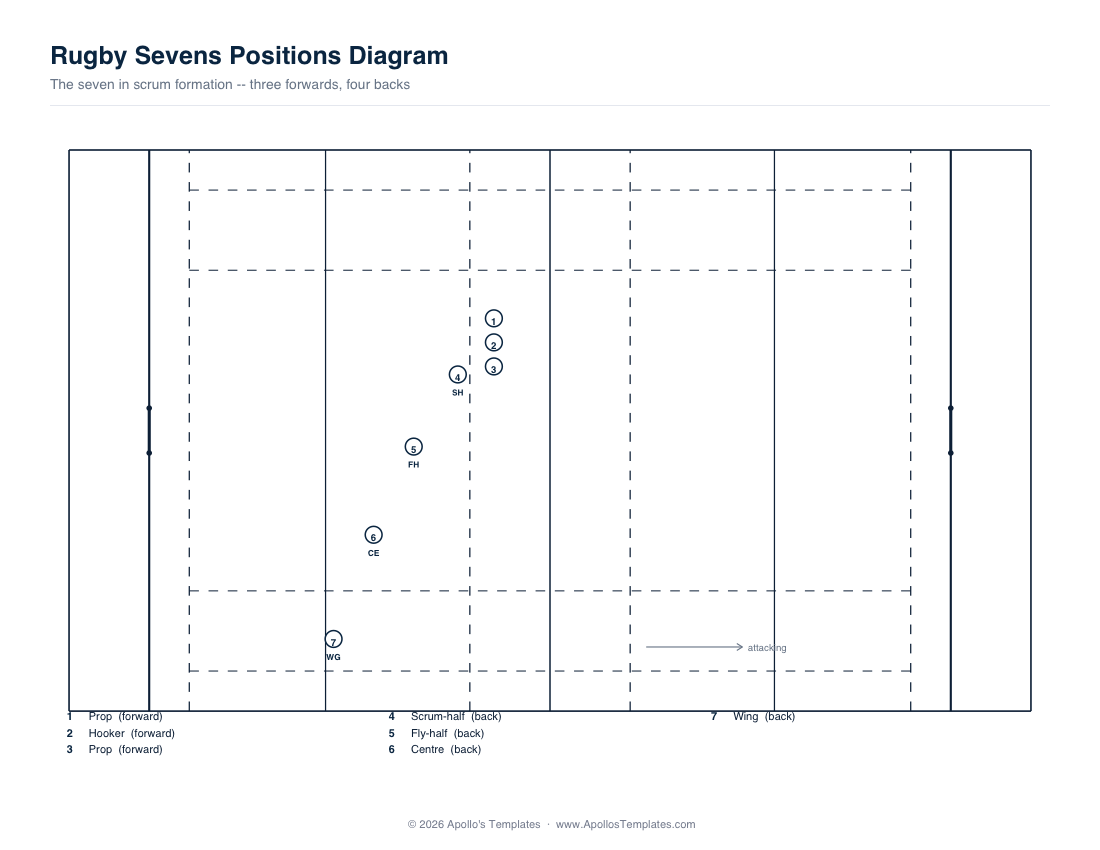
Rugby sevens positions diagram — three forwards in a scrum with scrum-half, fly-half, centre and wing spread across the full pitch
PDF

Sevens Positions — the Seven

Three forwards, four backs, on the full-size pitch that makes sevens what it is. Build Custom puts names on the seven.

Why the positions sheet is a scrum

Rugby positions only make sense at a set piece. In open play everyone runs, passes and tackles; it is the scrum that shows why a prop is a prop and why the 9 stands where the 10 can see him. So each positions sheet is drawn at a scrum on the team’s own 40, attacking to the right, with the open side on the near touchline — the formation a coach draws on the whiteboard on the first night of the season.

The forwards in the scrum carry their numbers only, because eight labels do not fit in a space two metres wide; the builder prints a name under a forward as soon as you type one.

Need the measurements?
Rugby field dimensions — union, league, sevens
Every line measured in metres and in yards and feet, the goal posts to scale, and a union-vs-league table.
Open
Teaching the game?
Rugby rules explained, code by code
Plain-English rules with the labeled pitch as the illustration — union, league, sevens and touch side by side.
Open
Is there a rugby positions diagram with names?
Three of them — union, league and sevens — each showing one team in a scrum formation with the jersey numbers in the markers and a legend naming every position. Build Custom goes further: type your players' names and they print under the numbers, untick anyone who is not playing, and add the club crest. It is the quickest way to make a team sheet a new player can actually read.
Why are the numbers different in union and league?
Union numbers the forwards first: 1 loosehead prop, 2 hooker, 3 tighthead prop, 4 and 5 locks, 6 and 7 flankers, 8 number 8, then the backs 9 to 15 out to the fullback. League counts the other way — 1 is the fullback, 2 to 5 the wings and centres, 6 the five-eighth, 7 the halfback, and 8 to 13 the forwards, ending with the lock. Same shape on the field, opposite numbering, which is why the two positions sheets are drawn separately.
Which sheet do I use for lineout and scrum moves?
The half pitch. One end at twice the scale gives room to draw a lineout between the 5 m and 15 m dash lines, a scrum on the 22, or a back-line move off either, and the goal at the top keeps the direction of attack obvious. For a whole session plan use the four-per-page drill cards and put one drill on each.
Is there a diagram of the rugby field lines with names?
Yes — the labeled pitch names every line and area: dead-ball lines, goal lines, the 5-metre lines, the 22s, the 10-metre lines, halfway, the touchlines and touch-in-goal lines, both in-goals, and the 5 m and 15 m dash lines, with three notes on what they are for. It pairs with the rules page, which uses the same diagram to explain the 22 and the 50:22.
Do the blanks show a union pitch or a league field?
Both are here. The union sheets show the World Rugby pitch, which sevens also uses. The league sheet is drawn to the RFL / NRL laws — 68 m wide, a numbered line every ten metres, broken lines 10 m and 20 m in from touch — because a coach drawing a six-tackle set needs the numbers on the page.
Can I add my club's crest?
Yes. Build Custom takes a PNG, JPG or SVG, places the crest top-right or bottom-left of the page and lets you size it. Add a team name and a subtitle — opponent and date — across the top, choose a line colour, and print.
Are the diagrams to scale?
Yes. The union pitch is drawn from World Rugby Law 1 — 100 × 70 m with 10 m in-goals, the 22s, dashed 10-metre and 5-metre lines, dash lines at 5 m and 15 m and posts 5.6 m apart — and the league field from the RFL / NRL laws at 100 × 68 m with 8 m in-goals and posts 5.5 m apart. The measured versions are on the dimensions page.
Are these free?
Completely — no signup, no watermark, no account. Download Blank gives you a print-ready PDF immediately; Build Custom generates your version in the browser and downloads it the same way.

Pitch geometry from World Rugby Law 1 and the RFL / NRL Laws of the Game. Updated through September 2026.