





Rugby Rules Explained — Union, League and Sevens
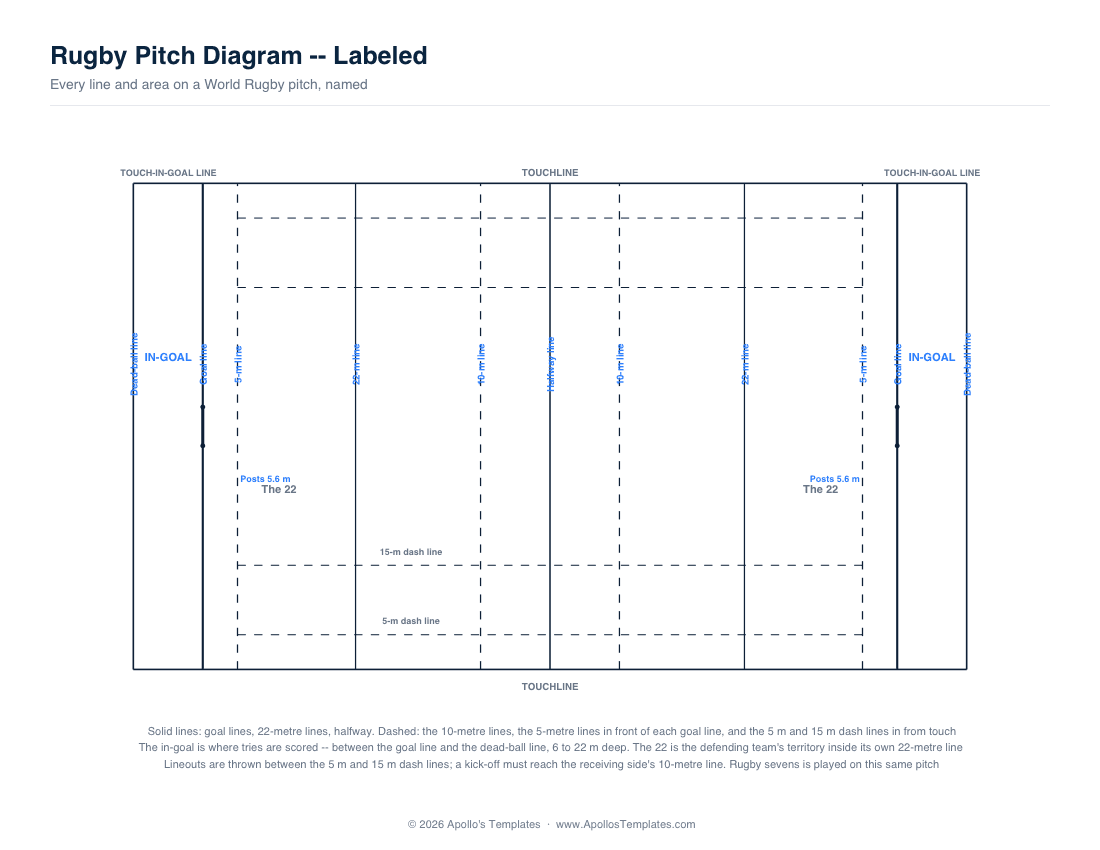
Rugby is three games that look alike from the stands. This page starts with the rules every code shares — passing backwards, the tackle, offside, how you score — then shows exactly where union, league, sevens and touch part company, with a table to keep them straight and the labeled pitch to point at.
The game in a minute
Two teams try to carry an oval ball over the other side’s goal line and touch it down for a try, or kick it between the posts for a goal. You may run with the ball and kick it in any direction, but you may only pass backwards or sideways: a forward pass, or fumbling the ball forwards off your hands (a knock-on), hands the other team a scrum. The player with the ball can be tackled — grabbed and brought to ground, below the line of the shoulders — and once down must let go of it. Everyone else must stay behind the ball: being in front of it and taking part is offside. There are no downs, no blocking, and no stoppage after a tackle in union; play flows until someone breaks a law, the ball crosses a touchline, or a score is made.
The codes, side by side
Same ball, same shape of field, four rulebooks. These are the differences that decide what you are watching.
| Code | Players | Match | Scoring | The tackle | Set piece | Cards |
|---|---|---|---|---|---|---|
| Rugby union | 15 (8 forwards, 7 backs); 23-man squad, 8 replacements | Two 40-minute halves | Try 5 · conversion 2 · penalty goal 3 · drop goal 3 | Unlimited -- the ball is contested in rucks and mauls | 8-man scrum; lineout after the ball goes into touch | Yellow: 10 min in the sin bin. Red: off (a 20-minute red card with a replacement is used in competitions trialling it) |
| Rugby league | 13 (6 forwards, 7 backs); 17-man squad, 8 interchanges | Two 40-minute halves | Try 4 · conversion 2 · penalty goal 2 · field goal 1 (2 from beyond 40 m in the NRL since 2021) | Six tackles, then the ball is handed over; the tackled player plays the ball with the foot | 6-man scrum, effectively uncontested; no lineouts -- a scrum or tap restarts play | Yellow: 10 min in the sin bin. Red: off for the match |
| Rugby sevens | 7 (3 forwards, 4 backs); 12-man squad, 5 substitutes | Two 7-minute halves (finals may be longer) | Same as union: try 5 · conversion 2 (drop-kicked, within 30 s) · penalty 3 · drop goal 3 | Unlimited, as in union | 3-man scrum; lineouts with fewer players | Yellow: 2 min in the sin bin. The team that scores kicks off |
| Touch | 6 on the field (14-player squad) | Two 20-minute halves | Touchdown 1 point; no kicking | Six touches, then a changeover; the touched player performs a rollball | None -- a tap restarts play | Period of time off the field at the referee's discretion |
Rugby union: the contest never stops
Fifteen a side, two 40-minute halves, and a try worth five with a two-point conversion kicked from in line with where it was scored. What defines union is that the ball is contested after every tackle. The tackled player must release it; the first arrivals from each side bind over it to form a ruck, and from then on it may only be moved with the feet until it comes out the back. A maul is the standing version — ball carrier held up, team-mates bound on, the whole thing driving forward. Because possession can turn over at any breakdown, there is no limit on how many phases an attack can run.
Set pieces restart play after mistakes. A forward pass or knock-on brings an eight-man scrum; the ball going into touch brings a lineout, thrown in straight between the 5 m and 15 m dash lines and contested by lifted jumpers. Penalties can be kicked at goal for three, kicked to touch (your team throws in), or tapped and run. Inside your own 22 you may kick straight into touch; outside it the ball must bounce first — and a 50:22, a kick from your own half that bounces into touch inside the opposition 22, wins your side the lineout. A ball grounded or held up in-goal by the defence restarts with a goal-line drop-out. A yellow card is ten minutes in the sin bin; a red is the match, and many competitions now trial a 20-minute red card that lets a replacement come on.
Rugby league: six tackles and a kick
Thirteen a side, a try worth four, a conversion two, a penalty goal two and a field goal one. League took the contest out of the tackle in 1906 and built a different game around it: when a player is tackled the play simply stops, the tackler stands off, and the tackled player rolls the ball back under a foot to the dummy-half — the play-the-ball. The defence must retreat ten metres apart from two markers, so every tackle resets the field. An attack gets six tackles; on the last it almost always kicks, because on the seventh the ball is handed over where it lies.
There are no rucks, no mauls and no lineouts. A ball into touch restarts with a scrum or, more often now, a tap 20 metres in, and the six-man scrum is rarely pushed. The kicking game is rewarded by the 40/20 — kick from behind your own 40-metre line, bounce into touch past the opposition’s 20, and your team keeps the ball — and since 2020 the NRL adds the 20/40 in reverse. Teams carry four on the bench and make eight interchanges; the sin bin is ten minutes.
Rugby sevens: union at sprint pace
Sevens is union with the numbers changed. Seven players on the full-size pitch, two seven-minute halves, three-player scrums and short lineouts. Conversions must be drop-kicked within 30 seconds of the try, the scoring team kicks off rather than the conceding one, and a yellow card is two minutes — a huge penalty when a side is already outnumbered on 7,000 square metres. Squads are twelve with five substitutes, and a World Series tournament fits its whole pool stage into a day.
Touch, and rugby in the United States
Touch replaces the tackle with a touch: six players a side on a 70 × 50 m field, six touches then a changeover, a rollball after each touch, a one-point touchdown and no kicking. It is the mixed, social and school version of the game, and its own international sport under the Federation of International Touch. In the United States, Major League Rugby (professional 15s since 2018), USA Rugby, National Collegiate Rugby and NCAA women’s rugby all play World Rugby’s laws unchanged, with age-grade adjustments for youth. The Rugby World Cup uses the same laws and adds pool bonus points — one for four tries, one for losing by seven or fewer.
What are the basic rules of rugby?
How many points is a try, a conversion and a penalty?
What is the difference between rugby union and rugby league?
How long is a rugby match?
What is a ruck, and what is the six-tackle rule?
What is the 50:22 and the 40/20?
Are Major League Rugby and college rugby played under different rules?
How is rugby different from Australian rules football?
Based on the World Rugby Laws of the Game, the RFL / NRL Laws of the Game and the Federation of International Touch playing rules. Updated through September 2026.