





Rugby Field Dimensions
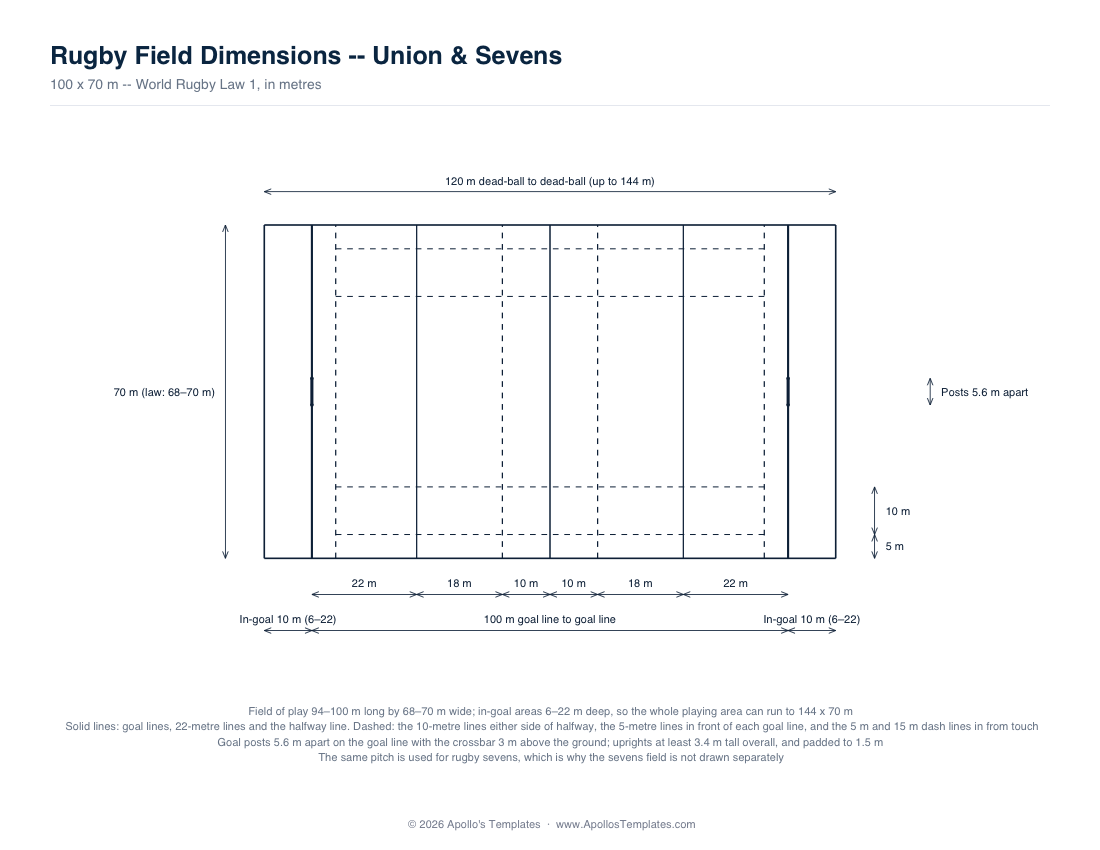
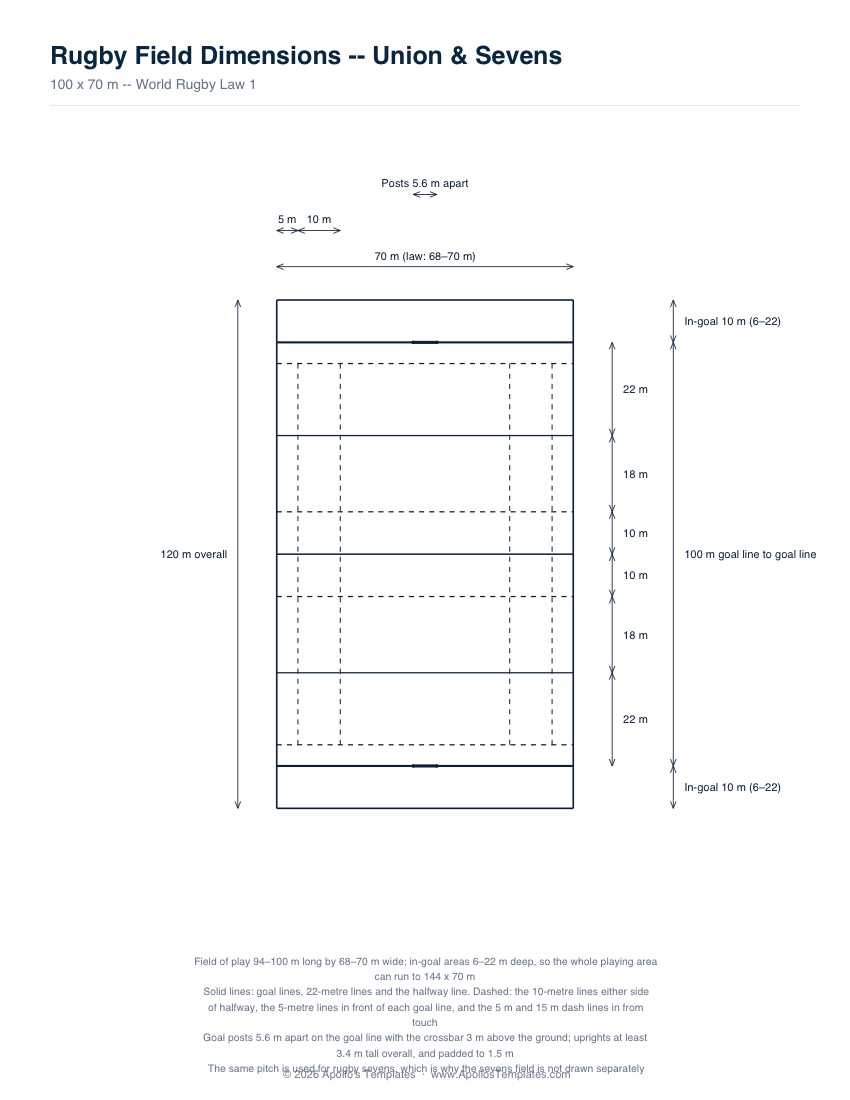
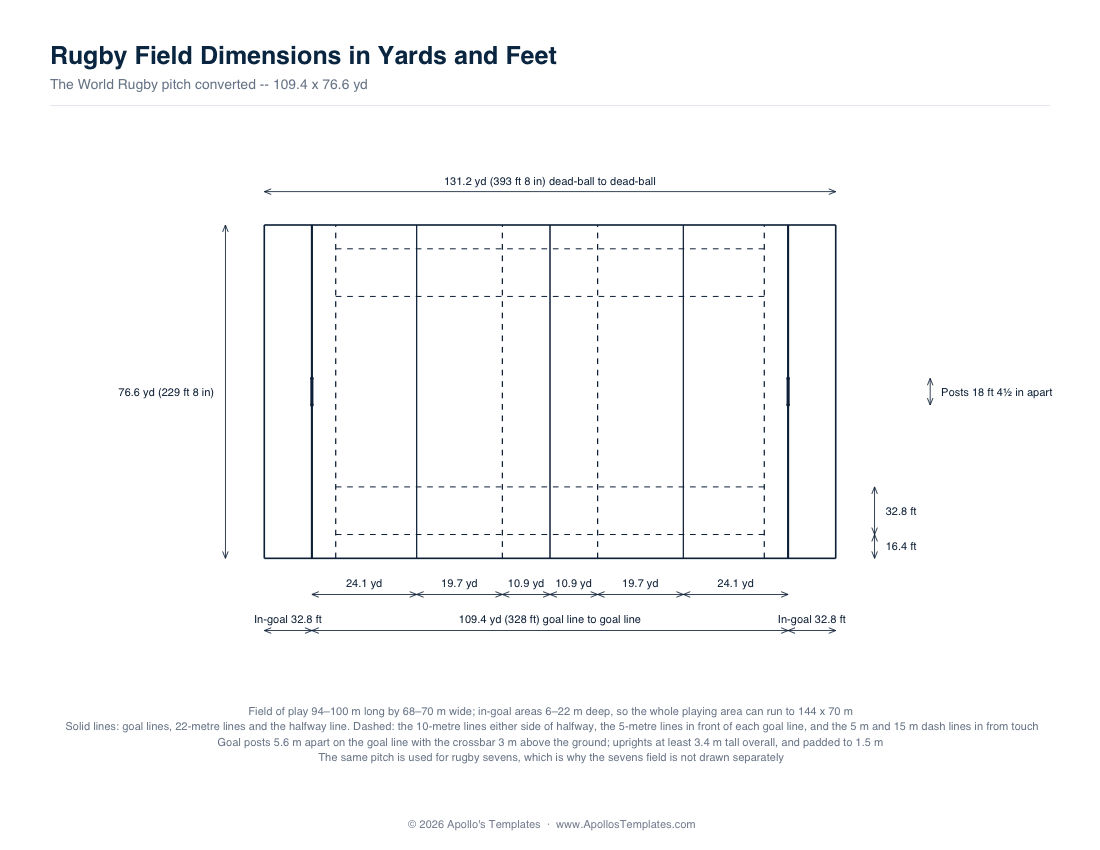
Rugby has two fields, not one. Union and sevens share the World Rugby pitch — up to 100 × 70 m with in-goals as deep as 22 m — while rugby league marks a fixed 100 × 68 m field with a numbered line every ten metres. Both are measured here line by line, in metres and in yards and feet, with the goal posts drawn to scale and a code-by-code table of what is played on them.
Five sheets, two fields and the posts.
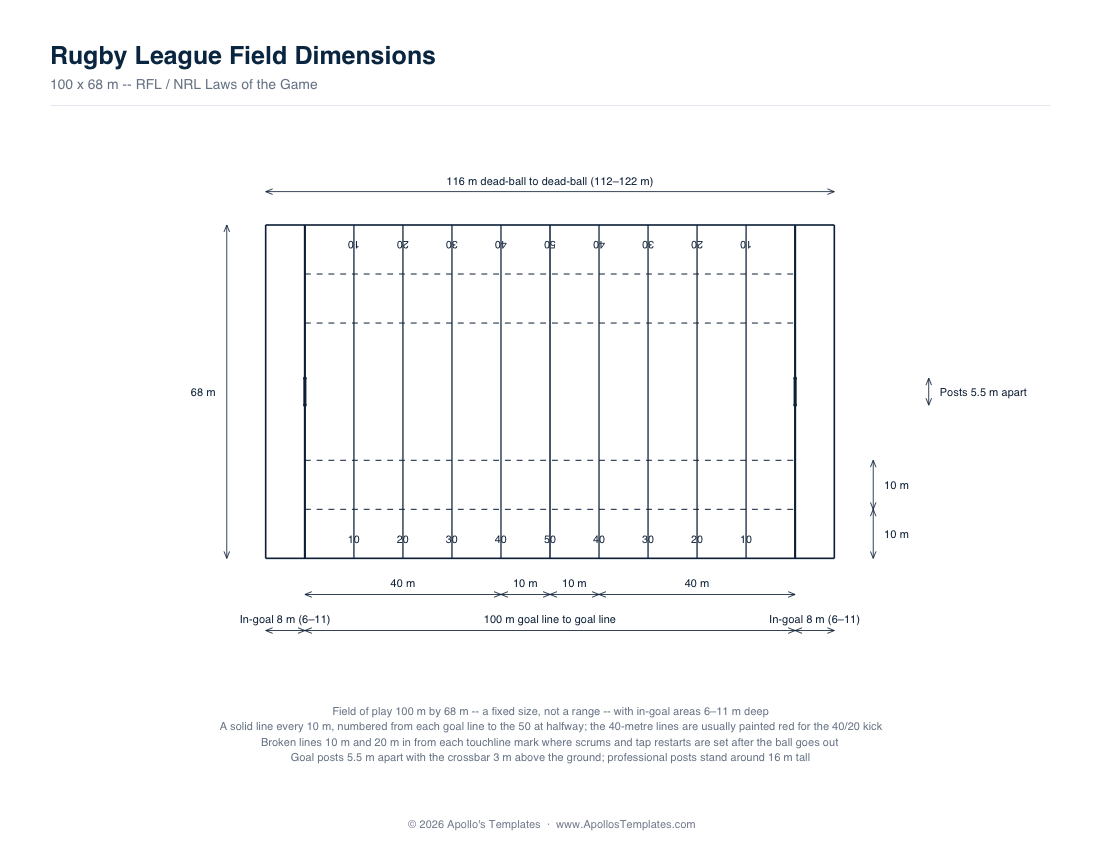
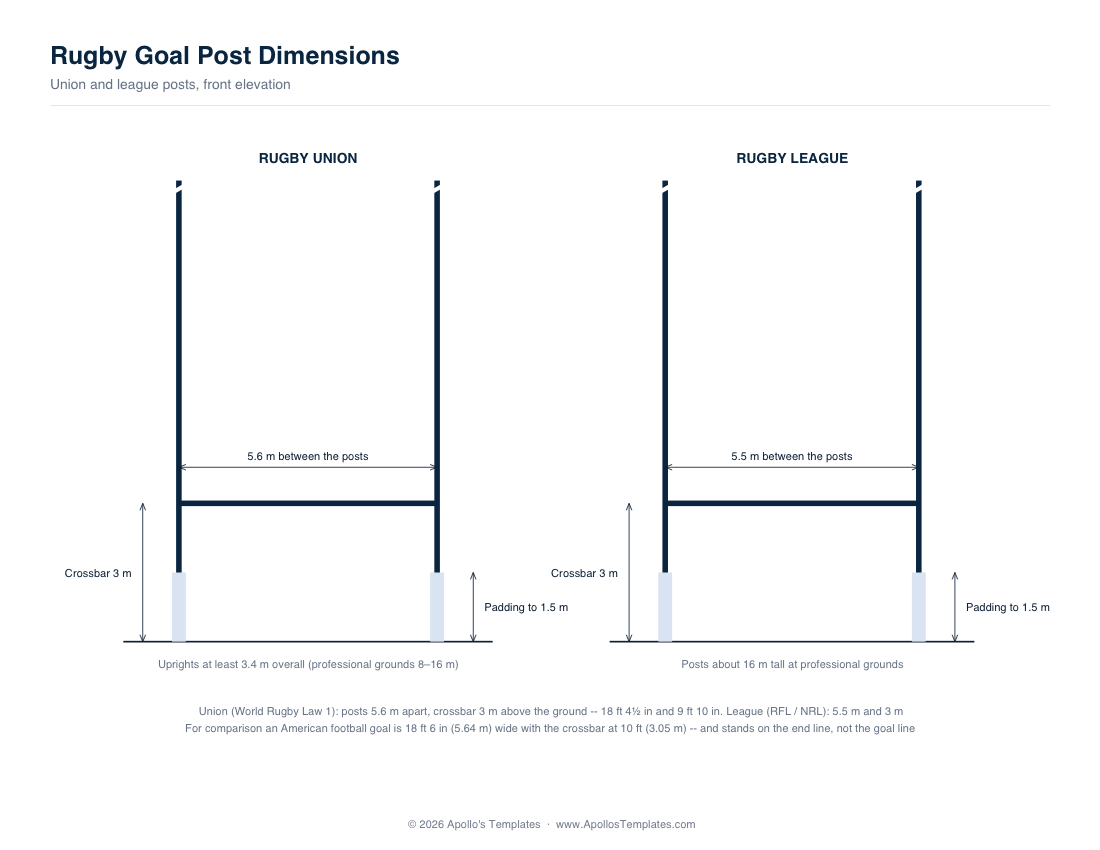
The union pitch three ways, the league field, and both sets of goal posts in front elevation. Every number is on the diagram or in the facts beneath it.
Union vs. league vs. touch
Two metres of width, a lot more paint, and shallower in-goals — that is the whole difference between the fields of the two main codes.
| Measurement | Rugby union & sevens | Rugby league | Touch |
|---|---|---|---|
| Governing law | World Rugby Law 1 (sevens uses the same pitch) | RFL / NRL Laws of the Game, section 1 | Federation of International Touch |
| Goal line to goal line | 94–100 m (100 m is standard) | 100 m — fixed | 70 m |
| Width | 68–70 m | 68 m | 50 m |
| In-goal depth | 6–22 m (pro grounds usually 8–12 m) | 6–11 m | Set by the venue |
| Overall length | Up to 144 m | 112–122 m | 70 m plus in-goals |
| Solid lines | Goal lines, 22-metre lines, halfway | Every 10 m, numbered; halfway is the 50 | Scorelines, halfway |
| Dashed lines | 10-metre lines, 5-metre lines, 5 m and 15 m dash lines in from touch | 10 m and 20 m in from touch | None |
| Goal posts | 5.6 m apart, crossbar 3 m, uprights at least 3.4 m | 5.5 m apart, crossbar 3 m, about 16 m tall | No posts |
| Players | 15 (7 in sevens) | 13 | 6 |
The codes, side by side
The fields are similar; the games on them are not. Players, scoring, the tackle and the set piece all change by code — the rules page explains each in plain English.
| Code | Players | Match | Scoring | The tackle | Field |
|---|---|---|---|---|---|
| Rugby union | 15 (8 forwards, 7 backs); 23-man squad, 8 replacements | Two 40-minute halves | Try 5 · conversion 2 · penalty goal 3 · drop goal 3 | Unlimited -- the ball is contested in rucks and mauls | 94–100 x 68–70 m, in-goal 6–22 m, posts 5.6 m apart |
| Rugby league | 13 (6 forwards, 7 backs); 17-man squad, 8 interchanges | Two 40-minute halves | Try 4 · conversion 2 · penalty goal 2 · field goal 1 (2 from beyond 40 m in the NRL since 2021) | Six tackles, then the ball is handed over; the tackled player plays the ball with the foot | 100 x 68 m, in-goal 6–11 m, posts 5.5 m apart |
| Rugby sevens | 7 (3 forwards, 4 backs); 12-man squad, 5 substitutes | Two 7-minute halves (finals may be longer) | Same as union: try 5 · conversion 2 (drop-kicked, within 30 s) · penalty 3 · drop goal 3 | Unlimited, as in union | Full union pitch |
| Touch | 6 on the field (14-player squad) | Two 20-minute halves | Touchdown 1 point; no kicking | Six touches, then a changeover; the touched player performs a rollball | 70 x 50 m |
Reading the pitch
The 22-metre line does more work than any other mark on a union pitch. Inside your own 22 you may kick directly into touch and keep the ground you gained; outside it the ball has to bounce first. A kick that goes dead or is grounded in-goal restarts with a drop-out, and since 2022 a ball held up over the line brings a goal-line drop-out instead of a five-metre scrum. The dashed 10-metre lines exist for the kick-off — it has to reach the receivers’ 10 — and the dashed 5-metre line in front of each goal line is where scrums and lineouts are held back from the try line.
The dash lines running lengthwise at 5 m and 15 m in from touch frame the lineout: the throw has to travel five metres, and the players stand between the two. League has no lineout, so its lengthwise broken lines sit at 10 m and 20 m and fix where scrums and tap restarts are set after the ball crosses the touchline — and its 40-metre lines are painted red because a kick from behind your own 40 that bounces into touch past the opposition’s 20 wins your team the ball.
How big is a rugby field?
What are rugby field dimensions in feet and yards?
What is the difference between a rugby league and a rugby union field?
Is a rugby field bigger than a football field?
Is a rugby pitch the same size as a soccer pitch?
Is a rugby sevens field smaller?
What are the dimensions of rugby goal posts?
What size field do college and Major League Rugby teams use in the US?
How big is a touch rugby field?
What size is a rugby ball?
Measurements from World Rugby Law 1 and Law 2, the RFL / NRL Laws of the Game and the Federation of International Touch playing rules. Updated through September 2026.