





Bumper Pool Rules — The Break, the Marked Ball and the Penalties
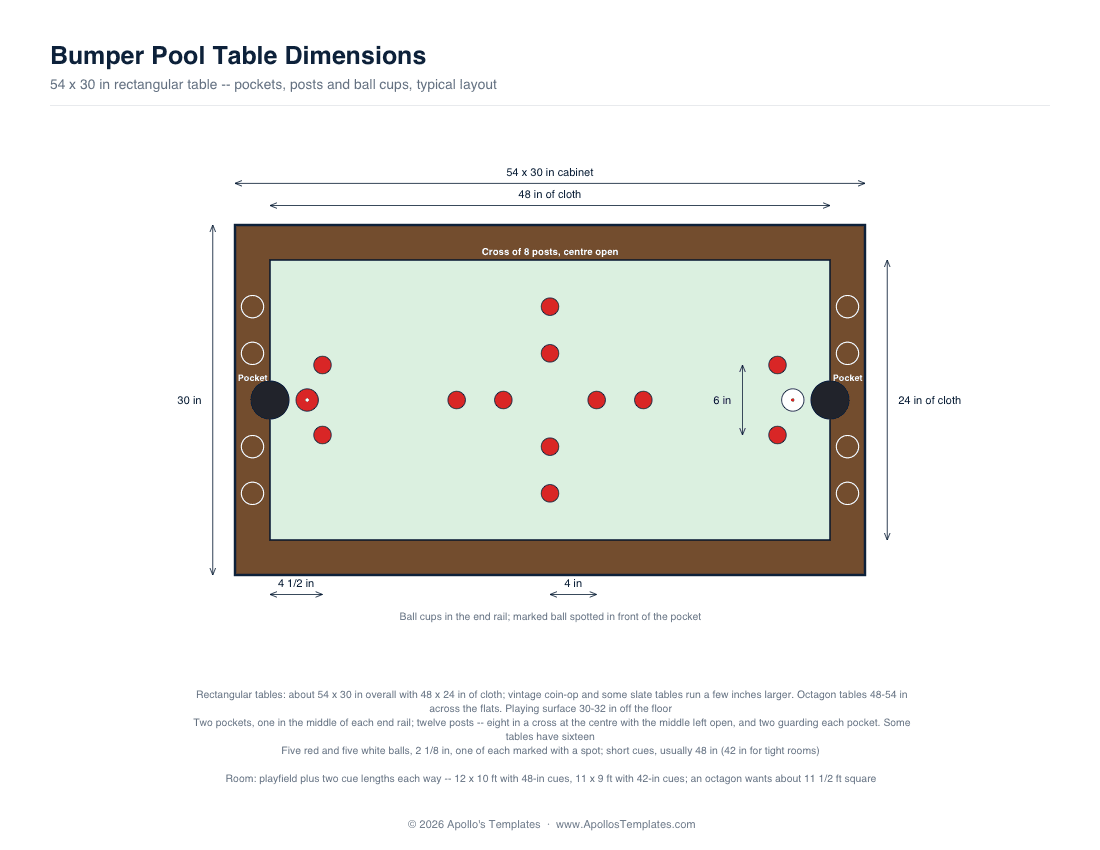
Bumper pool is two players racing to sink five balls each in the pocket at the far end of a small table, around a dozen posts put there to stop them. The rules fit on the card that used to be glued under the rail, and this page gives them that way — the setup, the break, play, the penalties and the win — then shows where houses diverge from the printed version, because they all do.
Bumper pool in ten lines
- Five balls each, red or white, set in the cups along your own end rail with the marked ball in front of the pocket at your end.
- Your pocket is the far one — the pocket in front of your opponent. Theirs is the one in front of you.
- Break together: both shoot the marked ball at once, off the right-hand side cushion, at the far pocket.
- Whoever sinks it, or gets closer, shoots next. If both drop, break again.
- Marked ball first. Until it is down, none of your other balls count.
- Keep shooting while you pocket your own balls; miss, and the other player shoots.
- Bank off anything — cushions and posts — but never jump a ball over a post. A jumped ball is respotted and the turn ends.
- Wrong pocket, or a ball off the table: your opponent drops two of their balls in by hand.
- Unmarked ball before the marked one: it comes back up and your opponent drops one in. Sink an opponent’s ball and it counts for them.
- First to five wins. Doubles: partners share an end and alternate shots.
The printed rules, the house rules and the octagon
Bumper pool has no governing body, so the rules glued to the table are as official as it gets. Most arguments are between someone who read that card and someone who grew up with the house version.
| Rulebook | The break | Order | Scratch / ball off | Opponent’s ball | Winning |
|---|---|---|---|---|---|
| Rules printed on most tables (Valley-style) | Both players shoot their marked ball at the same time, off the right-hand side cushion, at the pocket at the far end; whoever sinks it or gets closest shoots next | Marked ball must go in first; then any of your balls, in any order | Sink a ball in the wrong pocket, or knock one off the table: the opponent drops two of their balls in by hand | Sinking an opponent's ball counts for them; it stays down | First to sink all five |
| Common house variants | Break alternates by game, or the loser of the last game breaks first; no simultaneous shot | Marked ball first is kept; some houses let you shoot any ball once the marked ball is down or after a scratch | Opponent drops one ball, not two; a ball off the table goes back to its cup instead | Some houses respot an opponent's ball you sink; agree first | First to five, or games to a set number in a session |
| Octagon and 3-in-1 tables | Same simultaneous break; the right-hand cushion is the flat to the right of your pocket | Same | Same | Same | Same; the shorter table plays faster and banks more |
The break, properly
The simultaneous break is the thing that makes bumper pool feel different from every other cue game. Both players set their marked ball in front of their own pocket, and on a count both shoot at once, each banking off the side cushion to their right toward the far pocket — the two balls cross in the middle and, on a good night, drop together. If one drops, that player has the table and keeps shooting. If neither drops, whoever finished nearer their target pocket shoots next; if that is a judgement call, the printed rules give it to whoever is closer, and the house rules give it to whoever argues better. If both drop, set them up and break again. Some houses have abandoned the simultaneous break for an alternating one, which is quieter and loses the one moment the game has that nothing else does.
Play, and why the marked ball matters
After the break, play is ordinary pool with two pockets and a lot of furniture: you keep shooting while you pocket your own balls, in the far pocket, and hand over when you miss. The marked ball has to be the first one down, which stops a player picking off the easy balls while the marked one sits behind a post, and once it is down the rest go in any order. Every shot that is not the straight thread through the open centre of the cross is a bank — off the long cushions past the cross, or off the end cushion in beside a guard post — and a ball that stops in front of a pocket stays there and becomes a problem for whoever it belongs to. You may hit your opponent’s balls to move them, and you will, because parking one of yours behind their marked ball is the best defence in the game.
Penalties
The penalties are all paid in balls. Sink one of your own balls in the wrong pocket — the one at your end — or knock any ball off the table, and your opponent takes two of their balls off the rail and drops them in their pocket by hand. Pocket an unmarked ball before your marked one and it comes back up to its cup while your opponent drops one in. Sink one of your opponent’s balls, in either pocket, and it simply counts for them. A jumped ball is respotted where it left the cloth and the turn ends. The one penalty the printed cards disagree on is a scratch on your last ball while your opponent still has balls up: most houses call it a loss, some call it two balls for the opponent and play on, and the only wrong answer is to not have decided before the break.
How do you play bumper pool?
Which pocket is mine?
What happens if I sink the wrong ball first?
What is the penalty for knocking a ball off the table?
What if I sink my opponent's ball?
Can you jump the posts?
How do you play bumper pool on an octagon table?
How do you play doubles?
Based on the rules printed on Valley-style tables and repeated by current makers; house variants noted where they are common. Updated through September 2026.