
Apollo's Templates
HomeCalendarsShift Work Calendar
Calendars

Shift Work Calendar

A free printable month calendar with your rotating shift pattern pre-filled and colour-coded — day shifts blue, night shifts violet, 24-hour tours amber, off days clear. Anchor it to the first day of any of your ON blocks and the whole rotation lines up with your real roster.

NEW
Shift work calendar

Your rotation on a real month calendar — lined up to your actual roster.

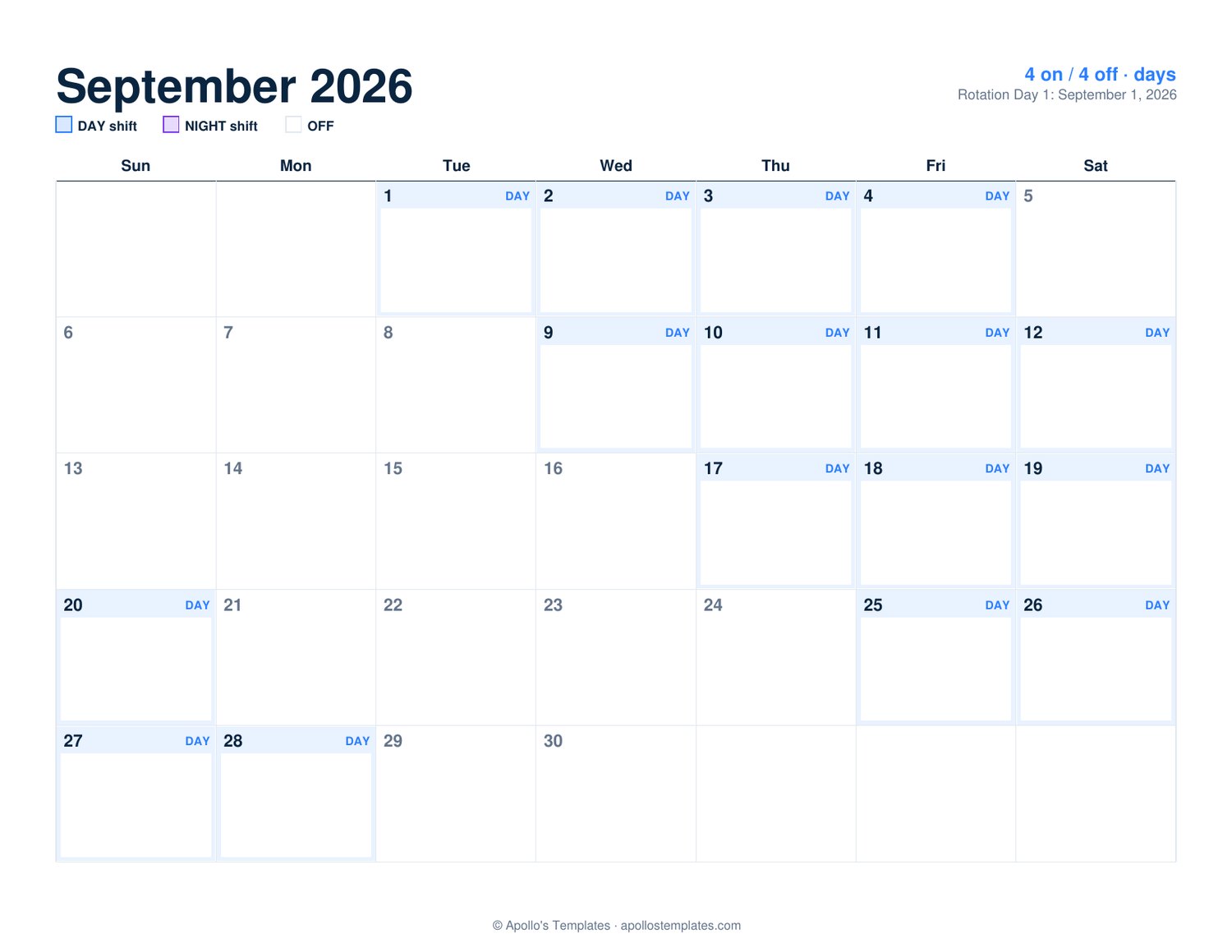
Pick your pattern, then tell us the first day of any of your ON blocks (past or future) — the whole rotation aligns to it. Working days are colour-coded day/night, and every day has a fillable box for notes.

4 consecutive 12-hour shifts, then 4 days off. 8-day cycle. “Day 1” is the first day of an ON block. On a crew system (A/B/C/D), each crew enters its own block-start date.

1-page PDF · US Letter landscape · colour-coded + fillable notes

The patterns, briefly

4 on / 4 off — four consecutive 12-hour shifts, four days off. The workhorse of UK policing, manufacturing, and healthcare. Averages 42 hours/week.

Panama / Pitman (2-2-3) — 2 on, 2 off, 3 on, 2 off, 2 on, 3 off over 14 days. You're never on more than three days in a row, and every other weekend is a full Friday–Sunday off. Common in dispatch centers, plants, and hospitals.

DuPont — the 28-day rotating cycle (4 nights · 3 off · 3 days · 1 off · 3 nights · 3 off · 4 days · 7 off) with a built-in week off every month. The day/night rotation is part of the pattern, and the calendar marks each correctly.

24/48 and 48/96 — 24-hour tours used by fire and EMS: one tour on / two days off, or two tours on / four days off. The calendar marks tour days ON, since a 24-hour tour isn't a "day" or "night" shift.

3 on / 3 off and 5 on / 2 off — the simpler blocks: three 12-hour shifts then three off, or the classic five-day week anchored to whichever weekday your rotation starts on.

Tips for the best result

Anchor it once, print it forever. Your "Day 1" can be any ON-block start you remember — even months ago. The math carries the rotation forward and back, so next month's sheet just needs the same date.

Plan sleep windows. Night blocks are marked violet — block out daytime sleep on those days in the notes boxes, and guard the first off-day after a night block (most of it goes to recovery sleep).

Pre-mark family commitments. Type doctor appointments, kids' activities, and family events into the fillable boxes before printing — you'll see instantly which fall on working days vs off days.

Trade days clearly. If you swap a shift with a coworker, mark the swap on both calendars (yours and theirs). Avoids the "wait, who's covering Saturday?" panic.
Coordinate the household
Family Calendar
Weekly family planner — pair with the shift calendar so your family knows when you're working and when you're not.
Open
Plan around the shift
Weekly Planner
General-purpose weekly planner — use to plan personal commitments around your shift rotation.
Open

Frequently asked questions

How do I line the calendar up with my actual schedule?
Set “Day 1 of your rotation” to the first day of any of your ON blocks — last week's, next month's, whichever you know. The generator runs the cycle forwards and backwards from that date, so the whole month lands on your real working days. On a crew system (A, B, C, D shift), every crew works the same pattern offset by a few days — each crew just enters its own block-start date.
Which shift patterns does the generator support?
Seven: 4 on / 4 off, Panama / Pitman (2-2-3), DuPont (the 28-day rotating day/night cycle with a built-in week off), 24/48 and 48/96 (24-hour fire & EMS tours), 3 on / 3 off, and 5 on / 2 off. For the fixed-shift patterns you also choose whether your team works days or nights; DuPont's day/night rotation is built into the cycle itself.
What's the difference between the Panama and Pitman schedules?
Structurally nothing — both are the same 14-day skeleton: 2 on, 2 off, 3 on, 2 off, 2 on, 3 off, using 12-hour shifts, and both give you every other weekend as a 3-day weekend. “Panama” and “Pitman” (and “2-2-3”) are different names for the same rotation; some workplaces slow-rotate teams between days and nights every few weeks, others keep teams fixed. Pick the one entry in the dropdown and choose Days or Nights for your team.
How does the DuPont schedule work?
It's a 28-day cycle: 4 night shifts, 3 off, 3 day shifts, 1 off, 3 night shifts, 3 off, 4 day shifts, then 7 consecutive days off. Four crews rotate through it so two crews are always on (one days, one nights). The famous perk is the built-in week off every four weeks; the tradeoff is a 42-hour average week and a mid-cycle stretch with only one day off. For “Day 1 of your rotation” use the first night of your 4-night block.
Does it show night shifts differently from day shifts?
Yes. Day shifts print with a blue tint and a DAY tag, night shifts violet with a NIGHT tag, and 24-hour tours (24/48, 48/96) amber with an ON tag. Off days stay white so the rotation is readable at a glance — on the fridge, from across the kitchen. A legend prints at the top, and the tags stay legible even on a black-and-white printer.
Why use a printed shift calendar when my employer publishes one?
Two big reasons: (1) personal annotations — every day has a fillable box for workout plans, family commitments, sleep windows, or swap reminders, either typed into the PDF before printing or handwritten after; (2) family visibility — print one for the fridge so your spouse, kids, or roommates can see your schedule without checking your employer's portal.
What's the hardest part of working a rotating shift schedule?
The body never fully adapts. Sleep researchers consistently find rotating-shift workers sleep 1–2 hours less per 24-hour cycle than day workers, with cumulative effects on alertness and health. A printed calendar can't fix that, but it helps with what's controllable: planning meals, social events, appointments, and sleep windows around the shift you actually have — which is why the night shifts are marked distinctly on this calendar.
Can I print this for the whole year?
Generate one sheet per month (the rotation carries across month boundaries automatically because it's anchored to your Day 1 date, not to the month) and bind 12 sheets into a shift-worker year planner. Some workers laminate the current month and dry-erase notes onto it, then wipe and re-use.
Updated through August 2026