


How to Write a Cover Letter
A cover letter is a one-page letter that does one thing a resume can't: it connects two or three of your results to this specific job, in the employer's own words, and asks for the interview. That's four moves — the opening, the evidence, the why-here, the ask — and every good cover letter is those four moves in that order. Here's how to write each one, a complete example you can read, and templates with the structure already built so you're filling in brackets rather than starting from a blank page.
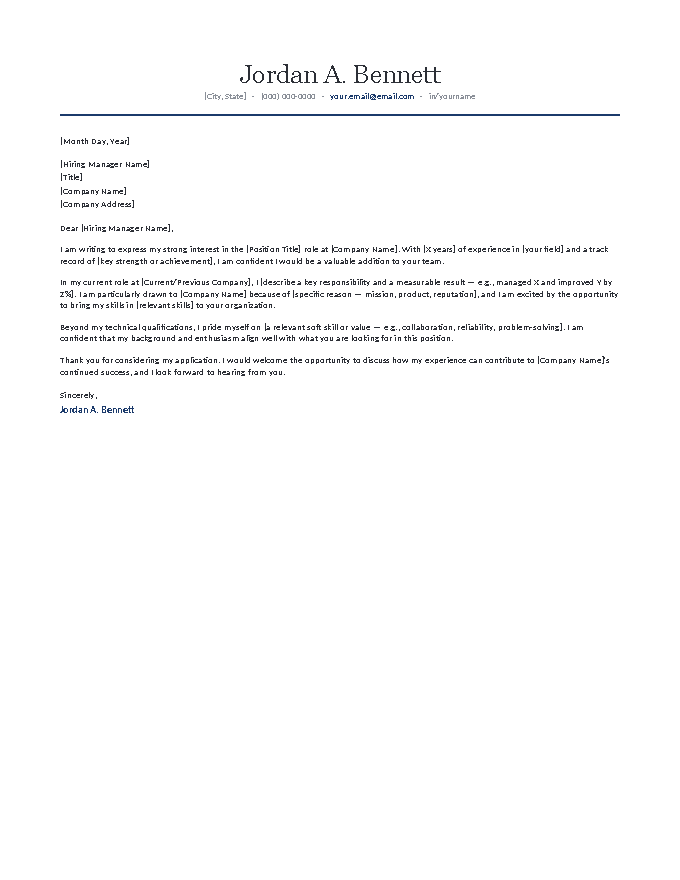
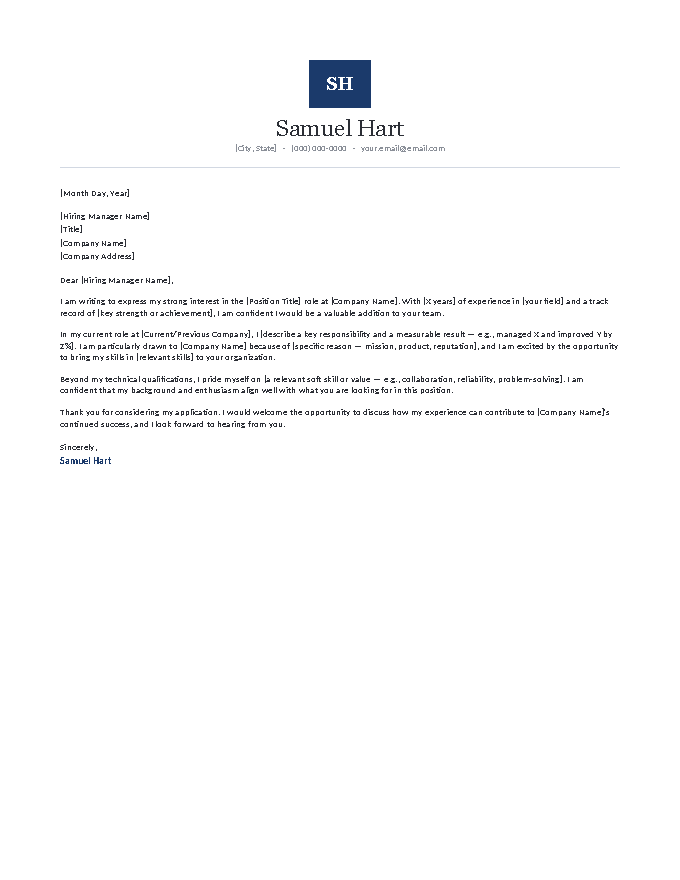
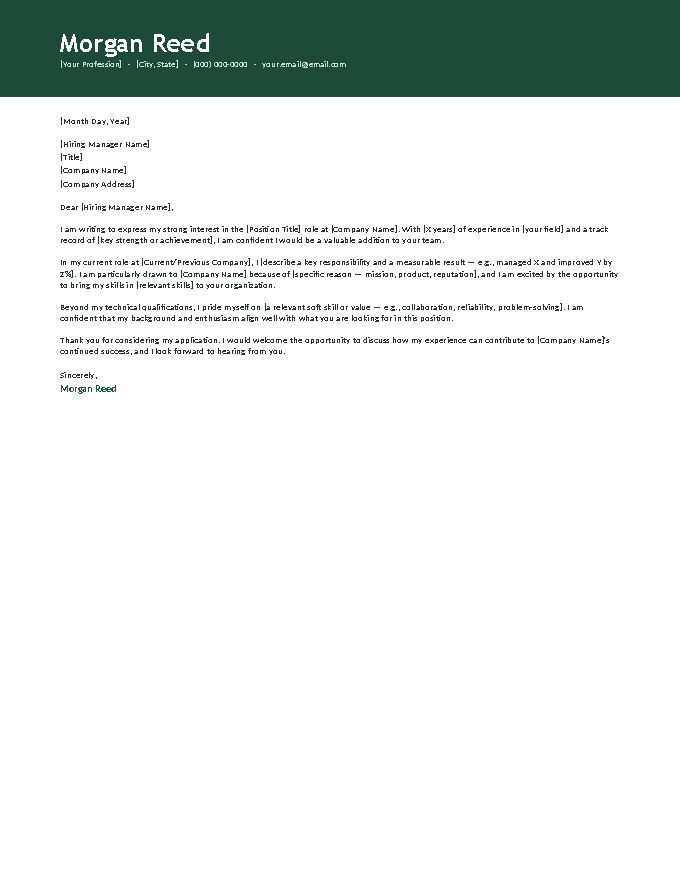
Three templates with the format already right.
Every rule below is already applied inside these — copy one to Google Docs or download the Word file, and you are editing a correctly formatted letter instead of building one.
What a cover letter is — and isn't.
A cover letter is the letter that accompanies your resume. The resume lists; the letter argues. It says which two or three things on the resume matter for this role and why, in the employer’s vocabulary, and it shows you can write — which for most jobs is itself a qualification.
It is not a summary of the resume, an autobiography, or a place to explain everything. It’s short (250–400 words, and shorter is often better), specific to one job, and written for one reader: the hiring manager. If a line could go to any employer, cut it.
Do you still need one? When the application asks, yes. When it’s optional, still yes — most applicants skip it, so a short specific letter is one of the few free ways to stand out, and hiring managers consistently report reading them.
The opening: name the job and one specific reason.
The first paragraph does two things in two or three sentences: it names the exact role (and where you saw it), and it gives one specific reason you want it at this company — a product you use, a project they announced, a person you spoke with, a value they state that you share. Then, if you have it, one credential that makes you obviously relevant: your license, your years in the field, your specialty.
Two openings, side by side
Weak: ’I am writing to express my interest in the Marketing Coordinator position at your company. I believe my skills and experience make me a strong candidate.’
Strong: ’I’m applying for the Marketing Coordinator role posted on LinkedIn. I’ve followed Northwind’s newsletter for two years — the June relaunch was the best product email I saw all quarter — and I’ve spent three years running email and social programs for a regional retailer.’
The strong version names the job, the company, a specific observation, and a credential. It also sounds like a person. That’s the whole trick of the opening.
The evidence: two or three results that match the posting.
The middle paragraph — or two, never three — is where the letter earns its interview. Read the posting, pick the two or three requirements it emphasizes most, and answer each with a result from your history: what you did, where, and what happened, with a number wherever one exists.
- ’At Contoso I ran the lifecycle email program — 14 automated flows — and lifted trial-to-paid conversion by 19% in a year.’
- ’I managed a caseload of 18 students across three settings with 100% of IEPs delivered on time.’
- ’I own the payments API, which handles 40,000 requests a minute; this year I led its migration to event-driven services and cut p95 latency by 38%.’
Notice the pattern: scope, action, number. Don’t re-narrate the resume — the letter highlights, the resume lists. If you don’t have a number, use a specific detail (a project name, a scale, a tool) rather than an adjective.
Writing without much experience? The same paragraph works with evidence from school, projects, volunteering, and part-time work — see the no-experience and entry-level collections for letters built that way.
The why-here: one paragraph that could only be about this company.
The third paragraph proves the letter wasn’t sent to fifty employers. One specific reason for this company (different from the opening’s if you can), and — the line almost nobody writes — one idea, observation, or question about their work that shows you’ve thought about it. For a marketing role, an opportunity you see in their channels; for engineering, the scale of the problem they’re solving; for a school, a program they run.
Keep it to three sentences. It’s the paragraph a hiring manager remembers.
The ask: close in two sentences.
Ask for the interview, say your resume is attached, thank them. That’s it. ’I’d welcome a conversation about the team’s priorities for the fall; my resume is attached. Thank you for your consideration.’ Then ’Sincerely,’ and your name. The how-to-end guide covers sign-offs and the closing paragraph in detail.
Before you send
- One page, 250–400 words. If it’s longer, cut the paragraph that restates your resume.
- The recipient’s name if you can find it; ’Dear Hiring Manager’ if you can’t. Never ’To Whom It May Concern.’
- Same fonts and header as your resume, so the two read as one packet.
- Export a PDF unless the posting asks for Word.
- Read it once as the hiring manager. Does every sentence say something only you could say?
A complete cover letter, annotated by the four moves.
CONTACT
[City, State]
(000) 000-0000
your.email@email.com
in/yourname
KEY STRENGTHS
[Strength one]
[Strength two]
[Strength three]
[Strength four]
[Month Day, Year]
[Hiring Manager Name]
[Title]
[Company Name]
[Company Address]
Dear [Hiring Manager Name],
I am writing to apply for the [Position Title] position at [Company Name], which I found on [job board / referral / company site]. With [X years] of experience in [your field] and strengths in [two or three skills echoed from the posting], I am confident I can contribute from the first week.
In my most recent role at [Current/Previous Company], I [key responsibility and measurable result]. Earlier, at [prior company or role], I [second supporting result]. Together they cover exactly the capabilities your posting highlights: [mirror the posting's top requirements].
What draws me to [Company Name] is [specific reason — swap this sentence for every application; it is the line hiring managers check]. I would bring the same focus and reliability that produced the results above.
Thank you for your time and consideration. I would welcome the opportunity to discuss the role in more detail, and I am available at [phone / email] at your convenience. I look forward to hearing from you.
Sincerely,
Taylor Morgan
How to Write a Cover Letter FAQ
How do I start a cover letter?
What should a cover letter include?
How long should a cover letter be?
How do I write a cover letter with no experience?
Should a cover letter repeat the resume?
Do I need a different cover letter for every job?
Is it okay to use a cover letter template?
How to Write a Cover Letter · Updated September 2026