





How to Address a Cover Letter
Address a cover letter to a person whenever you can find one — the hiring manager or recruiter by name — and to the team or role when you genuinely can't. The salutation is the first line the reader sees, and it signals whether the letter was written for them or for everyone. Here is how to find the name in five minutes, what to write when there isn't one, and the salutations that read right in every situation.
Three templates with the format already right.
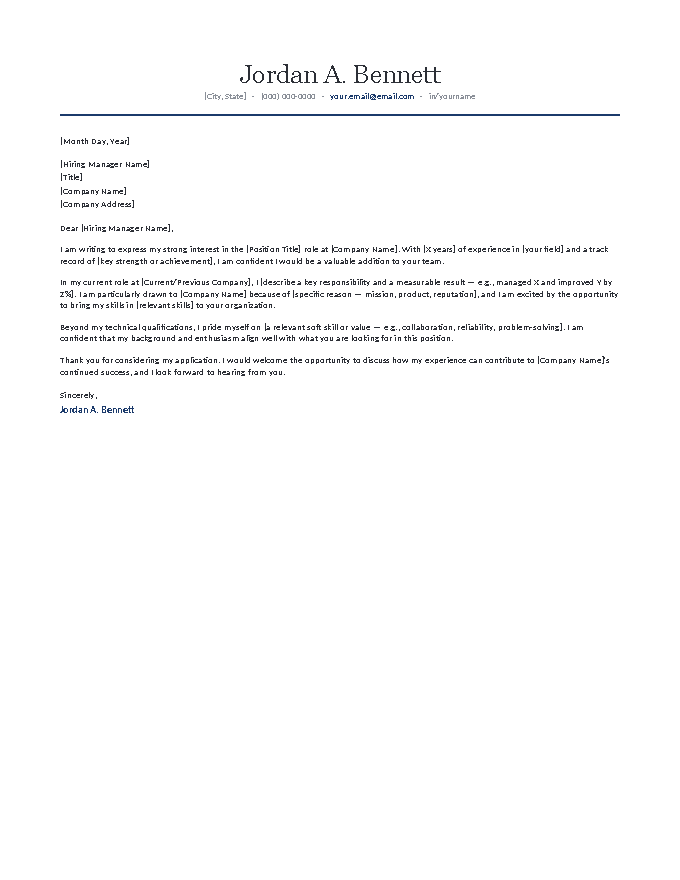
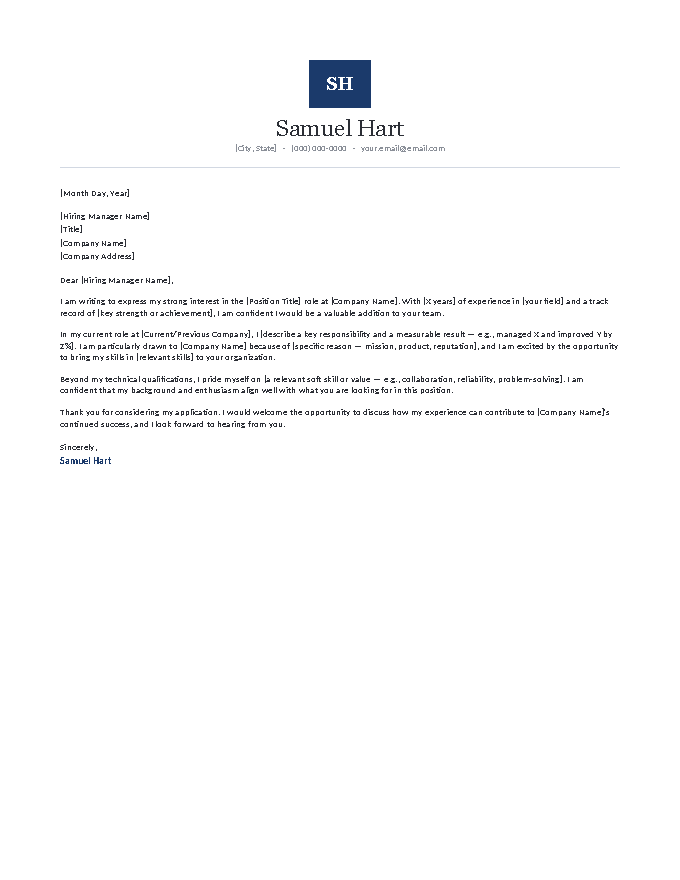
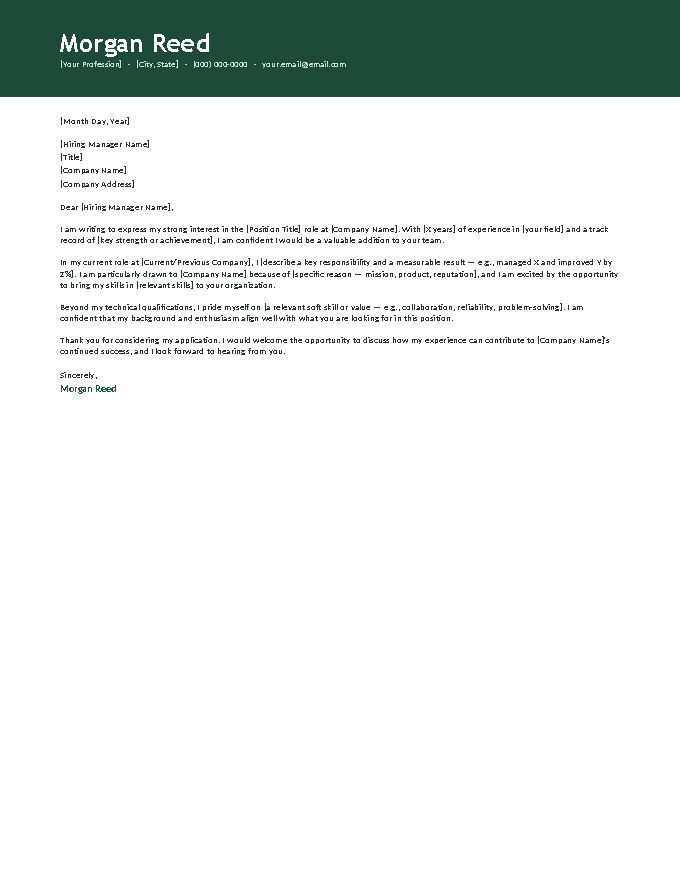
Every rule below is already applied inside these — copy one to Google Docs or download the Word file, and you are editing a correctly formatted letter instead of building one.
Find the name — it takes five minutes.
- The posting. Many name a contact or the hiring manager; some name a recruiter in the ’apply’ instructions.
- The company’s team page. Look for the head of the department the role reports to — the posting usually says which.
- LinkedIn. Search the company plus the department (“Northwind marketing director”). The person a step above the role is the likely hiring manager; a recruiter listing the job is also a correct addressee.
- Ask. If the posting gives an email, a one-line note — ’Could you tell me who the hiring manager for the Marketing Coordinator role is, so I can address my letter correctly?’ — usually gets an answer and is remembered.
Found it? Use it: ’Dear Ms. Rivera,’ or ’Dear Alex Rivera,’ — the full name avoids guessing at gender or marital status, and it’s now the more common form. Use ’Dr.’ when it applies. Never a first name alone unless you’ve corresponded on those terms.
No name? These are the accepted salutations.
Sometimes there’s genuinely no name to find — a large employer, an agency posting, an anonymous listing. Use one of these, in order of preference:
- Dear Hiring Manager, — the standard fallback; accurate and neutral.
- Dear [Team] Team, — ’Dear Marketing Team,’ ’Dear Nursing Recruitment Team,’ — good when you know the department.
- Dear [Title], — ’Dear Director of Engineering,’ when the posting names the role’s manager by title.
- Dear Hiring Committee, — for schools, universities, and public-sector roles that hire by committee (this is often the accurate choice for teaching jobs).
- Dear Recruiter, — when the posting is clearly from a recruiting team or agency.
What not to use
’To Whom It May Concern’ — it tells the reader you didn’t look, and it’s the phrase most hiring managers name when asked what they dislike in a letter. ’Dear Sir or Madam’ — dated for the same reason. ’Hello,’ ’Hi there,’ ’Greetings’ — too casual for a first contact, even at a startup. A guessed name — worse than no name.
Punctuation, titles, and the recipient block.
End the salutation with a comma in American business letters (’Dear Ms. Rivera,’); a colon is the more formal option and is also correct (’Dear Ms. Rivera:’). Pick one and match your closing’s punctuation.
The recipient block above the salutation — name, title, company, address — should match the salutation. If you have a name, put the name and title there; if you don’t, put the department and company (’Marketing Department, Northwind Traders’). Leave out lines you don’t have rather than inventing them. Every template on this page has the block laid out with [bracketed] prompts.
Email cover letters
In an email, the salutation is the first line of the message and the recipient block is unnecessary — the ’To’ field carries it. Same rules for the name. The email cover letter collection has three short versions with subject lines.
A correctly addressed cover letter, top to bottom.
[Month Day, Year]
[Hiring Manager Name]
[Title]
[Company Name]
[Company Address]
Dear [Hiring Manager Name],
I am writing to express my strong interest in the [Position Title] role at [Company Name]. With [X years] of experience in [your field] and a track record of [key strength or achievement], I am confident I would be a valuable addition to your team.
In my current role at [Current/Previous Company], I [describe a key responsibility and a measurable result — e.g., managed X and improved Y by Z%]. I am particularly drawn to [Company Name] because of [specific reason — mission, product, reputation], and I am excited by the opportunity to bring my skills in [relevant skills] to your organization.
Beyond my technical qualifications, I pride myself on [a relevant soft skill or value — e.g., collaboration, reliability, problem-solving]. I am confident that my background and enthusiasm align well with what you are looking for in this position.
Thank you for considering my application. I would welcome the opportunity to discuss how my experience can contribute to [Company Name]'s continued success, and I look forward to hearing from you.
Sincerely,
Jordan A. Bennett
How to Address a Cover Letter FAQ
Who should I address my cover letter to?
How do I address a cover letter without a name?
Is 'To Whom It May Concern' okay for a cover letter?
Should I use 'Dear Mr.' or 'Dear Ms.'?
Do I put the recipient's address on a cover letter?
How do I find the hiring manager's name?
Comma or colon after 'Dear Hiring Manager'?
How to Address a Cover Letter · Updated September 2026