
How to End a Cover Letter
End a cover letter in two sentences: ask for the interview, and thank the reader — then 'Sincerely,' and your name. The closing is where most letters go soft ('I hope to hear from you at your earliest convenience') or oversell ('I know I would be the perfect fit'). Here's what a strong closing paragraph does, seven sign-offs that read right, the ones to avoid, and closing examples for common situations.
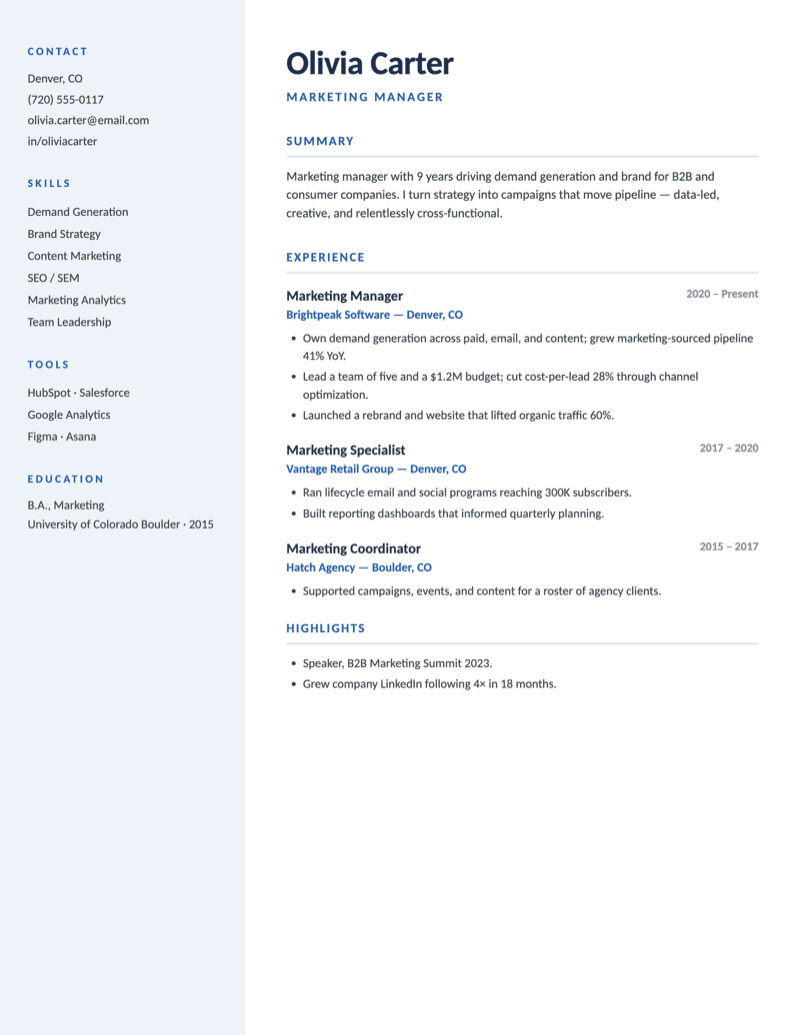
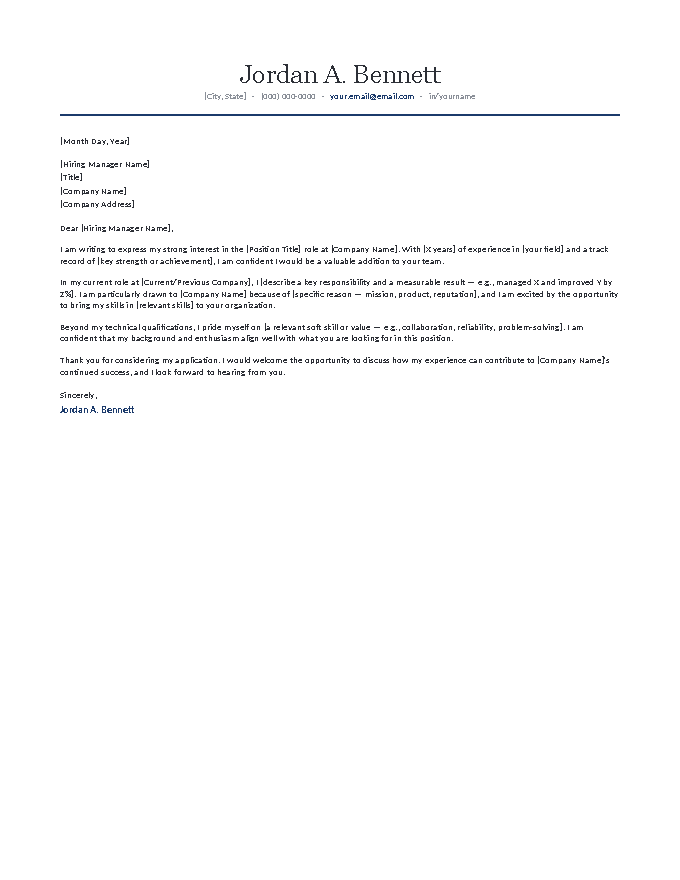
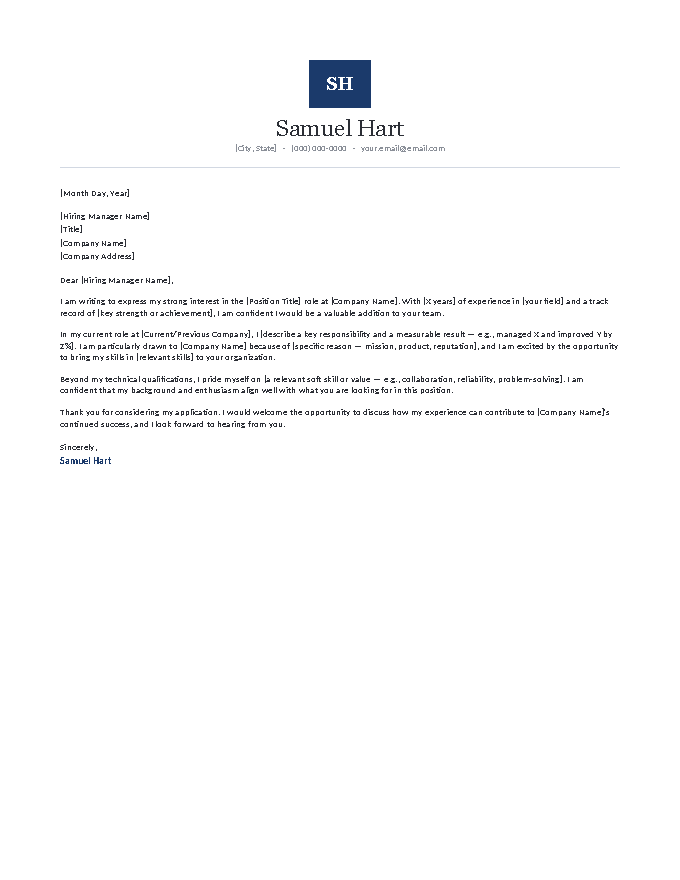
Three templates with the format already right.
Every rule below is already applied inside these — copy one to Google Docs or download the Word file, and you are editing a correctly formatted letter instead of building one.
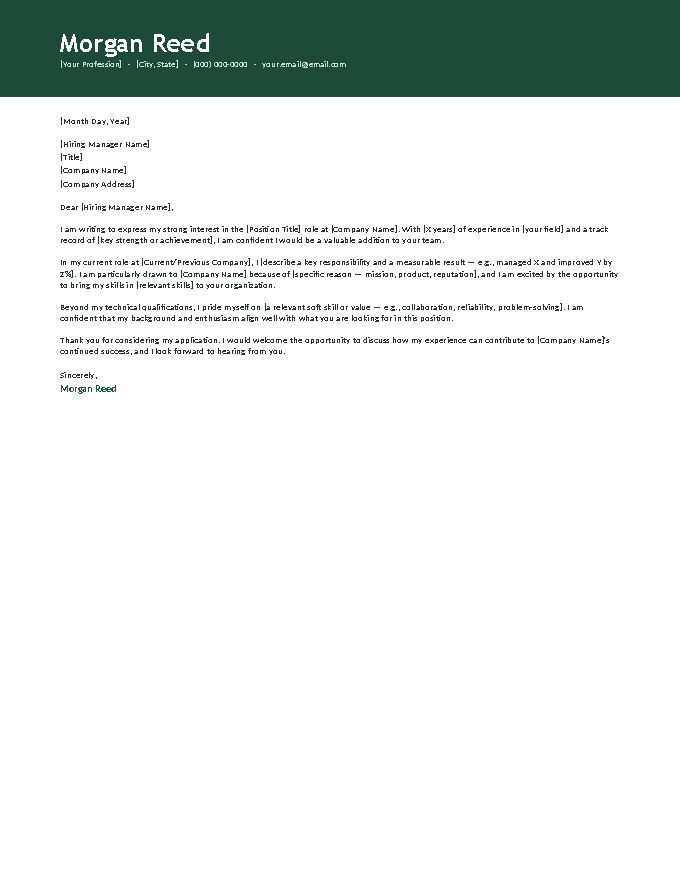
Three jobs, two sentences.
A closing paragraph does three things: it asks for the conversation, it points to the attached resume (and anything else — portfolio, references), and it thanks the reader. It does not restate the letter, repeat your qualifications, or promise to follow up on a specific day (a line that reads as pressure).
Closing paragraph examples
- Standard: ’I would welcome the opportunity to discuss how my experience could contribute to the team’s goals; my resume is attached. Thank you for your consideration.’
- With a specific hook: ’I’d enjoy talking through the fall product roadmap you outlined in the posting, and how I’d approach the first ninety days. Thank you for your time.’
- Entry-level: ’I’m available to start in June and would welcome an interview at your convenience. Thank you for considering my application.’
- Portfolio or samples: ’My resume and three placements are attached; I’d welcome the chance to walk through my process. Thank you for your consideration.’
- Referral: ’Priya Shah suggested I reach out, and I’d be glad to continue the conversation she started. Thank you for your time.’
- Relocation: ’I’ll be local by January and am available for video interviews any time before then. Thank you for your consideration.’
Confident, brief, specific. The ask is direct (’I would welcome’), not tentative (’I hope that perhaps’).
Seven that work, and the ones that don't.
The sign-off is a formality — one word or two, a comma, a blank line, your typed name. It should be invisible; the only way to get it wrong is to make it noticeable.
- Sincerely, — the default. Correct everywhere.
- Best regards, / Kind regards, — slightly warmer; fine in any field.
- Regards, — neutral; common in tech and business.
- Respectfully, — formal; suits government, legal, military, and academic applications.
- Thank you, — acceptable when the last sentence isn’t already a thank-you.
- With appreciation, — warm; fits nonprofit and education.
- Yours sincerely, — British convention; fine for UK and Commonwealth employers.
Avoid
’Cheers,’ ’Thanks!’, ’Best,’ alone, ’Warmly,’ ’Yours truly,’ ’Cordially,’ — too casual, too intimate, or too dated for a first contact. Don’t add a second thank-you if the paragraph already has one. And no exclamation points anywhere in the letter.
Name, signature, and enclosures.
Type your full name on the line after the sign-off (one blank line between). For an email or portal upload, that’s all — no scanned signature, no image. For a printed letter, sign in the gap. Below your name you may add a phone number or email if your header doesn’t carry them, and ’Enclosure: Resume’ is an older convention you can safely skip. Every template here ends ’Sincerely,’ with the name styled to match the letterhead.
A complete letter with a strong closing paragraph.
[Month Day, Year]
[Hiring Manager Name]
[Title]
[Company Name]
[Company Address]
Dear [Hiring Manager Name],
I am applying for the [Position Title] role at [Company Name]. In [X years] in [field], my headline result is [one quantified achievement] — the rest is on the attached resume.
Your posting emphasizes [top requirement]; that has been the core of my work at [Current/Previous Company], where I [one matching result].
I would welcome a conversation — I am available at [phone / email], [days and times].
Thank you for your consideration. I look forward to hearing from you.
Sincerely,
Alex Rivera
How to End a Cover Letter FAQ
How should I end a cover letter?
What is the best sign-off for a cover letter?
Should I say 'thank you' at the end of a cover letter?
Should I mention following up?
What's a good last sentence for a cover letter?
Should I sign a cover letter I'm emailing?
Can I end with 'I look forward to hearing from you'?
How to End a Cover Letter · Updated September 2026