




Apollo's Templates
HomeSportsCourts & FieldsSoccer Field Dimensions
Soccer · measured dimension sheets

Soccer Field Dimensions

A soccer pitch is the one field whose size is a range — 100–130 × 50–100 yards under the Laws of the Game — so every sheet here names the range, draws a typical size inside it, and measures the markings that never change: the 18-yard box, the 6-yard box, the penalty mark, the arc, the goals. Seven sheets from the World Cup pitch down to the U6 field, plus futsal.

Full-size · 11v11

FIFA, high school and college.

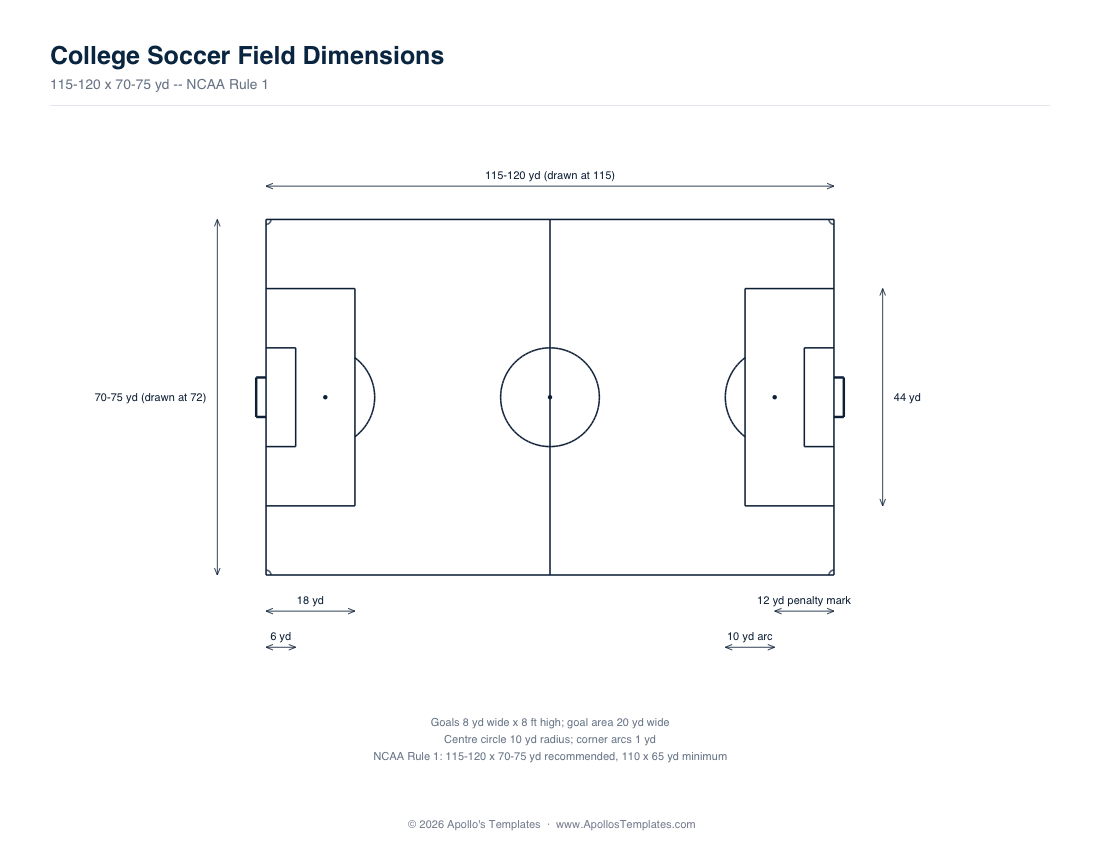
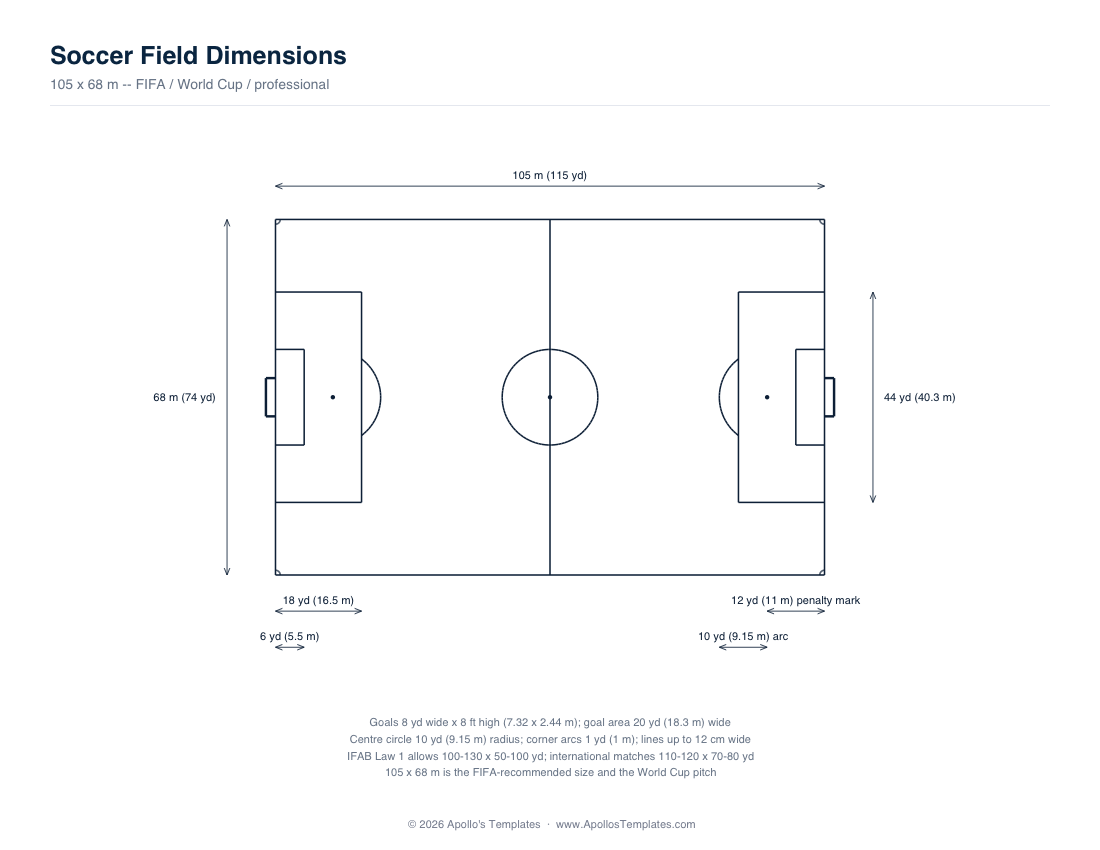
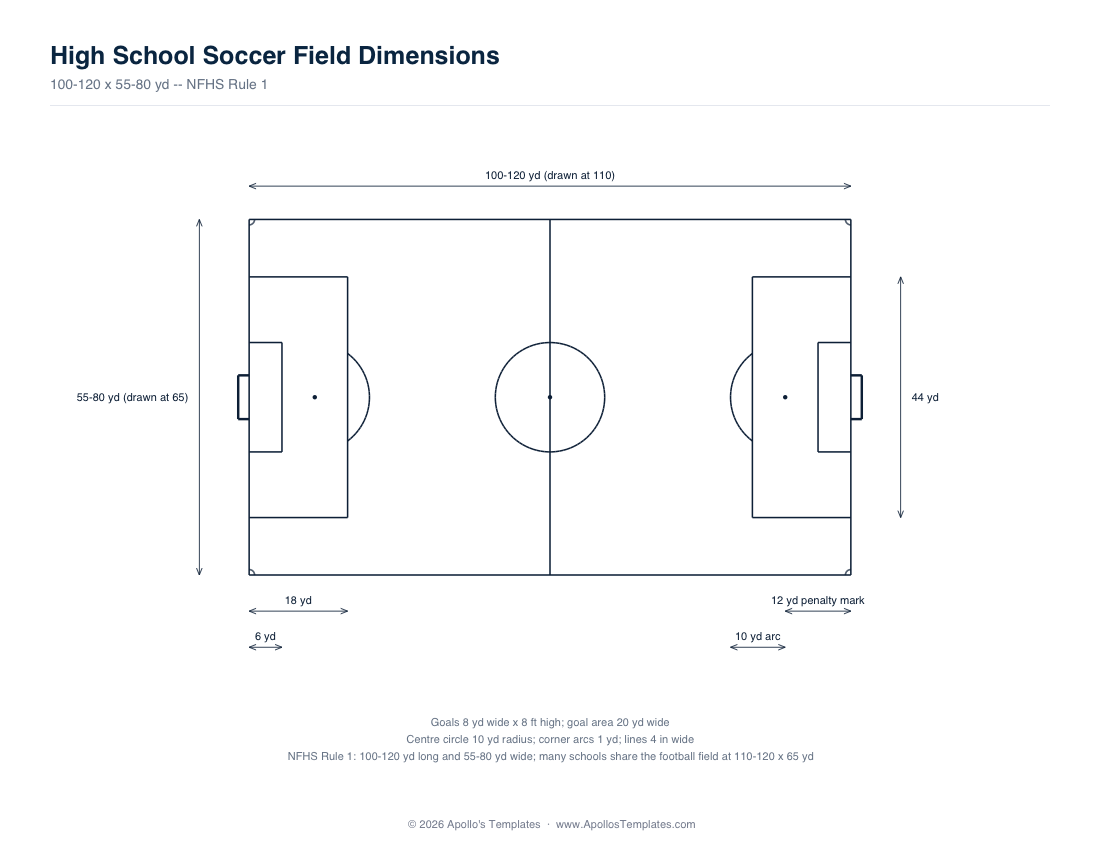
Same markings on all three; only the outline moves. The FIFA sheet is the 105 × 68 m standard, the other two are drawn at a typical size inside their rule book's range.
Field size by level

Youth sizes follow the US Soccer Player Development Initiative; adult sizes are each governing body’s own rule. Goals are height × width.

FormatAgesFieldGoal
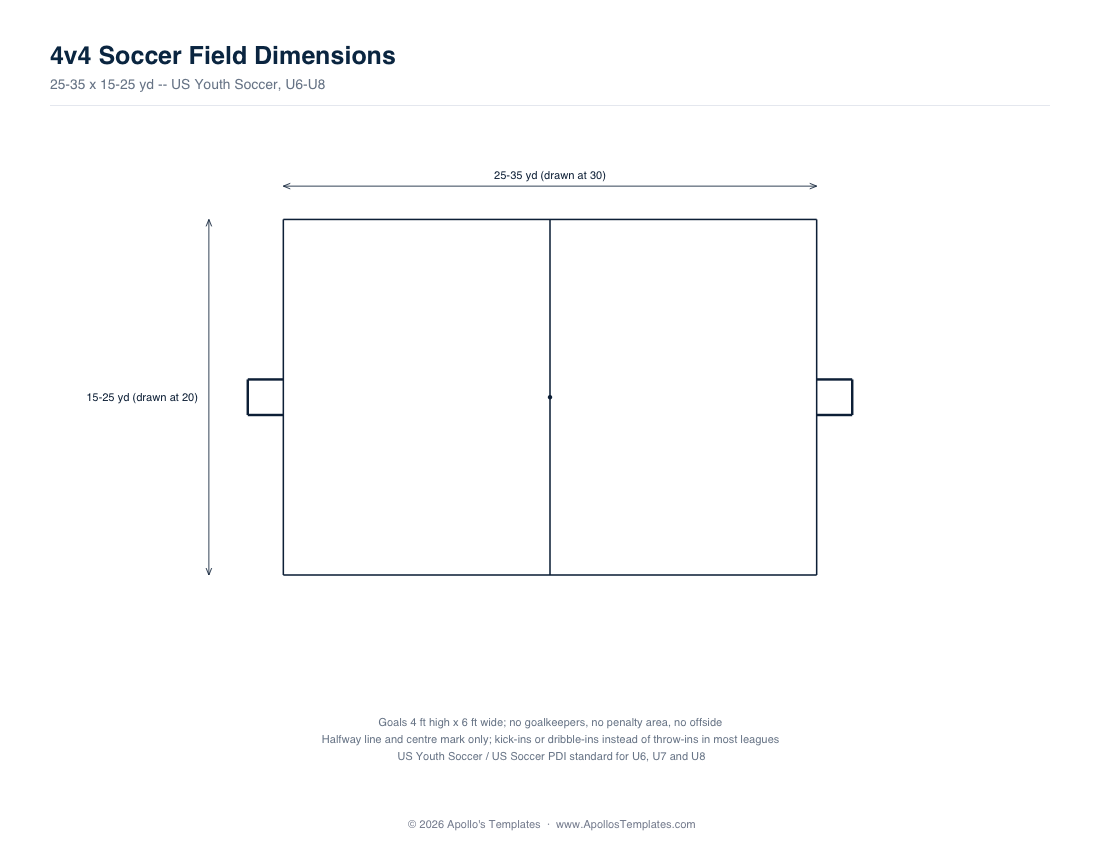
4v4U6–U825–35 × 15–25 yd4 × 6 ft
7v7U9–U1055–65 × 35–45 yd6.5 × 18.5 ft
9v9U11–U1270–80 × 45–55 yd6.5 × 18.5 ft (max 7 × 21)
11v11 youthU13+100–130 × 50–100 yd8 ft × 8 yd
High school (NFHS)100–120 × 55–80 yd8 ft × 8 yd
College (NCAA)115–120 × 70–75 yd8 ft × 8 yd
FIFA international110–120 × 70–80 yd (105 × 68 m standard)8 ft × 8 yd
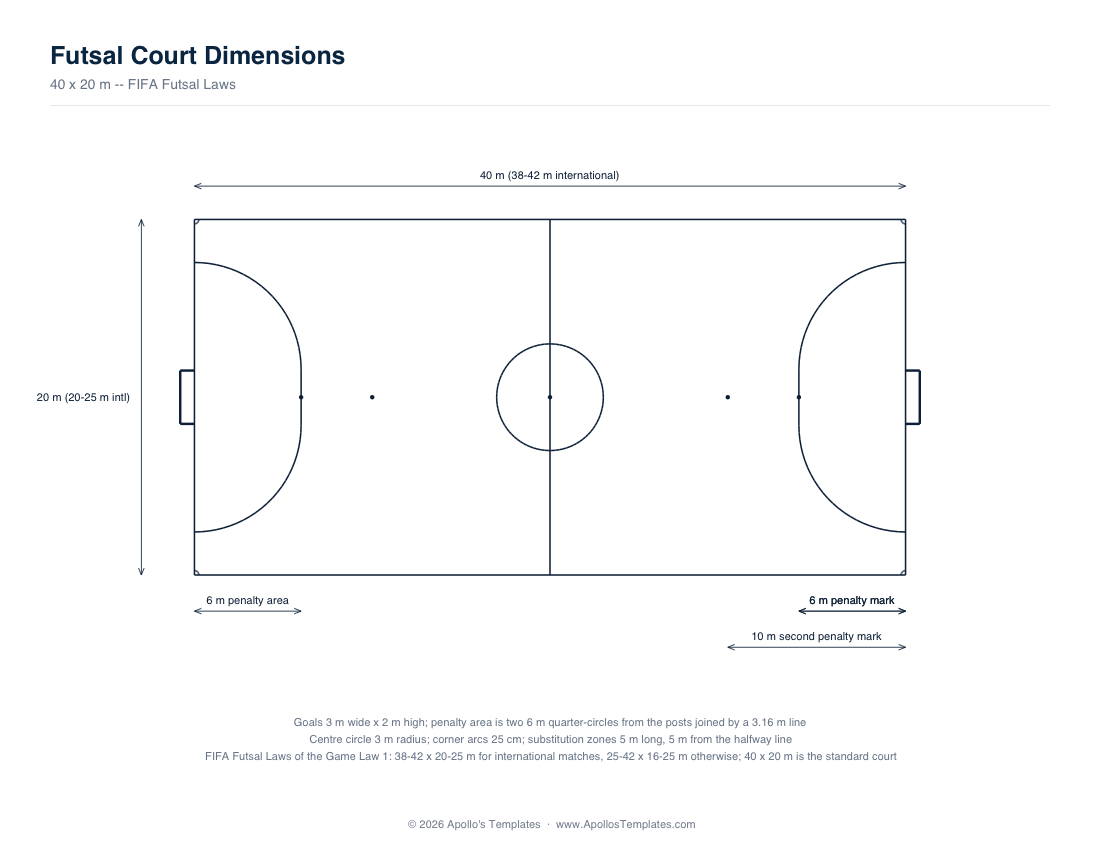
Futsal40 × 20 m (38–42 × 20–25 intl)2 × 3 m
Small-sided · youth and futsal

The fields most coaches actually line.

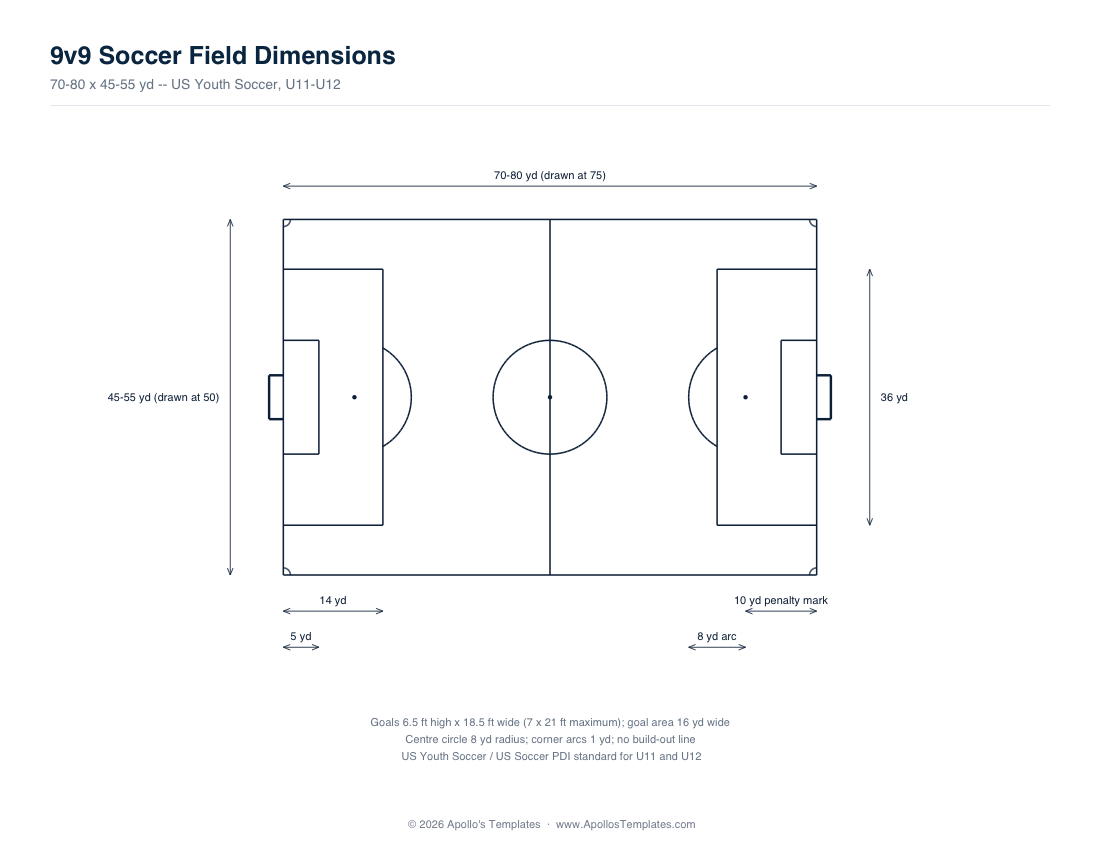
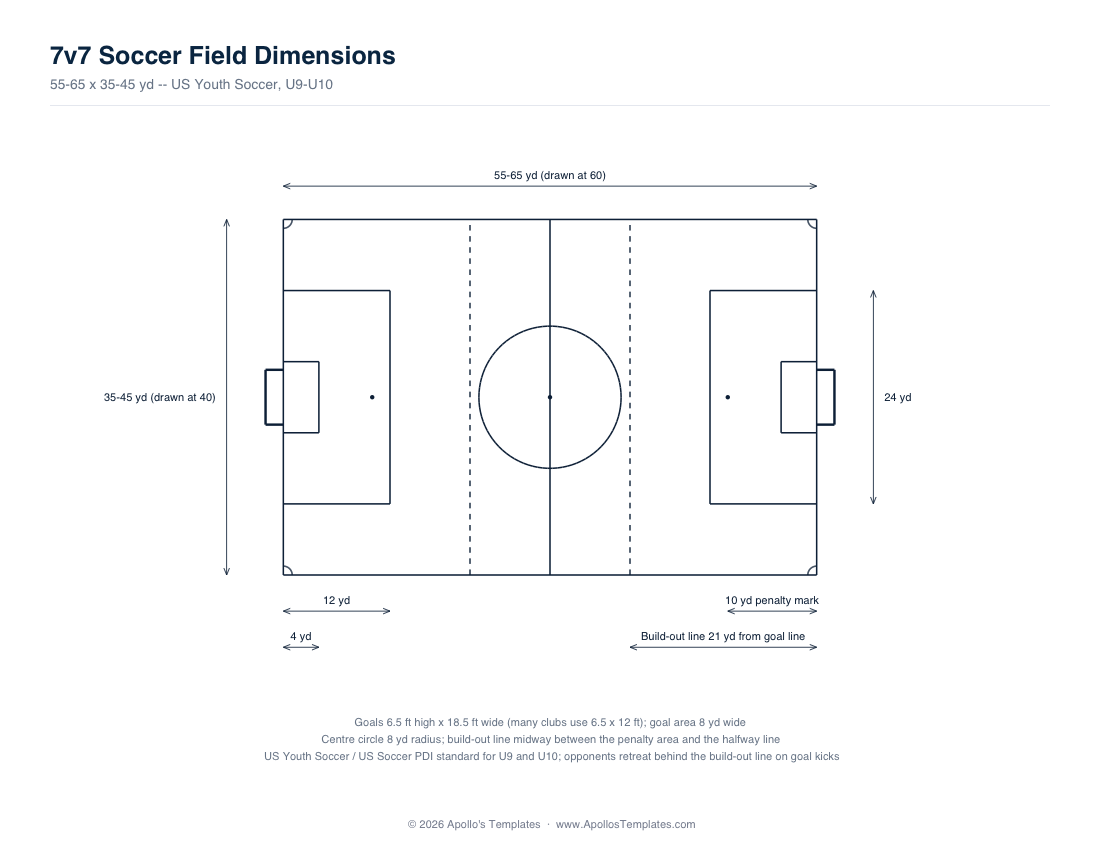
Youth boxes and goals shrink with the age group; the build-out line appears at 7v7 and disappears again at 9v9. Each format on its own sheet.
Why the outline is a range and the boxes are not

Soccer grew up on whatever ground a town had, and the Laws still allow that: a pitch can be anything from 100 to 130 yards long and 50 to 100 wide, and a club that wants a narrow, fast pitch is entitled to one. What the Laws fixed instead was everything measured from the goal — the 6-yard box, the 18-yard box, the penalty mark at 12, the arc at 10 — because those decide free kicks, penalties and offside, and they have to be the same in every stadium.

The youth formats work the other way round: the boxes shrink with the players. A 9v9 penalty area is 14 × 36 yards rather than 18 × 44, the mark moves in to 10 yards, and the goal drops to 6.5 feet — so a twelve-year-old keeper can actually reach the crossbar.

Coaching, not lining a field?
Blank soccer field diagrams
Full, half, 7v7 and 9v9 blanks — or draw a formation with squad numbers, your lineup and a club crest.
Open
Sharing the field on Friday nights?
Football field dimensions
120 × 53⅓ yd — the field most high-school soccer is squeezed onto.
Open
What are the dimensions of a soccer field?
There is no single answer, which surprises people: the Laws of the Game allow anything from 100 to 130 yards long and 50 to 100 yards wide (90–120 × 45–90 m), narrowing to 110–120 × 70–80 yards for international matches. The FIFA-recommended size — and the one every World Cup pitch uses — is 105 × 68 metres, about 115 × 74 yards. The markings inside are fixed: an 18 × 44 yd penalty area, a 6 × 20 yd goal area, the penalty mark 12 yd out, and a 10-yd centre circle.
How big is a soccer field in feet?
A 105 × 68 m FIFA pitch is about 344 × 223 feet. The permitted range is 300–390 feet long by 150–300 feet wide. For an American high-school field, 100–120 yards by 55–80 yards is 300–360 by 165–240 feet. The goal is 24 feet wide and 8 feet high, and the penalty area is 54 feet deep by 132 feet wide.
What size is a high school soccer field?
NFHS Rule 1 sets a range of 100 to 120 yards long and 55 to 80 yards wide. Because most schools play on the football field, 110–120 yards by 65 yards is typical — the football field's 53⅓-yard width is too narrow, so the touchlines usually sit outside the football sidelines. The boxes, goals and circle are full adult size.
What are the youth soccer field sizes by age?
Under the US Soccer Player Development Initiative: 4v4 for U6–U8 on a 25–35 × 15–25 yd field with 4 × 6 ft goals and no goalkeeper; 7v7 for U9–U10 on 55–65 × 35–45 yd with 6.5 × 18.5 ft goals and build-out lines; 9v9 for U11–U12 on 70–80 × 45–55 yd with the same goals; and 11v11 from U13 up on a full field. The table above has each format with its goal size, and each has its own measured sheet.
How big is the penalty area and the goal area?
On a full-size pitch the penalty area — the 18-yard box — extends 18 yards from the goal line and is 44 yards wide (16.5 × 40.3 m). The goal area — the 6-yard box — is 6 yards deep and 20 yards wide (5.5 × 18.3 m). The penalty mark is 12 yards from the goal line and the arc on the edge of the box is 10 yards from that mark. Youth fields shrink all of these: 14 × 36 and 5 × 16 yd at 9v9, 12 × 24 and 4 × 8 yd at 7v7.
Is a soccer field bigger than a football field?
Usually, yes — mostly in width. An American football field is 120 × 53⅓ yards including the end zones; a FIFA pitch is about 115 × 74 yards, so it is a little shorter but twenty yards wider, and a full 130 × 100 yd pitch would dwarf it. That width is why soccer played on a football field feels cramped, and why high schools mark the soccer touchlines outside the football sidelines.
How big is a soccer field in acres?
A 105 × 68 m pitch is 7,140 square metres — 1.76 acres, or about 76,900 square feet. A 100 × 50 yd minimum pitch is just over an acre; a 130 × 100 yd maximum is 2.7 acres. Add the run-off the rules want around it and a single full-size field needs close to 2 acres of ground.
What size is an indoor soccer or futsal court?
Futsal, the FIFA-governed indoor game, is played on a 40 × 20 m court (38–42 × 20–25 m for international matches), with 6 m penalty areas, marks at 6 and 10 m and 3 × 2 m goals. Arena or 'indoor soccer' played on turf inside boards has no single governing standard — venues are commonly around 200 × 85 ft, roughly a hockey rink — so check the facility.

Measurements from IFAB Laws of the Game Law 1, FIFA stadium guidelines, NFHS Soccer Rule 1, NCAA Soccer Rule 1, the US Soccer / US Youth Soccer small-sided standards and the FIFA Futsal Laws. Updated through September 2026.