






Ping Pong Rules — Serving, Scoring and Doubles
Everyone can play ping pong; the arguments start at the serve. This page gives the game in ten lines, then the serve, the scoring and the doubles rules the way the ITTF actually writes them, and shows where the official rules, the old 21-point game and the basement part company.
Ping pong in ten lines
- Games to 11, win by 2. Best of five or seven games makes a match.
- Serve from an open palm. Toss the ball at least 6 inches straight up from behind the end line and hit it on the way down; it must bounce on your side, then theirs.
- Serve changes every two points, and every point once the score is 10–10.
- A net serve that lands in is a let. Replay it. A net serve that misses is the receiver’s point.
- Let it bounce once, then return it over or around the net so it lands on their side. No volleys.
- The edge is in, the side is out. A ball clipping the top edge counts; one hitting the vertical side does not.
- You lose the point if it bounces twice, you hit it twice, you volley it, you touch the table with your free hand, or you touch the net.
- Doubles serve diagonally from your right half to their right half, and partners must alternate hits.
- Change ends after each game, and at 5 points in the deciding game.
- Deuce has no cap. From 10–10 play on, alternating serve, until someone leads by two.
Official rules, the 21-point game and the basement
Same table, three rulebooks. Most disagreements at a party come from two people who learned different columns.
| Rulebook | Game | Serve changes | The serve | Net serve | Doubles | Volleys |
|---|---|---|---|---|---|---|
| ITTF / USATT (official since 2001) | 11 points, win by 2; matches best of 5 or 7 | Alternates every 2 points (every point from 10–10) | Ball rests on an open palm behind the end line, tossed at least 16 cm (6 in) near-vertically, struck on the way down; bounce on your side, then theirs | Replayed, no limit | Serve from your right half to their right half; partners must alternate hits | Hitting the ball before it bounces on your side loses the point (unless it was going to miss the table) |
| The 21-point game (official before 2001) | 21 points, win by 2; best of 3 or 5 | Alternates every 5 points | Same open-palm toss (introduced earlier); many recreational players skipped it | Replayed | Same diagonal serve and alternating hits | Loses the point |
| Typical basement / bar rules | Usually 11 or 21; win by 2 almost always kept | Every 2 or every 5, whichever the house learned | Serve from the hand, anywhere behind the table; hidden serves common | Often replayed only a fixed number of times, or counts | Diagonal serve often kept; alternating hits often dropped | Argued about -- agree before play |
The serve, properly
The serve is the only shot with rules about how you hit it, and all of them exist to stop the server hiding spin. The ball starts resting on the open palm of your free hand, above the level of the table and behind your end line, where the receiver can see it. You throw it up at least 16 cm — about 6 inches — nearly vertically, without spinning it, and strike it as it falls. It must bounce first on your own half and then on the receiver’s; in doubles, on the right half of each. Your free arm has to come out of the way the moment the ball is thrown so nothing is between the ball and the receiver. Break any of those and the umpire calls a fault, which is simply the receiver’s point; at home, agree beforehand whether you are playing the toss rule, because it is the single biggest gap between club rules and kitchen rules.
Scoring, serve order and ends
Every rally scores a point for someone — there is no serving-to-score as in old volleyball. Games are to 11, win by two, and the serve passes across every two points so that at 10–10 it is passing every point. Ends change after each game and when the first player reaches 5 in the last game, so neither player spends the decider looking into the light. Matches are best of five (first to three games) in most leagues and best of seven in major events. The expedite system — a shot clock that comes in after ten minutes if a game is still going and fewer than 18 points have been played — is the one rule you will never need at home.
Doubles
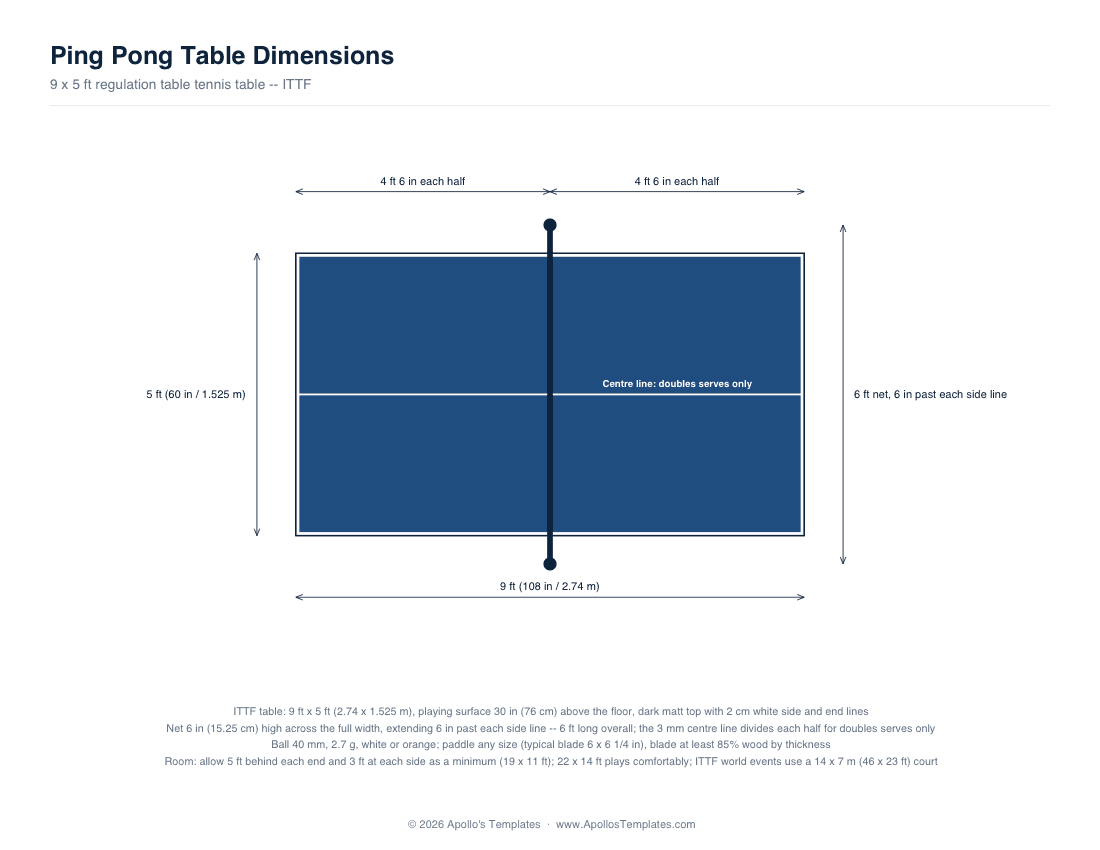
Doubles adds two rules and a rhythm. The serve must go diagonally, right half to right half, which is the entire purpose of the centre line. After the serve the partners on each side must alternate strokes — A serves, X returns, B plays the third ball, Y the fourth — and a side that lets the same player hit twice in a row loses the point. The serving order rotates so that each player serves two points in turn and each pair of players faces each other for one game; after every game the receiving side chooses who receives first.
What is a winning score in ping pong?
What are the serving rules in ping pong?
How often does the serve change?
What happens if the serve hits the net?
What are the doubles rules?
Can you hit the ball before it bounces?
What counts as in, and what is a point?
Where do these rules come from?
Based on the ITTF Laws of Table Tennis as adopted by USA Table Tennis. Updated through September 2026.