


Table Shuffleboard Rules and Scoring
The bar game: two colours of weights, a long waxed board, and one rule that decides everything — only the side with the closest weight scores. This page walks through a frame, the 1-2-3 zones and the hanger, the foul line, and where Knock Off, Horse Collar and Crazy Eight part company.
Table shuffleboard in ten lines
- Four weights each. Red and blue, four per side. Both players throw from the same end toward the far end of the board.
- Alternate throws. Red, blue, red, blue until all eight are down. That is a frame.
- Cross the foul line. A weight must pass the foul line 6 ft from the far end or it is removed before the next shot.
- Knock, block or draw. You may knock the other side’s weights off the end or sides, hide behind your own, or draw softly into the 3.
- Closest weight wins the frame. When the frame is over, whichever side has the weight nearest the end scores. The other side scores nothing.
- Count only the weights ahead. The winner scores each of its weights that lies beyond the loser’s best weight: 3, 2 or 1 by zone.
- A hanger is 4. A weight hanging over the end of the board without falling beats everything and scores four.
- On the line, take the lower number. A weight touching the 3-line scores 2; touching the 2-line scores 1.
- Winner throws first, loser gets the hammer. The side that scored opens the next frame, so the last weight belongs to the side that did not.
- Play to 15. First to 15 wins in singles and in Knock Off; doubles usually plays to 21. In doubles, partners stand at opposite ends and alternate frames.
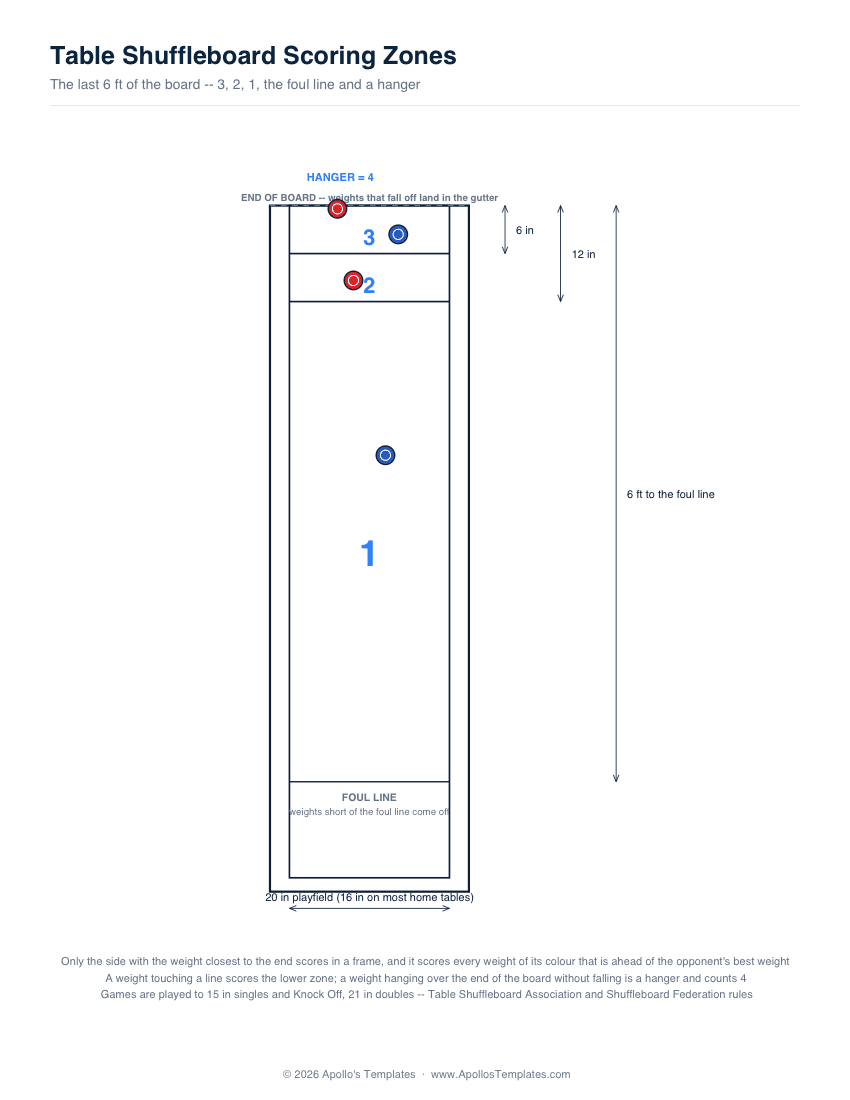
How scoring actually works
Look at the board after the eighth weight. Find the single weight nearest the end — that colour scores, the other does not. Now count that colour’s weights from the end back until you reach the first weight of the other colour, and stop: 3 for each in the 3 zone, 2 in the 2 zone, 1 in the 1 zone, 4 for a hanger. If red has a hanger and a 2 with a blue weight between them, red scores 4, not 6. That single rule is why the last weight, the hammer, is worth so much: one good knock-off can turn a frame from three points against you into two for you.
Weights that touch a line score the lower zone, weights that stop short of the foul line are taken off the moment they stop, and anything that goes into the gutter is out of the frame. Nothing is scored until the frame is finished, so a weight sitting on a 3 for seven throws is worth nothing if the eighth knocks it off.
Knock Off, Horse Collar and Crazy Eight
Knock Off is the game above and the one every bar plays: alternate weights, only the leader scores, 15 to win in singles and 21 in doubles. Horse Collar changes the rhythm — each player throws all four weights in a row, and only weights in the 3 zone or hanging count, with hangers scoring heavily and the game running to 51, so it rewards touch over defence. Crazy Eight lets both players score every frame instead of only the leader, which turns it into a drawing contest rather than a knocking one. The Shuffleboard Federation publishes the exact point values for the variants; agree which game you are playing before the first weight goes down.
Wax, weights and etiquette
The board is dusted with shuffleboard wax — silicone beads, not candle wax — and the speed of the wax changes the game more than anything in the rulebook. Weights are about 2⅜ inches across and come in matched sets of eight; the caps come off to be cleaned. Stand behind the end of the board to throw, do not touch the surface during a frame, and let the scorer call the frame before anyone lifts a weight.
How do you score in table shuffleboard?
What is a hanger?
What is the foul line rule?
How many weights do you get, and who goes first?
What is Knock Off?
How do Horse Collar and Crazy Eight differ?
Why do you put wax on a shuffleboard table?
Is this the same as outdoor shuffleboard?
Based on the Table Shuffleboard Association and Shuffleboard Federation rules. Updated through September 2026.