




Apollo's Templates
HomeBudget TemplatesGrant
Numbers that match the narrative

Grant Proposal Budget Template

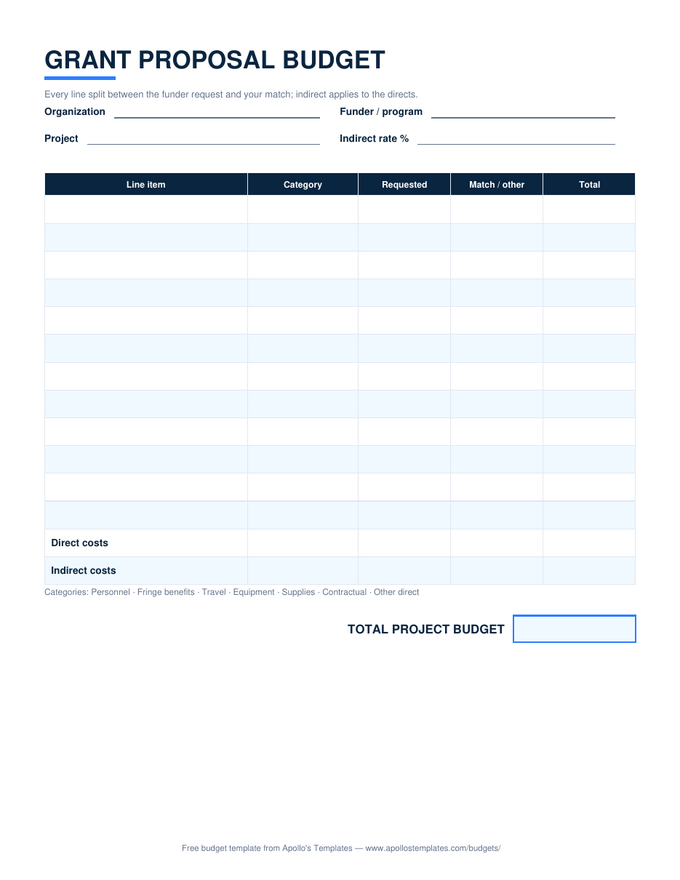
A grant budget is the proposal's most-read page \u2014 reviewers who skim the narrative still audit the numbers. This sheet is shaped the way funders expect: line items sorted into the standard categories (personnel, fringe, travel, equipment, supplies, contractual), each split between what you're requesting and what you're matching from other sources, with the indirect rate applied to direct costs and every total computed. When the program officer asks for the budget, this is the shape they mean.

The ask, itemized

One sheet, every format.

Excel — request vs match computed

Category dropdowns, requested and match columns, direct subtotals, and the indirect rate applied automatically.
Grant proposal budget with requested, match, and total columns and indirect cost rows
PDF

Printable PDF

The budget on paper for the working session — build it with the program team before it hardens.
Download PDF

Word / Google Docs

The layout as an editable document — some funders' portals want the budget pasted, not attached.
Worth knowing

The budget justification is where grants are won.

Most funders ask for two documents: this budget and a budget justification — a paragraph per line explaining what the money buys and why the amount is right. Write them together, not sequentially. “Project director, 0.5 FTE, $40,000” survives review when the narrative describes half a person’s year of work and the salary matches your actual pay scales; it dies when the justification reads reverse-engineered. Reviewers score coherence — the budget, the justification, and the narrative describing the same project in three dialects.

On the match column: funders love leverage, and the column is where you show it — but only pledge match you can document. Cash match needs a source; in-kind match (volunteer hours, donated space, staff time from other funding) needs a valuation method you can defend at report time. The trap to avoid is the aspirational match that wins the grant and haunts the grant report; an achievable 20% documented beats a fictional 50% every time an auditor calls.

The organizational context
Nonprofit Budget
The operating budget funders ask for alongside the project ask.
Open
Arts and media asks
Film Budget
The top-sheet format for film and media grant applications.
Open
Track the award
Budget vs Actual
When the grant lands, this is the report-time variance sheet.
Open

Frequently asked questions

What indirect rate should we use?
Whichever you legitimately have, in this order: a federally negotiated indirect cost rate agreement (NICRA) if your organization holds one; the 15% de minimis rate that federal rules let organizations without a NICRA apply to modified total direct costs (raised from 10% by the 2024 Uniform Guidance revision); or, for private foundations, whatever their guidelines cap — many limit indirect to 10-15%, and some fund none. The sheet's rate cell is editable per proposal for exactly this reason. Never invent a rate; the mismatch between proposals is the kind of thing that surfaces at the worst moments.
What's the difference between direct and indirect costs?
Direct costs exist because of this project: the coordinator's salary share, the workshop supplies, the travel to sites. Indirect costs keep the organization running underneath every project — rent, utilities, the bookkeeper, the audit — and can't be attributed to one grant without arbitrary math, which is why they're recovered as a percentage instead. The line moves with your accounting: an org that charges a project's exact phone line as direct can't also recover it through indirect. Consistency across all your grants is the rule auditors actually check.
How do we price personnel lines credibly?
Salary times effort, from real numbers: the actual (or budgeted-and-board-approved) salary, times the FTE share this project claims, with fringe benefits calculated at your organization's true rate on its own line. Reviewers know regional salary ranges — a program director at half the market rate reads as either an unrealistic plan or an underpaid team, and both cost points. Federal proposals add effort-certification obligations later, so the FTE you write is a commitment, not a gesture; write the number someone will actually work.
Can we build one budget and reuse it across funders?
Build the master project budget once — full cost, all sources — then cut each funder's version from it, and the requests stay coherent automatically. The master shows the whole project; each proposal's 'requested' column carves out that funder's slice while the match column shows the others (named or anonymized as 'other committed funding'). This is also the honest answer to the double-funding worry: overlapping asks are fine while pending if the master budget shows how they reconcile, and funders expect you to report what happens when both come in.
Updated through August 2026