




Apollo's Templates
HomeBudget TemplatesFilm
Above and below the line

Film Budget Template

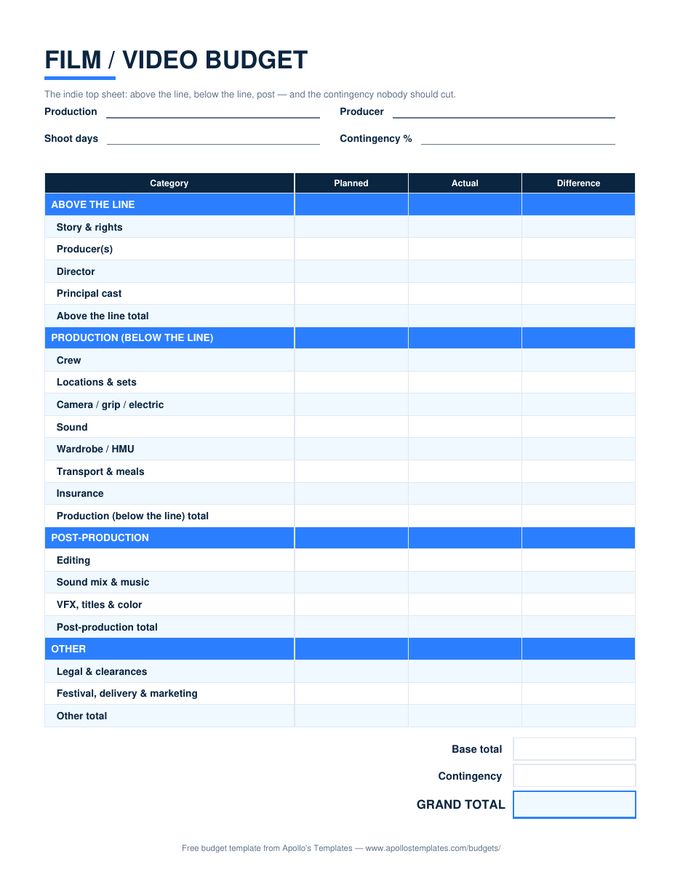
Every film budget in the industry, from studio tentpole to weekend short, organizes around one split: above the line (the creative package \u2014 rights, producers, director, principal cast) and below the line (what shooting it actually costs), with post-production and contingency closing the sheet. This is that structure at indie scale \u2014 the top sheet financiers expect to see, with the section math computed and contingency applied as the percentage you set.

The top sheet

One sheet, every format.

Excel — the computed top sheet

ATL, BTL, post, and other sections totaling themselves, with contingency computed from your percentage into the grand total.
Film budget top sheet with above-the-line, below-the-line, and post-production sections
PDF

Printable PDF

The top sheet on paper — the version that goes in the pitch deck appendix.
Download PDF

Word / Google Docs

An editable document version for grant applications and investor packets.
Worth knowing

The top sheet is a credibility document.

When a grant panel, investor, or festival lab reads your budget, they’re reading for fluency before they read for numbers — does this filmmaker know what things cost, and did they organize the answer the way the industry does? The ATL/BTL structure is that fluency. A $40,000 short with plausible section weights (BTL dominating, real money in sound, contingency present) reads as a filmmaker who’ll deliver; the same total as one undifferentiated list reads as a guess. The structure is doing half your pitching.

Two indie-specific honesty rules: budget the deferred and donated things at real value even when they’re free to you (the borrowed camera package and the DP working for credit are costs someone is eating — a budget that shows them tells financiers what the film actually costs to replicate), and never let post absorb the overage. The pattern that kills indie films isn’t overspending on the shoot — it’s the shoot consuming post’s money, delivering a film that exists but can’t be finished. The section subtotals exist so you can watch that boundary hold.

Fund it
Grant Proposal Budget
The funder-facing budget for arts grants — request vs match, indirect applied.
Open
The client version
Project Budget
Hours × rate task budgeting for commercial and client video work.
Open
Feed the crew
Event Budget
Wrap party, premiere, festival screening — each on its own sheet.
Open

Frequently asked questions

What actually goes above the line?
The creative package, committed before the camera rolls: story and rights (option fees, script purchase), producers, the director, and principal cast. Everything else — crew, equipment, locations, the entire machinery of the shoot — is below the line. The distinction matters because the two behave differently: ATL costs are negotiated once and fixed by contract, while BTL costs scale with shoot days and are where overruns actually happen. Financiers read the ratio too — an indie budget that's half ATL says the money is on screen talent rather than production value, which is sometimes exactly right and always worth being deliberate about.
How much contingency does a film need?
Ten percent of the base budget is the industry floor, and completion bond companies require it at minimum on bonded pictures. Indies with weather-dependent exteriors, stunts, animals, kids, or a first-time director carry more. Film contingency differs from other industries' in how certainly it gets spent — the question is which department, not whether. What it must never quietly become is post-production's funding: contingency covers surprises during production, and if it's intact at wrap, it makes post more comfortable rather than possible.
How do I budget deferred pay and donated gear?
Show them at fair value with a matching note — a 'deferred/in-kind' annotation per line or a summary at the bottom. A short whose crew works for credit and whose camera is borrowed might cost you $8,000 cash against a $35,000 real budget; showing both numbers is more credible, not less, because every experienced reader knows free labor isn't free. Grant applications often require exactly this split (cash vs in-kind), and deferred agreements should be papered — the deferred fee that was never written down is the classic indie dispute.
Does this work for documentaries and music videos?
Yes — the structure holds, the weights shift. Docs typically run light above the line and heavy in post: the shooting ratio means editing is where the film gets made, so post can rightly claim 30-40% of a doc budget, and archival licensing gets its own serious line under rights. Music videos and commercial work compress everything into fewer, denser shoot days — BTL dominates, post is fast, and the top sheet mostly proves to the label or client that the number is organized. For episodic work, run one sheet per episode plus a series overhead sheet.
Updated through August 2026