




Apollo's Templates
HomeBusinessExpense Report TemplatesMedical
Billed, covered, paid

Medical Expense Report Template

A year of medical bills is a stack of paper that never adds itself up. This sheet does: one row per visit, prescription, or bill, with what was billed, what insurance paid, and the out-of-pocket difference computed \u2014 then the totals that matter for an HSA or FSA reimbursement, a tax return, or a dependent-care and medical claim. Built for households, caregivers managing a parent's care, and anyone who has ever tried to answer \u201cwhat did we actually pay?\u201d

Three formats

The medical log, three ways.

Excel — out-of-pocket computes

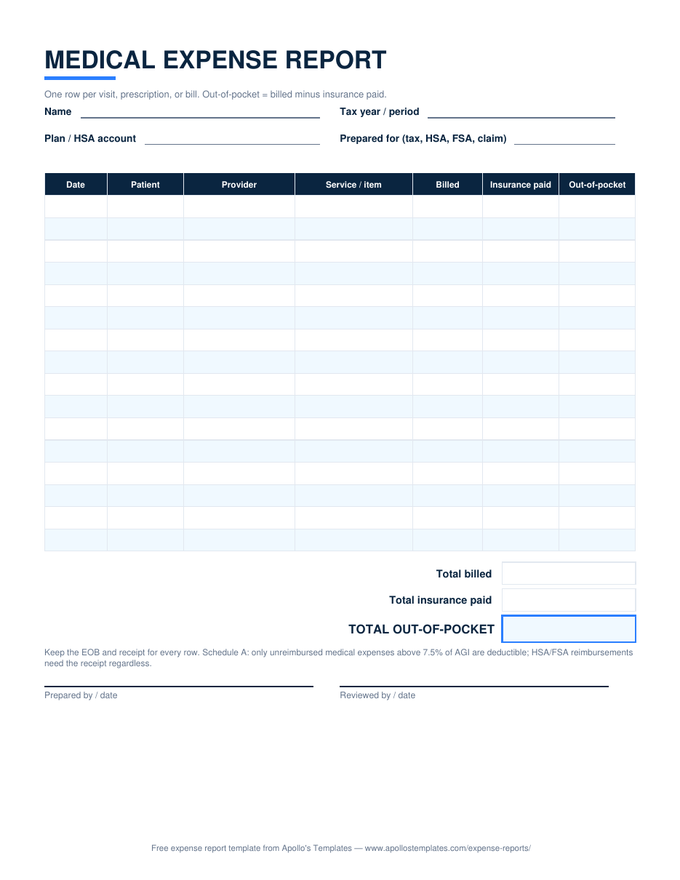
Eighteen rows: billed minus insurance paid gives out-of-pocket per row; totals for billed, insurance, and out-of-pocket compute.
Medical expense report with patient, provider, billed, insurance-paid, and computed out-of-pocket columns and an out-of-pocket total
PDF

Printable PDF

The folder version — file it with the EOBs and receipts and fill it in as bills arrive.
Download PDF

Word (.docx)

Editable for claim submissions that want a typed itemized statement.
Worth knowing

The EOB is not a bill, and the bill is not what you paid.

Medical paperwork arrives in three waves — the explanation of benefits from insurance, the provider’s bill, and the receipt for what you actually paid — and none of the three agrees with the others on its own. Logging each visit once, with billed, covered, and paid side by side, is the only way the year reconciles. It also catches the bill that arrived before insurance processed it, which is the most common medical overpayment there is.

Keep the sheet current through the year rather than reconstructing it in April. The 7.5% threshold means most households don’t deduct medical expenses — but the ones who cross it in a bad year are exactly the ones who can’t reassemble the records afterward.

Miles to appointments
Mileage Log Template
Medical mileage is deductible too — log it at the medical rate.
Open
The household's other spending
Expense Tracker Template
A running log with category and month totals.
Open
Plan for it
Family Budget Template
Where the healthcare line lives in the monthly plan.
Open

Frequently asked questions

Which medical expenses are tax-deductible?
Unreimbursed medical and dental expenses count toward the Schedule A deduction only to the extent they exceed 7.5% of your adjusted gross income, and only if you itemize — which is why the out-of-pocket column, not the billed column, is the number that matters. Premiums, prescriptions, mileage to appointments, and equipment can qualify; cosmetic procedures and reimbursed amounts don't. IRS Publication 502 is the authoritative list; this sheet just keeps the arithmetic ready.
What do HSA and FSA reimbursements need from this sheet?
The date, provider, service, and out-of-pocket amount for each row, plus the receipt or EOB behind it. HSAs let you reimburse yourself years later as long as you kept the record — an old sheet with receipts attached is money you can still take out tax-free. FSAs run on the plan year, so the Tax year / period field keeps claims sorted by deadline.
Why track billed and insurance paid separately?
Because the three numbers answer three different questions: billed is what the provider charged, insurance paid is what the plan covered, and the difference is your cost. Tracking all three catches billing errors (a claim insurance never processed shows up as a suspiciously large out-of-pocket) and makes appeals and deductible tracking possible.
Can I use it for a dependent's or parent's expenses?
Yes — the Patient column exists for exactly that: one household sheet with each row tagged to the person. Caregivers managing a parent's care use it as the record for the family, for the tax return of whoever claims the dependent, and for the conversations with siblings about who paid what.
Updated through September 2026