




Apollo's Templates
HomeBusinessInvoice TemplatesAuto Repair
Parts and labor

Auto Repair Invoice Template

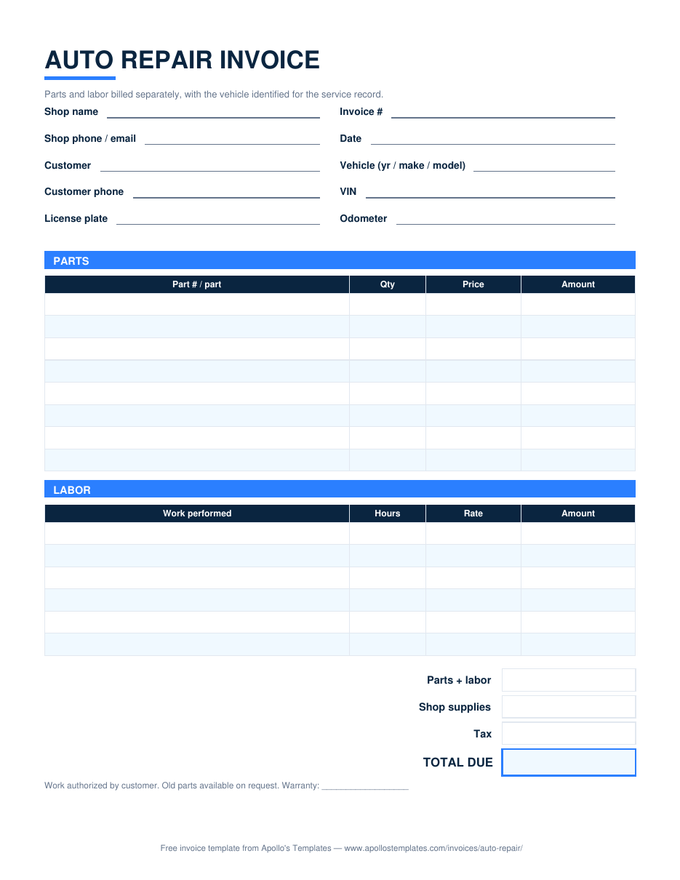
The shop bill, structured the way shops actually charge: a vehicle block with year, make, model, VIN, plate, and odometer; a parts table with part numbers and quantities; a labor table with hours and rates; then shop supplies, tax, and the total. The odometer and VIN aren't decoration \u2014 they make each invoice a service record the customer keeps and the next buyer of the car asks for.

Three formats

The shop counter bill.

Excel — parts + labor compute

Both tables multiply their rows; supplies and tax stack below; total in blue.
Auto repair invoice with a vehicle identification block and separate parts and labor tables
PDF

Printable PDF

The counter classic — print a stack, write the ticket while the car's still on the lift.
Download PDF

Word (.docx)

Editable for shops that type — put the shop logo where the title sits.
Worth knowing

The invoice is the shop's reputation, itemized.

Independent shops win on trust, and trust is built at the counter in the ninety seconds the customer reads the ticket. Part numbers they could google, hours that match the posted rate, a supplies line small enough to ignore — that’s what “honest shop” looks like on paper. The chains figured this out decades ago; the template gives the independent the same paper without the DMS subscription.

Staple or scan the parts receipts to your copy. Cost-plus arguments, warranty returns, and core-charge reconciliations all come down to the receipt for that caliper — searchable the day you need it or gone forever.

Same bones, different trade
HVAC Invoice Template
Service call, equipment, labor — unit identified.
Open
Print the stack
Printable Blank Invoices
All nineteen as blank clipboard PDFs.
Browse
The customer's proof
Invoice Receipt Template
Receipt with balance remaining for the cash payers.
Open

Frequently asked questions

Why do parts and labor have to be separated?
Because several states require it on repair invoices, warranty claims demand it, and customers price-check the two differently — parts against the internet, labor against trust. A blended “brake job: $415” invites both kinds of argument; $175 in listed parts plus 1.5 hours at the posted rate settles them before they start.
What's the shop supplies line, and is it legitimate?
It's the consumables no single job owns — solvents, rags, fasteners, fluid disposal — billed as a small flat amount or capped percent. It's legitimate exactly when it's visible and modest, which is why this sheet gives it a labeled line instead of letting it hide in labor. Some states cap it; your number should survive being asked about.
Do I need the customer's authorization on the invoice?
The authorization belongs on the estimate before work starts — many states require written authorization and make unauthorized work uncollectable. The invoice's job is to match that estimate. The footer's “work authorized by customer” line plus your signed estimate is the pair an inspector or small-claims judge wants to see.
Why record the odometer on every ticket?
It turns invoices into a service history — the thing that settles warranty timing, supports resale value, and catches the customer who swears the brakes were done “last year.” Mileage-stamped tickets are also your defense when a failure gets blamed on your work months of driving later.
Updated through September 2026