




Apollo's Templates
HomeBusinessInvoice TemplatesDaycare
The week, accounted for

Daycare Invoice Template

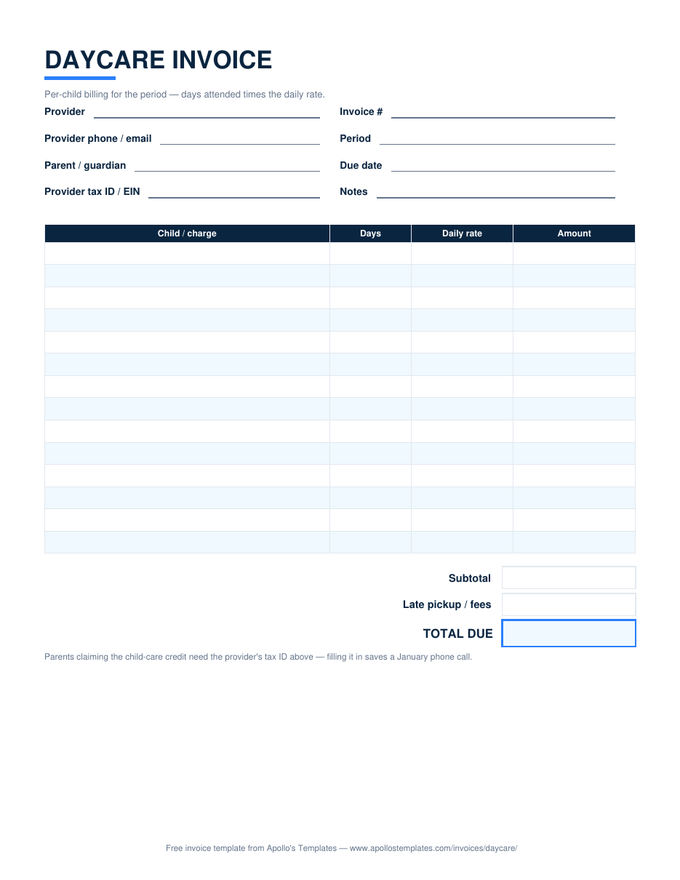
Per-child billing the way family childcare actually runs: days attended times the daily rate on each row, sibling rows side by side, late-pickup and registration fees labeled instead of awkward \u2014 and the provider tax ID printed on the invoice, because every parent needs it for the child-care credit and the January scramble for it helps no one.

Three formats

The children, the days, the total.

Excel — days times rate

Child rows multiplying days by rate, fee lines below, total computing.
Daycare invoice with days-attended times daily-rate rows, a late pickup fee line, and a provider tax ID field
PDF

Printable PDF

The cubby-note version — print weekly, send home in the folder.
Download PDF

Word (.docx)

Editable per-family masters with names and rates pre-typed.
Worth knowing

Small business, real paper.

Home childcare runs on relationships, and that’s exactly why the billing should run on paper — the invoice absorbs the money conversation so the door conversation stays about the child. A numbered weekly invoice with the days counted and the policy visible is how a provider charges fairly, raises rates professionally, and never has a payment talk at pickup.

Keep the year’s invoices per family: in January, the stack totals into the annual statement parents ask for in exactly one panicked text. Thirty seconds of filing a week replaces an evening of reconstruction — and the provider who hands over a tidy annual total keeps the family for the next child too.

The sitter's version
Babysitter Timesheet
Hours-based care with both signatures.
Open
Payment confirmed
Invoice Receipt Template
Receipts for the cash-paying families.
Open
Household money picture
Family Budget Template
Where the childcare line lives.
Open

Frequently asked questions

Why does the tax ID belong on every invoice?
Parents claiming the child and dependent care credit file Form 2441, which requires the provider's EIN or SSN. Printing it on the invoice — use an EIN, which is free from the IRS, rather than your SSN — answers the question permanently and marks you as a professional operation. The invoice stack becomes the family's tax documentation.
How should late-pickup fees be handled?
Posted policy, labeled line, no exceptions narrated: “Late pickup 9/12 — 25 min @ $1/min.” The labeled line is the entire enforcement mechanism; providers who bury it or waive it silently teach the behavior they're billing against. Most families never see the line — which is what it's for.
Weekly or monthly invoices for childcare?
Weekly matches how family budgets and most home providers run — small numbers, short memories, Friday folder. Centers and salaried-parent families often prefer monthly. This sheet works at either rhythm; the Period field just says which days the paper covers.
What about absences, holidays, and vacation weeks?
Per your written policy — most providers charge for holding the slot regardless (the row reads “Enrolled days” rather than attendance), some credit extended absences. Whatever the policy, the invoice should show it explicitly as counted days or a credit row; the document repeating the policy every week is what keeps it uncontroversial.
Updated through September 2026