




Apollo's Templates
HomeBudget TemplatesChurch
Stewardship on one page

Church Budget Template

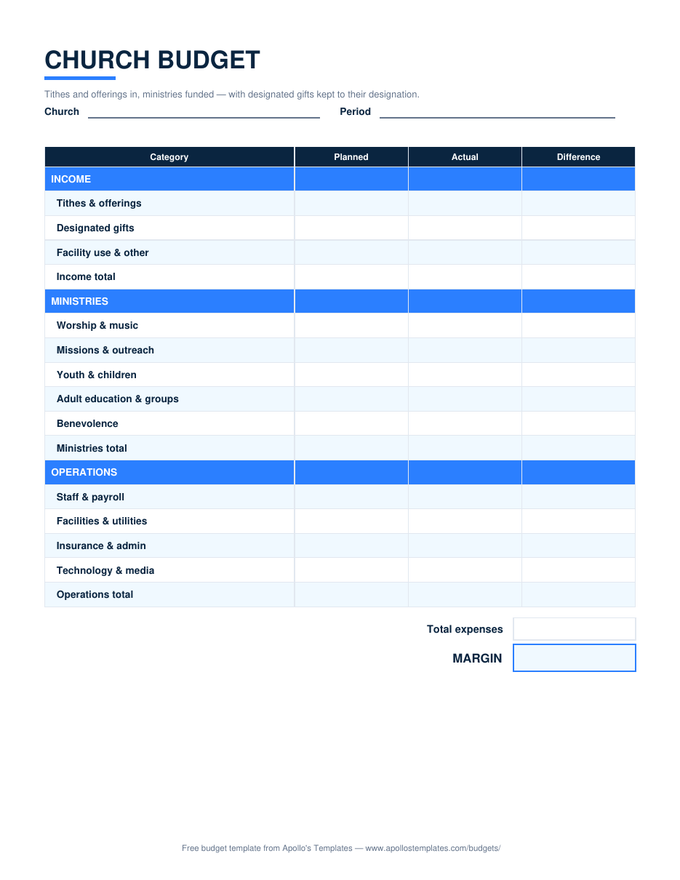
A church budget is a statement of priorities that happens to have numbers on it. This sheet keeps the statement legible: tithes, offerings, and designated gifts on the income side; ministries \u2014 worship, missions, youth, benevolence \u2014 funded by name rather than buried in operations; and the ministries-share line computing what portion of spending reaches the mission versus keeps the building warm. Planned against actual, the way a finance committee actually reviews it.

The ministry plan

One sheet, every format.

Excel — ministries funded by name

Income and ministry categories with planned/actual math, margin, and the ministries-share percentage computed.
Church budget with tithes income and ministry expense groups in planned and actual columns
PDF

Printable PDF

The budget on paper for the finance committee and the congregational meeting handout.
Download PDF

Word / Google Docs

An editable document version — annual-meeting ready, with your church's name on top.
Worth knowing

Designated gifts deserve their own discipline.

The gift marked “for the youth mission trip” is legally and morally different money from the Sunday offering, and the budget should treat it that way from the moment it arrives. Designated gifts get their own income line here so they can be spent only on their designation — the practice that protects the treasurer, honors the giver, and keeps the annual meeting free of its most avoidable controversy. If a designated fund outlives its purpose, the giver (or a documented policy) redirects it; the budget never quietly absorbs it.

The ministries-share line answers the question every congregation eventually asks: how much of what we give reaches the mission? There’s no mandated ratio — a congregation with an aging building will honestly run heavier on operations than a church plant meeting in a school — but computing the number every year keeps the drift visible and the conversation grounded. Churches that watch it tend to find their way toward the priorities they preach.

The 990 version
Nonprofit Budget
Functional expenses and the program ratio, for churches that file or grant-seek.
Open
Fund the mission trip
Event Budget
Per-line estimates for the fundraiser, retreat, or VBS week.
Open
On church letterhead
Church Letterhead
The stationery for the giving statements and the annual letter.
Open

Frequently asked questions

How should a church budget for variable giving?
Plan on trailing reality, not faith-adjusted hope: last year's actual giving, adjusted only for known changes (families arrived or left, a capital campaign ending), makes the honest baseline. Many churches budget at 90-95% of trailing giving, letting any surplus flow to reserves or missions at year end — which converts optimism from a budgeting method into a happy outcome. Seasonal patterns (summer dips, December generosity) matter for cash flow more than for the annual plan; a simple monthly giving history beside this sheet covers it.
What's a healthy split between staff, building, and ministry?
Common benchmarks put staff at 45-55% of budget and facilities at 20-30%, with the remainder reaching direct ministry — but the ranges are wide because contexts are: a church with a paid-off building funds ministry a mortgaged one can't yet. The ministries-share line this sheet computes is more useful than any universal ratio, because it tracks your trajectory: the number moving the right direction over three years matters more than where it stands today. Staff doing direct ministry work is genuinely arguable in either bucket; pick a convention and note it.
Who should see the church budget?
More people than usually do. The finance committee works the detail monthly; the board or elders approve it; and the congregation that funds it deserves at least the summary annually — the one-page version of this sheet at the annual meeting builds the trust that sustains giving. The balance to strike is transparency about categories without exposing individuals: total staff costs, yes; individual salaries, board-level only. The printable version exists partly for exactly this — a handout beats a projected slide nobody can study.
How do we handle benevolence without a fixed budget line?
Budget it anyway — a named benevolence line, even a modest one, beats the alternative of ad-hoc decisions under emotional pressure. The common pattern: a budgeted annual amount the deacons or pastor can disburse within policy (caps per situation, simple documentation), replenished by designated gifts when the congregation responds to needs. The line item does double duty: it guarantees help exists before the crisis, and it protects decision-makers with a framework when the hard cases come.
Updated through August 2026