





Apollo's Templates
HomeBusinessInvoice TemplatesService
Work done, billed

Service Invoice Template

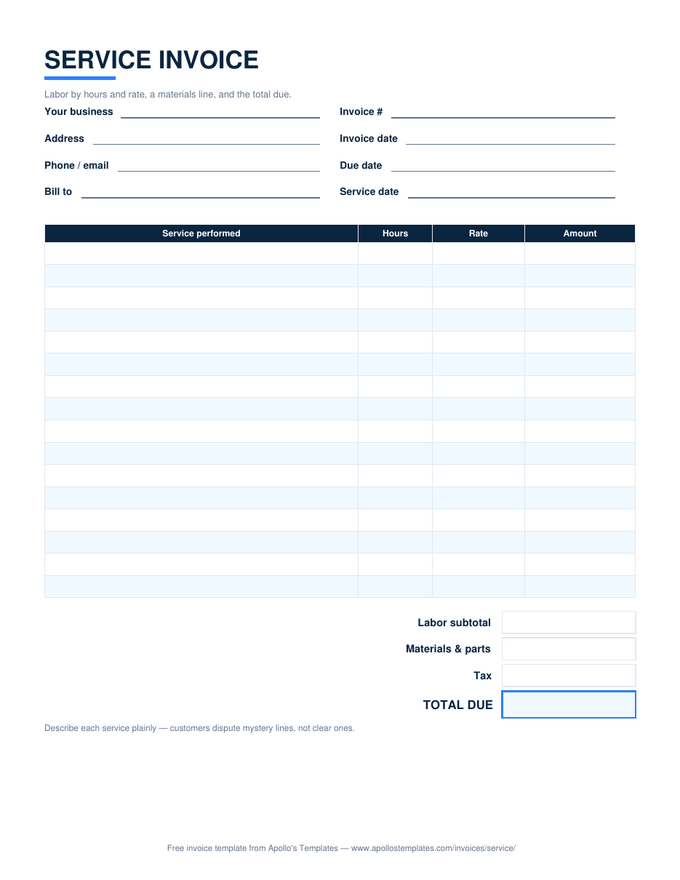
For businesses that sell work rather than things: each labor line carries hours and a rate, a materials row catches the parts you supplied, and the sheet totals it with a tax cell that applies to labor. If you fix, install, clean, tune, or maintain for a living and don't need a full trade-specific sheet, this is the everyday bill.

Three formats

The service bill, however you write it.
Excel — labor math done

Hours-times-rate rows, a materials line, and a tax cell that applies to the labor subtotal — disclosed right on the sheet.
Service invoice with labor rows by hours and rate, a materials line, and a total due box
PDF

Printable PDF

Blank service rows and a summary stack — labor, materials, tax, total — to fill at the kitchen table.
Download PDF

Word (.docx)

The service layout as an editable table for letterhead-style billing.
Worth knowing

Bill while the truck is still warm.

Service invoices age badly. The customer’s memory of the problem fades in about a week — the dead AC, the flooded sink, the gratitude — and with it the willingness to pay promptly. The businesses that get paid fastest invoice the same day, often from the driveway. Everything about this sheet is built to make same-day billing effortless: short fields, few decisions, and math that’s already done.

Photograph the finished work and keep it with the invoice copy. Not for marketing — for the one invoice in fifty that gets questioned three weeks later. “Attached is the invoice and the photo of the completed repair” ends most conversations before they start.

Parts-heavy trades
Auto Repair Invoice
Vehicle block plus separate parts and labor tables.
Open
Bigger jobs, stated markup
Contractor Invoice Template
Labor and materials in separate tables with a markup line.
Open
Paper on the clipboard
Printable Blank Invoices
All nineteen layouts as blank PDFs.
Browse

Frequently asked questions

Should I bill materials with markup or at cost?
Both are legitimate; what matters is that the invoice doesn't hide the choice. This sheet keeps materials as one visible line, so at-cost billing reads honestly. If markup is your policy, the contractor invoice makes it explicit with a stated markup percent — moving a markup silently into a padded materials number is the version clients eventually notice.
Why does the tax only apply to the labor subtotal here?
Because service taxation is the messiest corner of US sales tax — many states don't tax labor, some tax it for certain trades, and materials rules differ again. The sheet computes tax on the labor subtotal and leaves the materials line outside it, with a note saying so; if your state taxes materials, add them as a line item instead. One honest disclosed rule beats fake precision.
How do I describe the work so the invoice gets paid?
Write what changed, not what you did: “Replaced failed pressure valve, tested to spec” beats “plumbing work, 2 hrs.” A client can approve an outcome without understanding your craft. Two or three concrete lines outperform both the one-word invoice and the essay.
What about recurring service — same client, every month?
Save a filled master with everything but dates and amounts, duplicate it per visit, and advance the number. Recurring service billing dies from re-typing, not from math. If the work is visit-based at flat rates, the cleaning invoice's visits-times-rate structure may fit even outside cleaning.
Updated through September 2026