




Apollo's Templates
HomeBusinessInvoice TemplatesSimple
The universal bill

Simple Invoice Template

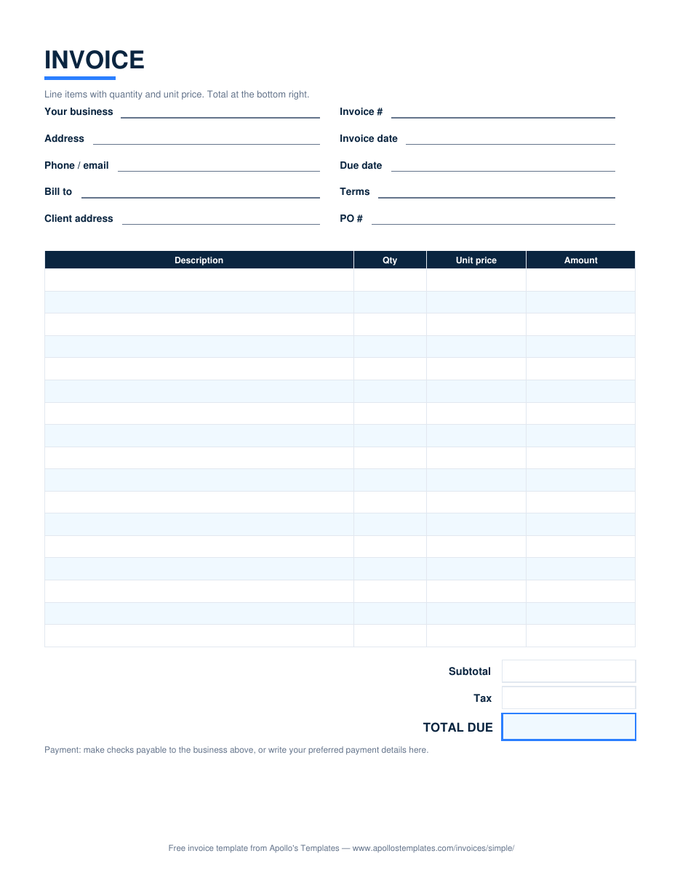
The invoice that fits when nothing fancier is needed: your business, their business, a table of what you sold with quantity and unit price, and a total. The Excel and Google Sheets versions multiply every line, apply the tax rate you set, and keep the total honest; the Word and PDF versions are the same layout for typing or a pen. Most businesses that think they need invoicing software need this sheet and a numbering habit.

Three formats

One layout, four ways to fill it.

Excel — totals compute

Seventeen line rows with guarded qty-times-price math, an editable tax cell, and a total that keeps itself.
Simple invoice with description, quantity, unit price, and amount columns and subtotal, tax, and total boxes
PDF

Printable PDF

The hand-write version: blank rows and write-in subtotal, tax, and total boxes at the bottom right.
Download PDF

Word (.docx)

A clean, brandable table — drop a logo in, save as your master, type the amounts.
Worth knowing

A numbering habit is half the system.

The template handles the document; the discipline that makes it a billing system is the invoice number. Pick a scheme that only counts up — INV-2026-001 onward — and never reuse or backfill a number. Sequential numbers make every conversation shorter (“re: invoice 041”), make gaps visible at tax time, and make you look like a business rather than a favor.

Send the PDF, keep the editable file. Whatever format you fill in, the thing that leaves your hands should be fixed — export from Excel, Sheets, or Word to PDF and attach that. The editable master stays home, becomes next month’s starting point, and quietly accumulates into your revenue record.

Money arrived
Invoice Receipt Template
The companion proof-of-payment with the balance remaining computed.
Open
Billing your time
Hourly Invoice Template
Dated work sessions, hours times rate, total hours computed.
Open
The whole fleet
Excel Invoice Templates
All nineteen invoices with working totals, one page.
Browse

Frequently asked questions

What has to be on an invoice for it to be valid?
In the US there's no statute dictating invoice fields — an invoice is valid when it identifies who is billing whom, for what, for how much, and by when. That's exactly the sheet: both parties' blocks, an invoice number and dates, line items, and the total. Requirements only formalize with VAT-style regimes abroad or specific contracts, and clients with special requirements will tell you.
Invoice, bill, receipt — what's the difference?
An invoice is the request for payment you send; a bill is that same document from the payer's side of the table; a receipt is proof the payment happened. Send this invoice, and once the money lands, issue the companion payment receipt — the pair makes a complete paper trail.
What payment terms should I put in the Terms field?
Net 30 is the convention, Net 15 is common for small business, and Due on receipt is fine for small amounts — the mistake isn't picking the wrong one, it's leaving it blank, because an invoice without terms has no defensible due date. Write the late policy in the payment note too if you have one; a stated policy collects better than a surprise fee.
When do I need something more than the simple invoice?
When your billing has structure this sheet flattens: hours by the day belong on the hourly invoice, labor-plus-materials jobs on the contractor version, and trades like auto repair or plumbing have purpose-built sheets with parts and fee lines. The simple invoice is the right default exactly until one of those shapes appears.
Updated through September 2026