





Credit Reference Letter Templates
A credit reference answers exactly one question \u2014 do they pay, and on what terms \u2014 and answering anything else weakens it. These three letters are written in the register credit departments expect: account tenure, terms extended, high credit, payment behavior, and the customary confidentiality language on the bank version.
Bank, supplier, and customer references.
Each carries the facts a credit file needs and stops there \u2014 the discipline that makes a credit reference usable.
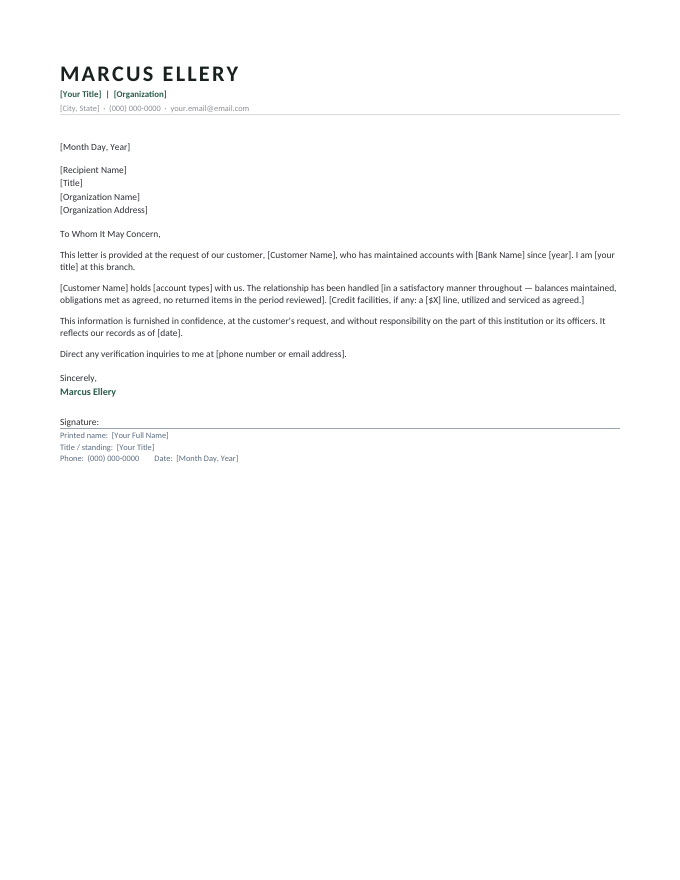
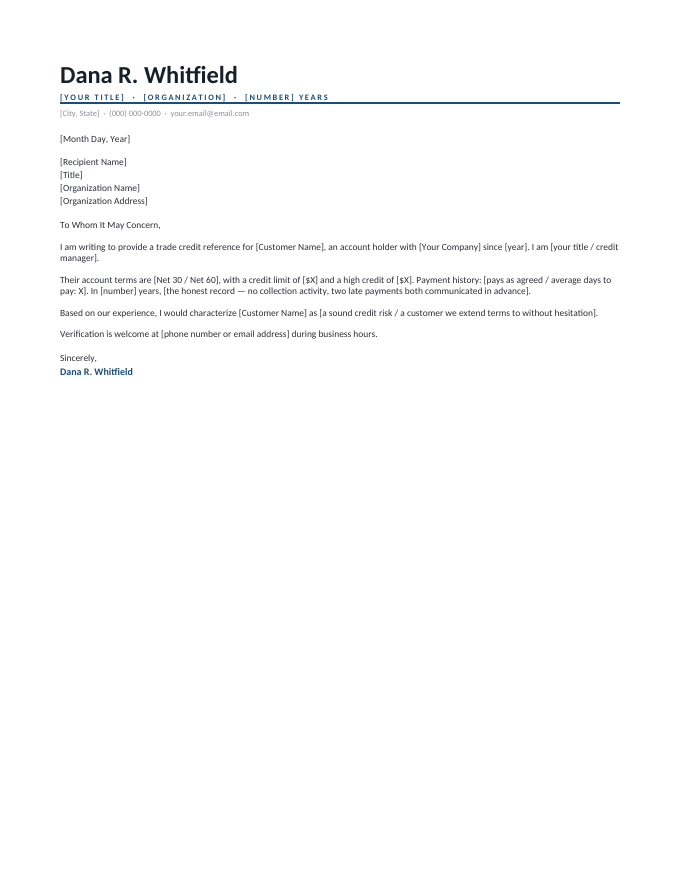
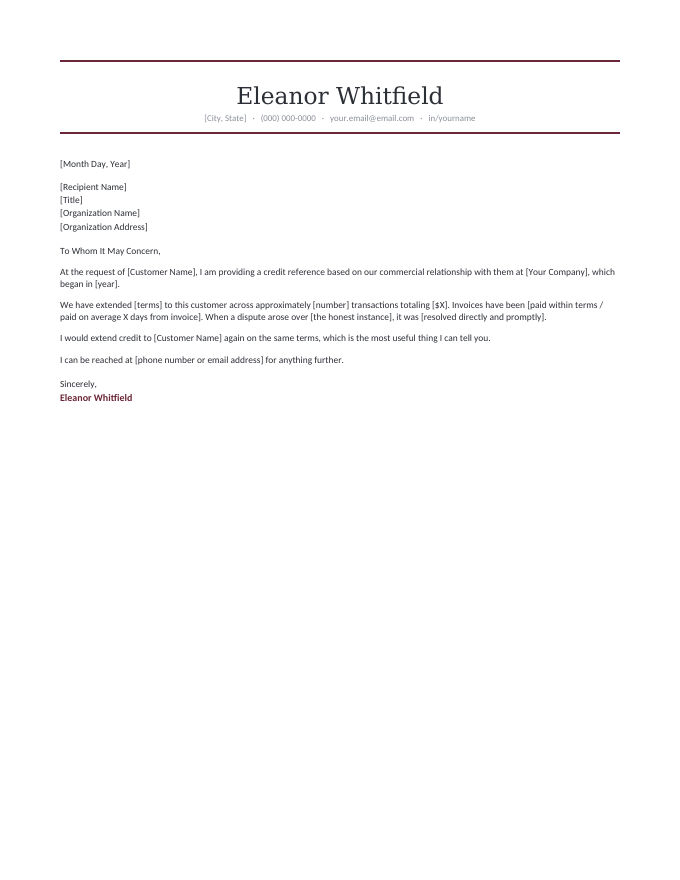
Credit reference letter sample — the letter inside the template.
[Month Day, Year]
[Recipient Name]
[Title]
[Organization Name]
[Organization Address]
To Whom It May Concern,
This letter is provided at the request of our customer, [Customer Name], who has maintained accounts with [Bank Name] since [year]. I am [your title] at this branch.
[Customer Name] holds [account types] with us. The relationship has been handled [in a satisfactory manner throughout — balances maintained, obligations met as agreed, no returned items in the period reviewed]. [Credit facilities, if any: a [$X] line, utilized and serviced as agreed.]
This information is furnished in confidence, at the customer's request, and without responsibility on the part of this institution or its officers. It reflects our records as of [date].
Direct any verification inquiries to me at [phone number or email address].
Sincerely,
Marcus Ellery
Five facts and nothing else.
Credit analysts extract the same five data points from every reference they receive. Give them cleanly and your letter gets used; bury them in prose and it gets set aside:
- How long the account has existed, and what terms apply (Net 30, Net 60).
- Credit limit and high credit — the most they have owed at once.
- Payment behavior — “pays as agreed” or an average days-to-pay figure. Be accurate; this is checkable.
- Any collection activity, stated honestly — omitting it is the one thing that destroys a reference’s value.
Banks conventionally add that the information is furnished in confidence and without responsibility on the institution’s part — that line is on the bank template already.
Three steps.
- Pick the source — bank, supplier, or a company that extends terms.
- Fill the brackets with exact figures from your records, as of a stated date.
- Sign with your title, add a verification line, and return it to the requester or directly to the credit department.
Credit reference FAQ
Who can issue a credit reference?
What does "furnished in confidence and without responsibility" mean?
Should I disclose late payments?
How fast should a credit reference be returned?
What is a credit reference letter sample?
Credit Reference Letter Templates · Updated September 2026
These are writing templates, not legal or financial advice — tenancy, credit, and utility rules vary by state and by the party asking, so confirm what they require. See our disclaimer.