

How to Ask for a Reference Letter
The hardest part of a reference letter usually isn't the letter — it's the ask. Below: exactly how to request one from a supervisor, a professor, or a personal contact, with copy-paste email scripts, the timing rules writers silently expect, and — because it goes both ways — what to send back when you're the one being asked.
Three request scripts.
Each script names the opportunity, states the deadline and destination, offers materials, and — the part people forget — hands the writer a graceful way out. Copy the one that fits and make it yours.
Hi [Name] — I'm applying for [the role / program], and a reference letter from you would carry more weight than anyone else I could ask, since you saw [the project / my work on X] firsthand.
The letter would be due [date] and goes to [portal / email / me directly]. I've attached my current resume, and if it helps, the things most relevant to this application are [one or two specifics].
I know how much lands on your plate, so if the timing doesn't work, absolutely no hard feelings — a quick no helps me plan. And if yes: thank you, truly. Happy to draft talking points or answer anything.
Dear Professor [Name] — I was in your [course] in [term], where I [the thing they'd remember: wrote the paper on X, earned the A, asked too many questions in office hours]. I'm applying to [program / opportunity] and would be honored to have a reference from you.
The deadline is [date], submitted via [portal / email]. I've attached my transcript, resume, and a short note on what the program looks for, in case it's useful to aim the letter.
I understand this season is full of these requests — if your letter-writing list is already long, I completely understand. Either way, thank you for [the course]; it's the reason I'm applying to this.
Hey [Name] — I'm applying for [the apartment / the job / the program] and they ask for a personal reference. You've known me [number] years, which makes you the person whose word actually means something here.
It's about one page, due [date], and I can send you a template with the letter basically written — you'd fill in your details and the stories only you have. Fifteen minutes, honestly.
Zero pressure if it's not your thing — just say so and I'll ask [other name]. But if you're up for it, I'd really appreciate it, and I owe you the beverage of your choice.
Timing, targeting, and the nudge.
Reference requests succeed or fail on things nobody writes down. The people who write letters for a living — professors, principals, managers — all quietly expect the same three courtesies:
- Two weeks, minimum — a month in academic seasons. The deadline you give should be a few days before the real one.
- The right writer over the big title — specifics beat seniority every time; ask the person who actually watched you work.
- Materials with the ask — resume, transcript, two things worth mentioning. You’re not writing the letter for them; you’re making theirs specific.
And the nudge: one, gentle, 4–5 days before the deadline, with the escape hatch attached — “if the timing’s bad, no hard feelings, just let me know by Friday.” It reads as consideration and works better than silence or pressure.
When someone asks you.
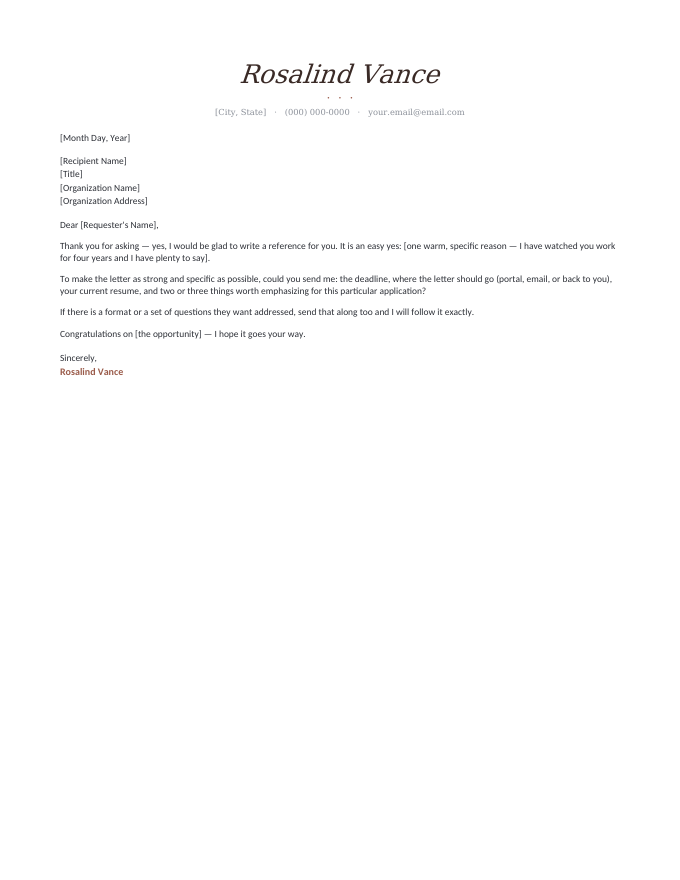
Saying yes: reply warmly, then immediately ask for what good letters are made of — the deadline, the destination, their resume, and what this particular application cares about. Then skip the blank page entirely: every letter in this library is already written, from the professional reference to the friend letter — fill the brackets with what only you know.
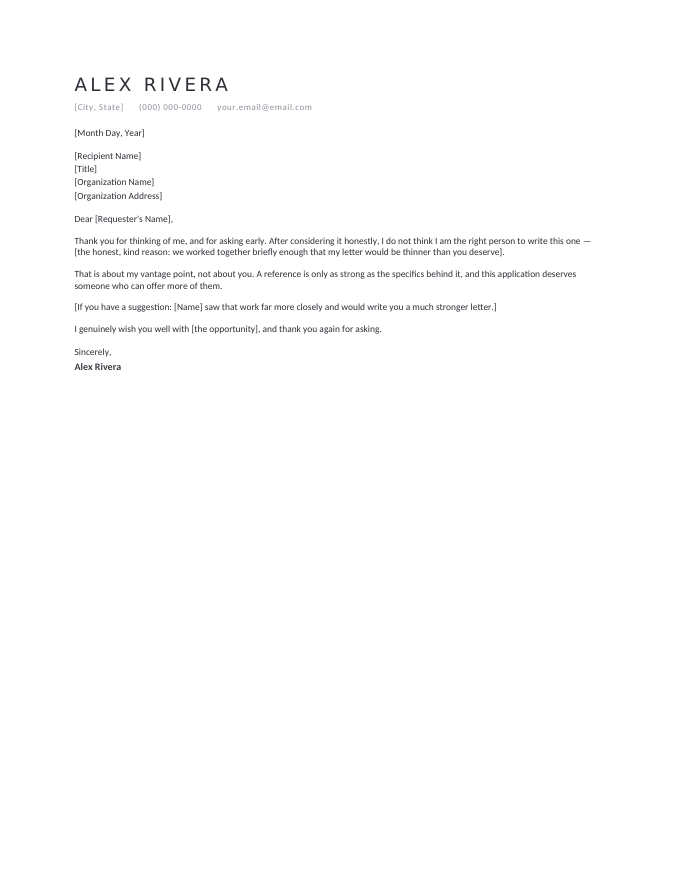
Saying no: do it fast and kindly — “I don’t think I’m positioned to make this as strong as it deserves; [name] saw that work more closely.” A quick, warm no is a professional courtesy. A reluctant yes becomes a lukewarm letter, and lukewarm letters are legible to every reader who matters.
The etiquette FAQ
How far in advance should I ask for a reference letter?
Should I ask in person or by email?
What should I include with my request?
What if someone says no — or just goes quiet?
Someone asked ME for a letter — how do I respond?
How to ask for a reference letter · Updated September 2026