




Reference Letters for a Student
Teachers write more reference letters than anyone \u2014 and the blank page costs the same every time. These three carry complete letters for the student moments that actually recur: the general program or application letter, the first-job letter that translates classroom habits into work evidence, and the selective-program letter that argues trajectory.
The letter for what they are applying to.
Each is written in a teacher's honest voice \u2014 daily evidence, one concrete scene, and a prediction you can stand behind.
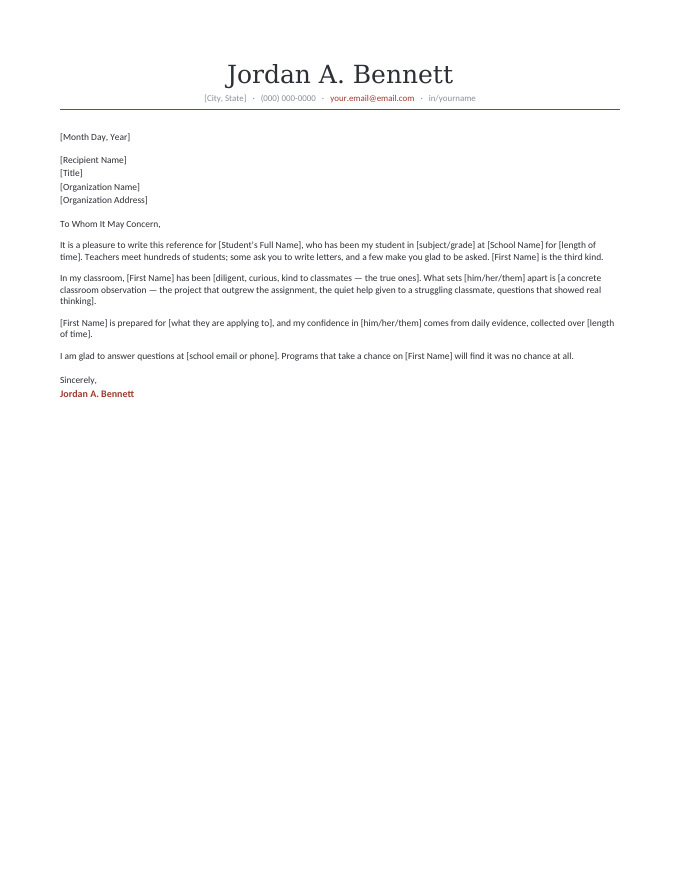
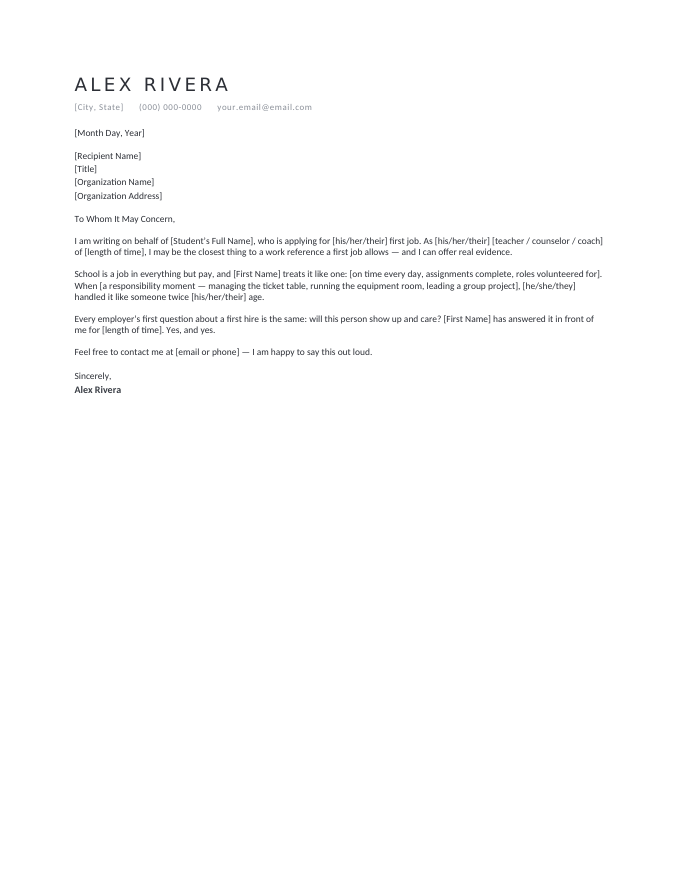
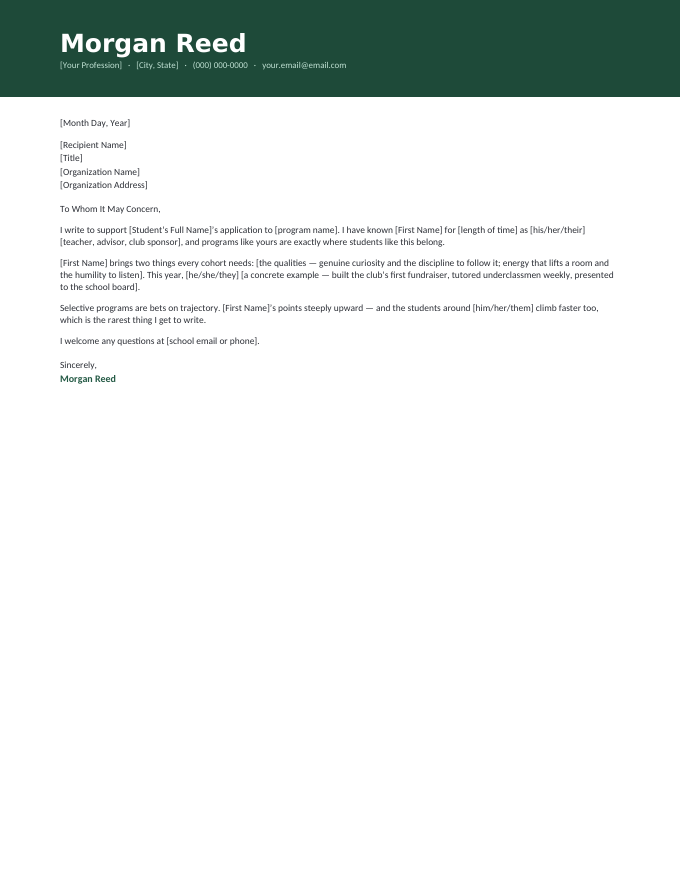
Student reference letter sample — the letter inside the template.
[Month Day, Year]
[Recipient Name]
[Title]
[Organization Name]
[Organization Address]
To Whom It May Concern,
It is a pleasure to write this reference for [Student’s Full Name], who has been my student in [subject/grade] at [School Name] for [length of time]. Teachers meet hundreds of students; some ask you to write letters, and a few make you glad to be asked. [First Name] is the third kind.
In my classroom, [First Name] has been [diligent, curious, kind to classmates — the true ones]. What sets [him/her/them] apart is [a concrete classroom observation — the project that outgrew the assignment, the quiet help given to a struggling classmate, questions that showed real thinking].
[First Name] is prepared for [what they are applying to], and my confidence in [him/her/them] comes from daily evidence, collected over [length of time].
I am glad to answer questions at [school email or phone]. Programs that take a chance on [First Name] will find it was no chance at all.
Sincerely,
Jordan A. Bennett
Evidence a young resume can’t hold.
A student’s application is thin by definition — your letter is where the missing evidence lives. The readers on the other side are looking for three things:
- Daily observation — you see them 180 days a year; the reader gets twenty minutes. Spend your specifics: the project, the question, the moment.
- Work-shaped habits — punctuality, completion, initiative. For first jobs especially, classroom behavior is the only work history there is.
- A real prediction — end with what you believe they’ll do next. Readers trust teachers who commit.
Write from your school email, sign with your role, and keep it to a page — the standing is half the letter.
Twenty minutes between classes.
- Pick the moment — general, first job, or selective program — and download the letter.
- Fill the brackets: [subject/grade], [length of time], and the one classroom scene that proves your point.
- Sign with your title and school contact, save as PDF, and send it where the student directs.
Student reference FAQ
What should a teacher include in a student reference letter?
Can I write a reference for a student applying for their first job?
How is a student reference different from a college recommendation?
What if I barely know the student who asked?
How do I write a reference letter for a student?
Reference Letters for a Student · Updated September 2026