





Reference Letters for a Teacher
Schools hire on evidence of practice \u2014 and the letters that carry weight come from the people who have actually stood in the room: the principal with formal observations behind them, the colleague from the shared hallway, and the office that books the substitutes. Three complete letters, each written from its own authority.
Who saw the teaching, saying so.
The principal's observed record, the colleague's hallway truth, and the sub-coordinator's booking list \u2014 each carries evidence the others can't.
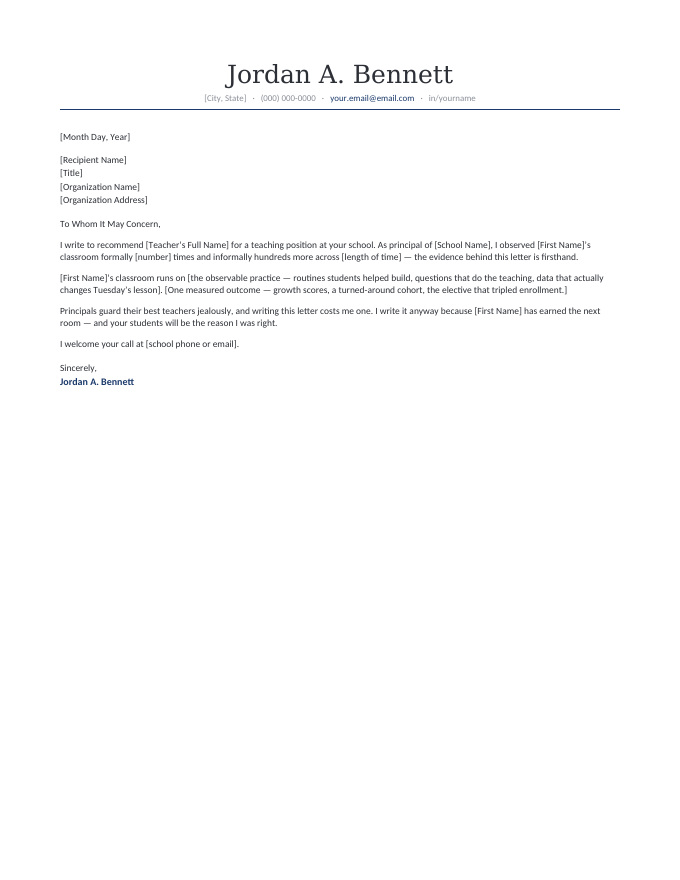
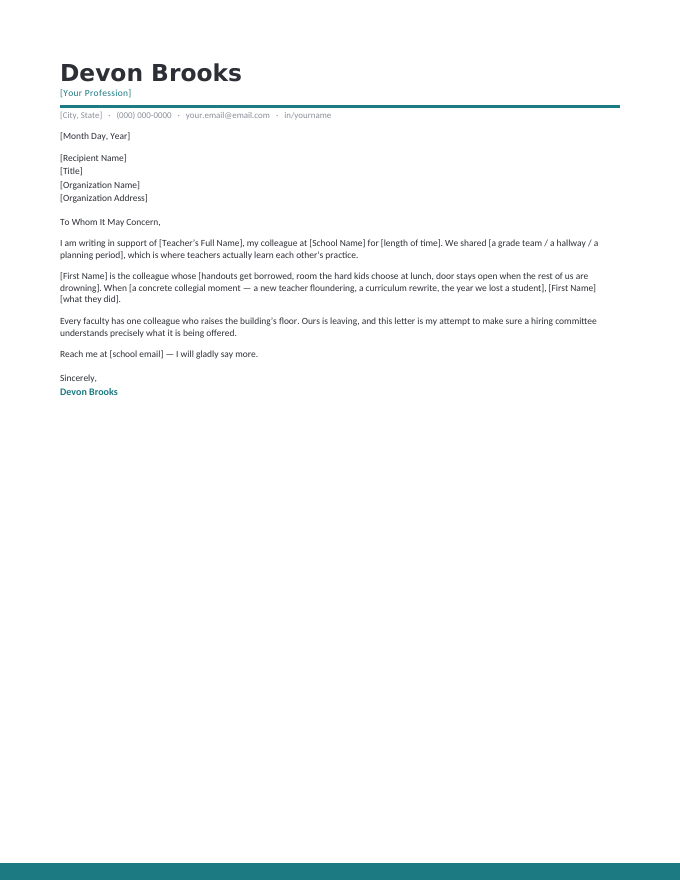
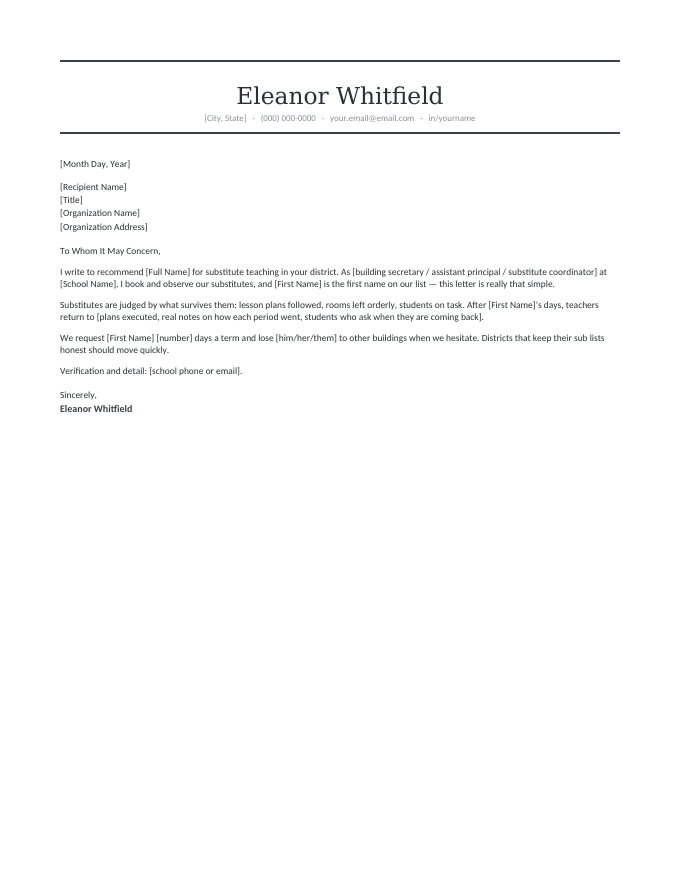
Teacher reference letter sample — the letter inside the template.
[Month Day, Year]
[Recipient Name]
[Title]
[Organization Name]
[Organization Address]
To Whom It May Concern,
I write to recommend [Teacher’s Full Name] for a teaching position at your school. As principal of [School Name], I observed [First Name]’s classroom formally [number] times and informally hundreds more across [length of time] — the evidence behind this letter is firsthand.
[First Name]’s classroom runs on [the observable practice — routines students helped build, questions that do the teaching, data that actually changes Tuesday’s lesson]. [One measured outcome — growth scores, a turned-around cohort, the elective that tripled enrollment.]
Principals guard their best teachers jealously, and writing this letter costs me one. I write it anyway because [First Name] has earned the next room — and your students will be the reason I was right.
I welcome your call at [school phone or email].
Sincerely,
Jordan A. Bennett
Practice, not philosophy.
Teaching applications are full of philosophy statements — reference letters are where committees look for what actually happens in the room. The evidence that lands:
- Observable practice — routines, questioning, how data changes Tuesday’s lesson. Describe the room, not the resume.
- One measured outcome — growth scores, a turned-around cohort, an elective that tripled. Numbers survive committee summarization.
- The cost admission — a principal writing “this letter costs me my best teacher” has said everything; scarcity is the credential.
For substitute letters, precision matters most — districts want reliability signals (requested again, plans followed, rooms steady), and the sub-coordinator’s letter is exactly that record.
Three steps to the file.
- Choose your seat — principal, colleague, or the coordinator’s desk — and download the letter.
- Fill the brackets with observed practice and one measured outcome; for subs, the booking evidence.
- Sign with your role and school contact, and send the PDF to the applicant or the district’s portal.
Teacher reference FAQ
Who should a teacher ask for references?
What makes a substitute-teaching reference different?
Can a colleague's letter really matter next to a principal's?
Should the letter address grade level or subject fit?
How do I write a reference letter for a teacher from a principal?
Reference Letters for a Teacher · Updated September 2026