




College Reference Letter Templates
Admissions readers move through letters in minutes and remember the ones with evidence and a prediction. These three carry that structure for the three academic thresholds: first-time admission, the transfer application with a college record behind it, and graduate study \u2014 where the question shifts from can they learn to can they contribute.
Admission, transfer, and the graduate seminar.
Each is written for its reader \u2014 the admissions officer, the transfer committee, the graduate program weighing research promise.
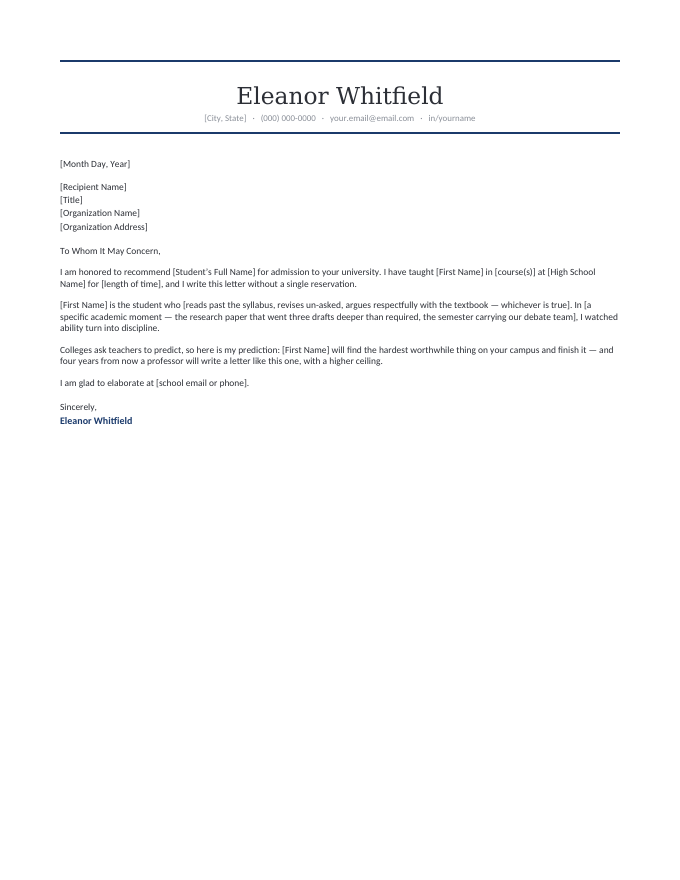
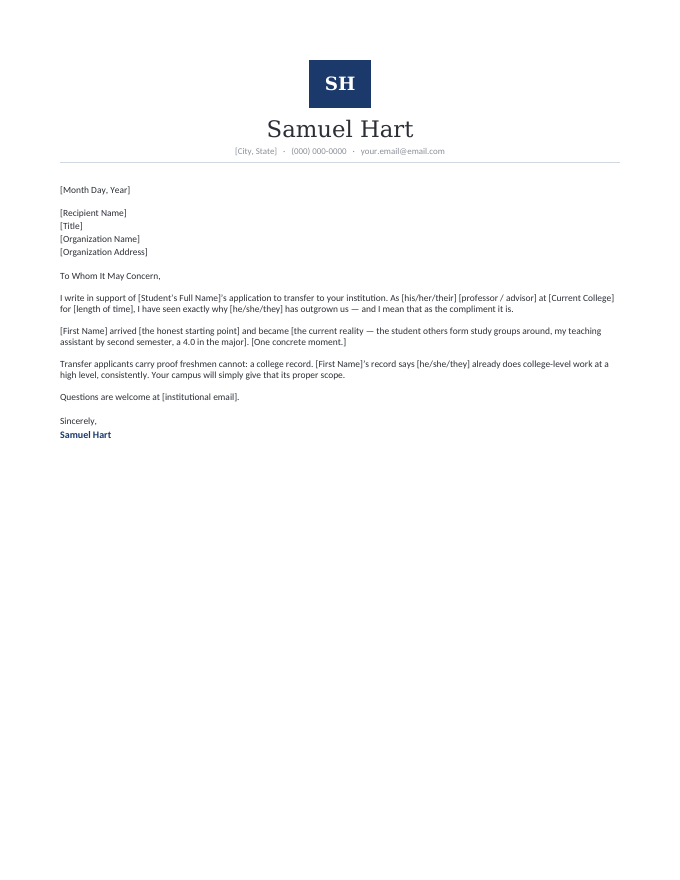
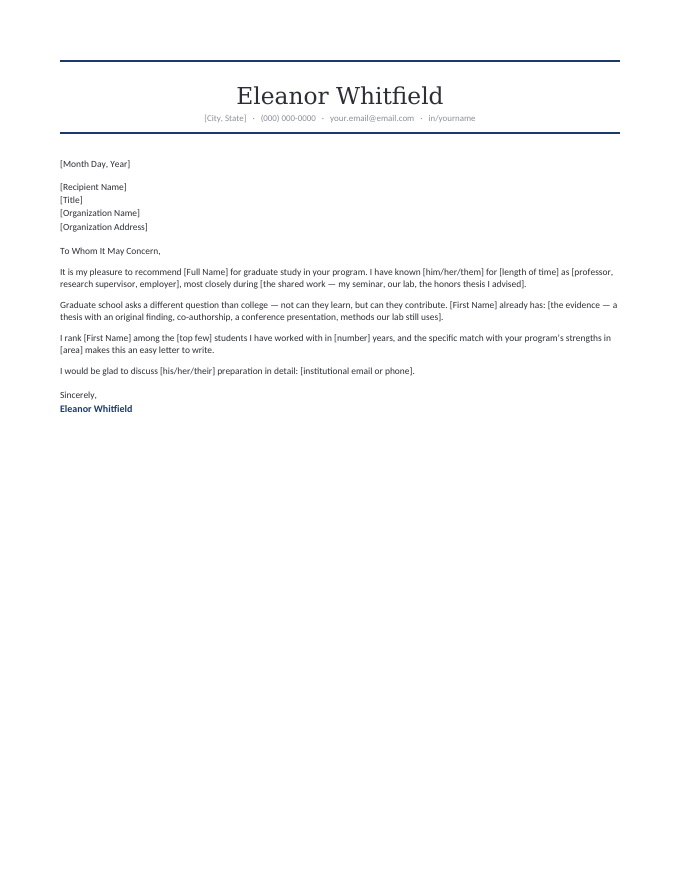
College reference letter sample — the letter inside the template.
[Month Day, Year]
[Recipient Name]
[Title]
[Organization Name]
[Organization Address]
To Whom It May Concern,
I am honored to recommend [Student’s Full Name] for admission to your university. I have taught [First Name] in [course(s)] at [High School Name] for [length of time], and I write this letter without a single reservation.
[First Name] is the student who [reads past the syllabus, revises un-asked, argues respectfully with the textbook — whichever is true]. In [a specific academic moment — the research paper that went three drafts deeper than required, the semester carrying our debate team], I watched ability turn into discipline.
Colleges ask teachers to predict, so here is my prediction: [First Name] will find the hardest worthwhile thing on your campus and finish it — and four years from now a professor will write a letter like this one, with a higher ceiling.
I am glad to elaborate at [school email or phone].
Sincerely,
Eleanor Whitfield
Rank, evidence, predict.
Academic readers are calibration machines — they read thousands of letters and discount inflation automatically. Three habits survive the discounting:
- Comparative ranking — “among the three strongest in fifteen years” is the sentence committees quote to each other. If it’s true, write it.
- Work they can check — the paper, the thesis, the presentation. Named artifacts anchor the praise.
- A specific prediction — what this student will do on their campus. Predictions show you’re spending reputation, not politeness.
Institutional email and title matter here more than anywhere — send from the school address and sign with the full role.
From request to portal upload.
- Choose the threshold — admission, transfer, or graduate — and download the letter.
- Fill the brackets with named work (the course, the paper, the lab) and your honest ranking.
- Export the PDF and upload it where the application directs — most schools use portals with deadlines, so ask the student for theirs.
College letter FAQ
Is this a reference letter or a letter of recommendation?
Who should write a college reference — teacher, counselor, or employer?
What makes a transfer letter different from a freshman one?
How long should an academic reference be?
College Reference Letter Templates · Updated September 2026