





Scholarship Reference Letter Templates
Scholarship committees fund people, not GPAs \u2014 and the letters that move money are the ones showing what the transcript can't: the shifts worked, the Saturdays served, the obstacles that make the record remarkable. Three vantages: the teacher who knows record and person, the community leader who knows the Saturdays, and the employer who knows what happens after the school day ends.
The whole student, from three angles.
Committees weigh need, merit, and character \u2014 each letter leads with the evidence its writer uniquely holds.
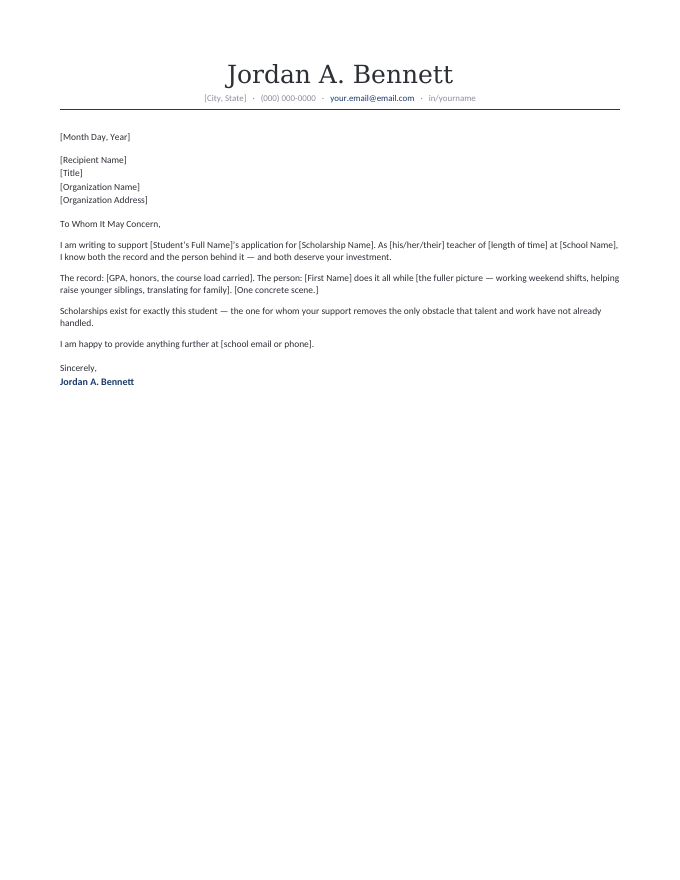
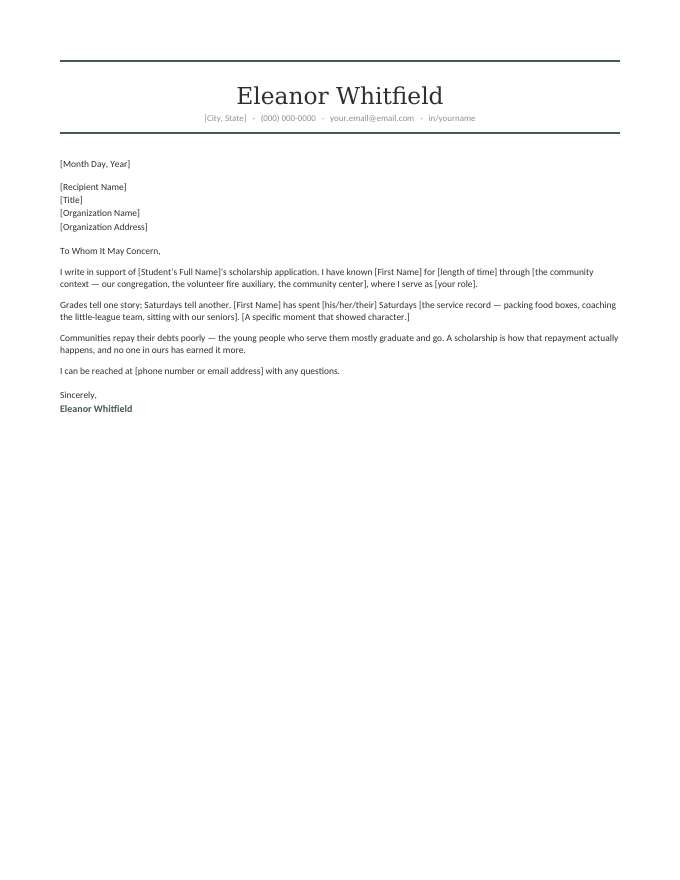
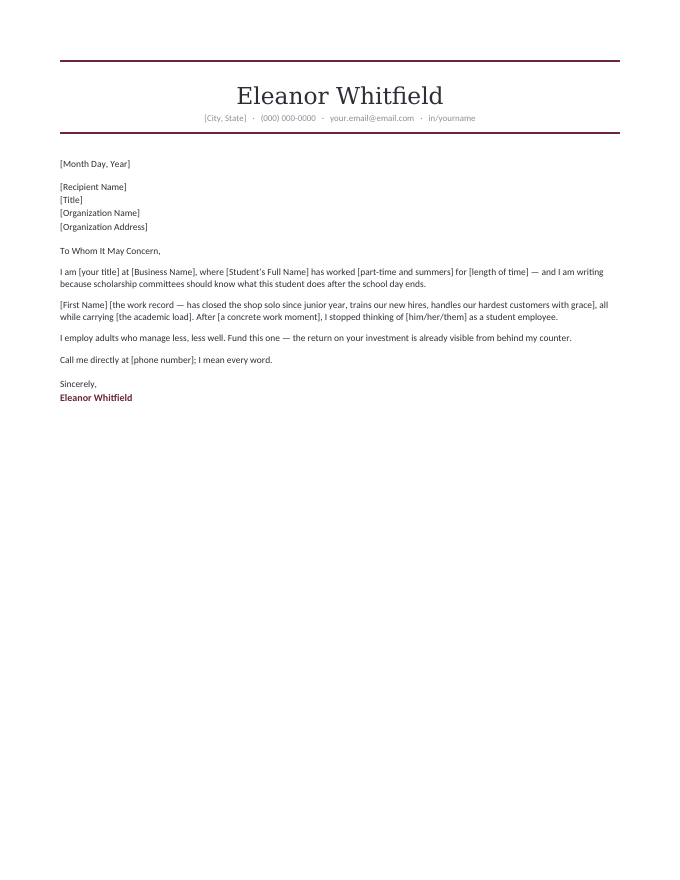
Scholarship reference letter sample — the letter inside the template.
[Month Day, Year]
[Recipient Name]
[Title]
[Organization Name]
[Organization Address]
To Whom It May Concern,
I am writing to support [Student’s Full Name]’s application for [Scholarship Name]. As [his/her/their] teacher of [length of time] at [School Name], I know both the record and the person behind it — and both deserve your investment.
The record: [GPA, honors, the course load carried]. The person: [First Name] does it all while [the fuller picture — working weekend shifts, helping raise younger siblings, translating for family]. [One concrete scene.]
Scholarships exist for exactly this student — the one for whom your support removes the only obstacle that talent and work have not already handled.
I am happy to provide anything further at [school email or phone].
Sincerely,
Jordan A. Bennett
Context is the argument.
Every applicant folder has grades and activities — your letter’s job is the context that makes them mean something. The letters above are built on three context moves:
- The against-what — achievements alongside hours worked, family carried, obstacles cleared. Same GPA, different story.
- Money’s specific job — name what the award actually unlocks: the first semester, the unbought laptop, the shifts not worked.
- Return on investment — committees are investors; tell them what funding this particular student buys the world.
Check the scholarship’s criteria before writing — need-based, merit, field-specific — and aim your evidence at the stated mission; committees notice when a letter read their instructions.
Three steps before the deadline.
- Pick your vantage — teacher, community, or employer — and download the letter.
- Fill the brackets with the record, the against-what, and one scene; name the scholarship where prompted.
- Sign with your role and contact, PDF it, and submit it the way the scholarship directs — many use portals with hard deadlines.
Scholarship letter FAQ
Who makes the strongest scholarship reference?
Should the letter mention financial need?
Can an employer really write a scholarship letter?
How specific should I get about the scholarship itself?
Scholarship Reference Letter Templates · Updated September 2026