





How to Write a Reference Letter
A reference letter has four paragraphs and one rule: one story beats ten adjectives. This guide gives you the paragraphs, the rule, the format, the length, and what changes when the reader is a judge, an immigration officer, a landlord, or an admissions committee — plus a complete sample you can copy and three templates with the letter already inside. Call it a letter of reference if your form does; it's the same document.
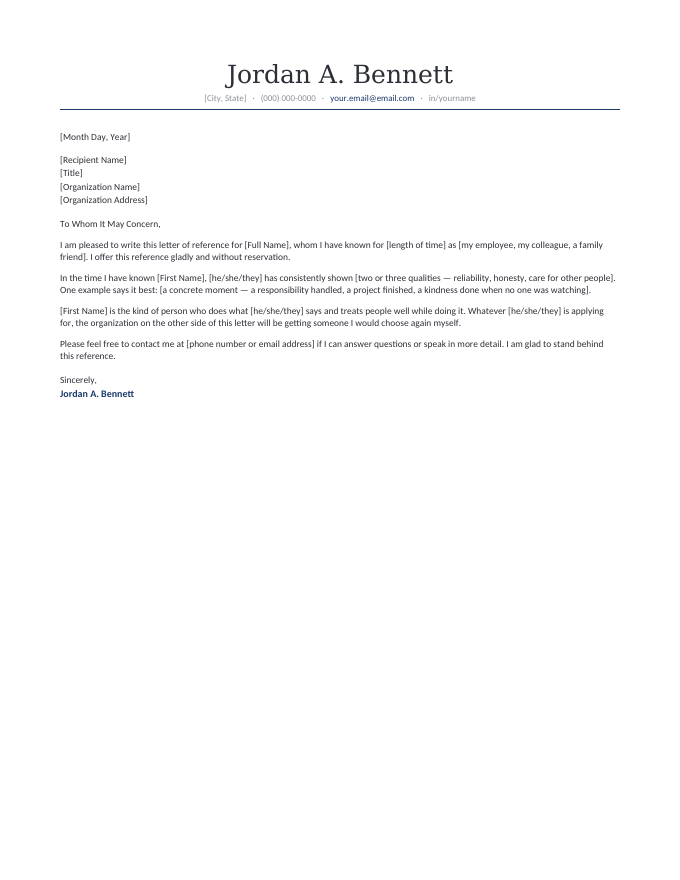
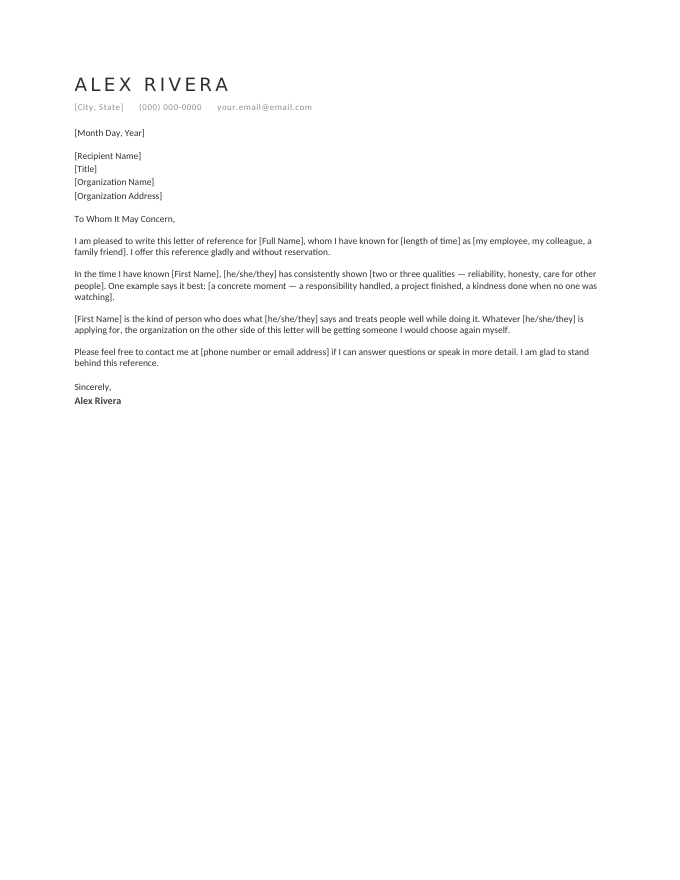
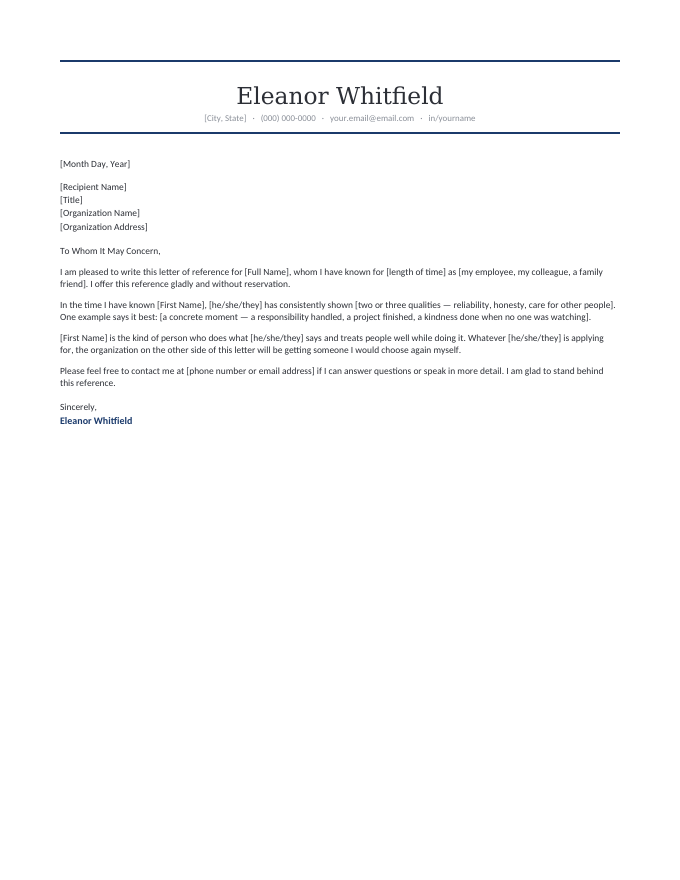
Three templates with the general letter already written.
Every rule below is already applied inside these. Copy one to Google Docs or download the Word file and you are editing a correct letter, not writing one.
What a reference letter is — and how it differs from a recommendation.
A reference letter vouches for a person: who they are, how you know them, what you’ve seen them do, and whether you’d stand behind them. It’s usually general — ’To Whom It May Concern’ — and portable, used for jobs, apartments, courts, immigration, adoptions, scholarships. A recommendation letter is the same instrument aimed at one specific job or program and addressed to it. Employers and landlords ask for references; schools ask for recommendations. Call it a ’letter of reference’ or a ’reference letter’; readers treat them as the same document.
The reader is checking a claim the person has already made about themselves. Your letter works when it gives them something they can’t get from the application: a firsthand account.
Format: the four paragraphs every reference letter has.
Every sample on the examples page follows the same skeleton. It’s the format.
- Who you are and how you know them. Name, title, relationship, and how long — in the first two sentences. ’I supervised [Name] for three years as [title] at [company]’ or ’I have been [Name]’s neighbor for eleven years.’ The reader weighs everything else by this.
- The qualities, each with a story. Two or three, chosen for what the reader needs — reliability for a job, judgment for a court, steadiness for a landlord. Each one backed by something you saw: a project finished, a driveway cleared all winter, a shift covered. One story beats ten adjectives.
- The judgment. One sentence that says what all of it adds up to: ’I would hire [Name] again without hesitation,’ ’I would rent to them again,’ ’I trust them completely with my children.’ This is the line the reader is looking for.
- The contact offer. ’Please contact me at [phone or email] if I can answer questions.’ Sign it, date it, add your title.
Layout
Business letter: your name and contact at the top, the date, the recipient (or ’To Whom It May Concern’), three or four paragraphs, ’Sincerely,’ your name and title. One page, 11–12 pt. Letterhead if you’re writing in a professional capacity. Every template on this site is that layout with the letter already inside.
The three things readers trust — and the three they discount.
Readers of reference letters — HR, landlords, judges, immigration officers, scholarship committees — have read hundreds. They trust:
- Specifics. Dates, numbers, names of projects, scenes you witnessed. ’He organized the department’s records after the fire’ is evidence; ’he is organized’ is a claim.
- Proportion. A letter that admits a limit (’I haven’t seen her manage a team, but…’) reads as honest and makes the praise believable.
- Fit. Qualities matched to what the reader needs. A court letter that discusses work ethic misses; one that discusses judgment and accountability lands.
They discount: superlatives without evidence (’the best employee I’ve ever had’), letters that could be about anyone, and anything that argues with the reader — disputing a charge, lecturing a landlord, telling a committee what to decide.
Length
One page. 250–400 words. Court, immigration, and academic letters can run to a full page; a rental or employment reference is often half. If you’re over a page, cut the adjectives, not the stories.
When the situation changes the letter.
The four paragraphs hold everywhere, but some readers have specific expectations, and the collection pages carry letters written for each:
- Court. Address the judge, acknowledge the charge in one sentence, never argue the case, describe the change since — and send it through the defense attorney.
- Immigration. Firsthand scenes over praise, an affirmation that the statements are true, your signature and contact details; letterhead helps.
- Housing. Facts from records — dates, rent, payment history, condition, deposit — and ’I would rent to them again.’
- Employment. Title, dates, responsibilities, one measurable result, how they worked with others, and rehire language.
- School and scholarship. What you taught them, evidence of growth and engagement, and why the investment will land.
- Family and friends. Declare the relationship up front; readers discount undisclosed bias but credit disclosed knowledge.
A complete reference letter, annotated by the four paragraphs.
[Month Day, Year]
[Recipient Name]
[Title]
[Organization Name]
[Organization Address]
To Whom It May Concern,
I am pleased to write this letter of reference for [Full Name], whom I have known for [length of time] as [my employee, my colleague, a family friend]. I offer this reference gladly and without reservation.
In the time I have known [First Name], [he/she/they] has consistently shown [two or three qualities — reliability, honesty, care for other people]. One example says it best: [a concrete moment — a responsibility handled, a project finished, a kindness done when no one was watching].
[First Name] is the kind of person who does what [he/she/they] says and treats people well while doing it. Whatever [he/she/they] is applying for, the organization on the other side of this letter will be getting someone I would choose again myself.
Please feel free to contact me at [phone number or email address] if I can answer questions or speak in more detail. I am glad to stand behind this reference.
Sincerely,
Jordan A. Bennett
Reference letter FAQ
How do I write a reference letter?
What should a reference letter include?
How long should a reference letter be?
What is the format of a reference letter?
How do I write a reference letter for someone I don't know well?
What is a neutral reference letter?
Can a family member write a reference letter?
What's the difference between a reference letter and a recommendation letter?
How to write a reference letter · Updated September 2026
This guide describes how reference letters are commonly written; it is not legal advice. For a court, immigration, or other legal matter, follow the attorney handling it. See our disclaimer.