





Character Reference Letters for Court
A court character letter is read by a judge who has seen thousands \u2014 and discards the ones that minimize the offense or lecture the bench. These three templates hold the tone courts actually credit: aware of the matter, honest about the person, specific about what you have seen. General, pre-sentencing, and first-offense versions, each addressed properly to the court.
Written for how judges actually read.
Every version acknowledges the case, establishes your standing, and offers concrete observation \u2014 the three things a court letter must do before anything else it says can matter. Six moments in all: the general letter, sentencing, a first offense, a DUI, an expungement petition, and a parole board.
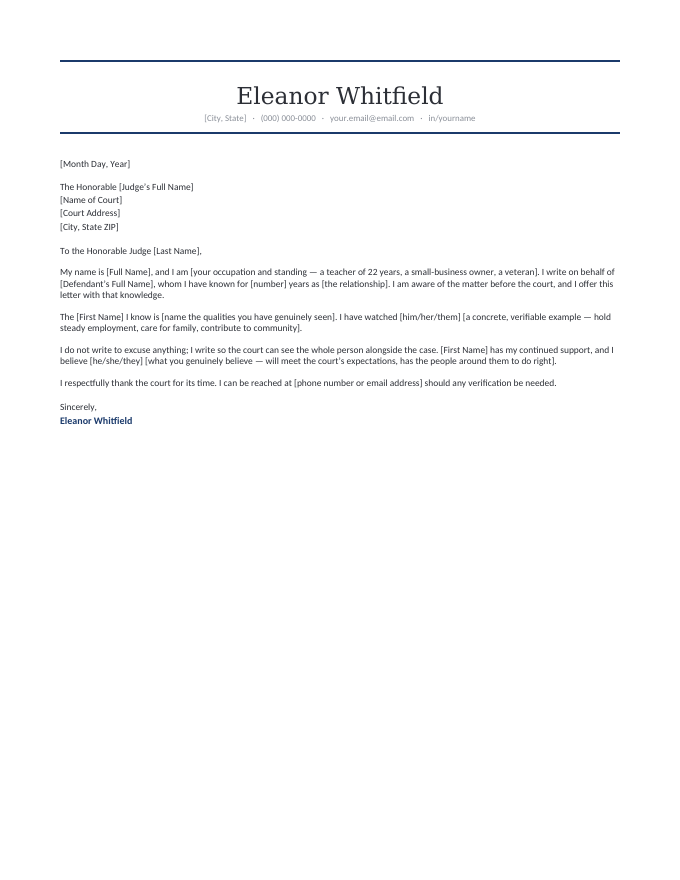
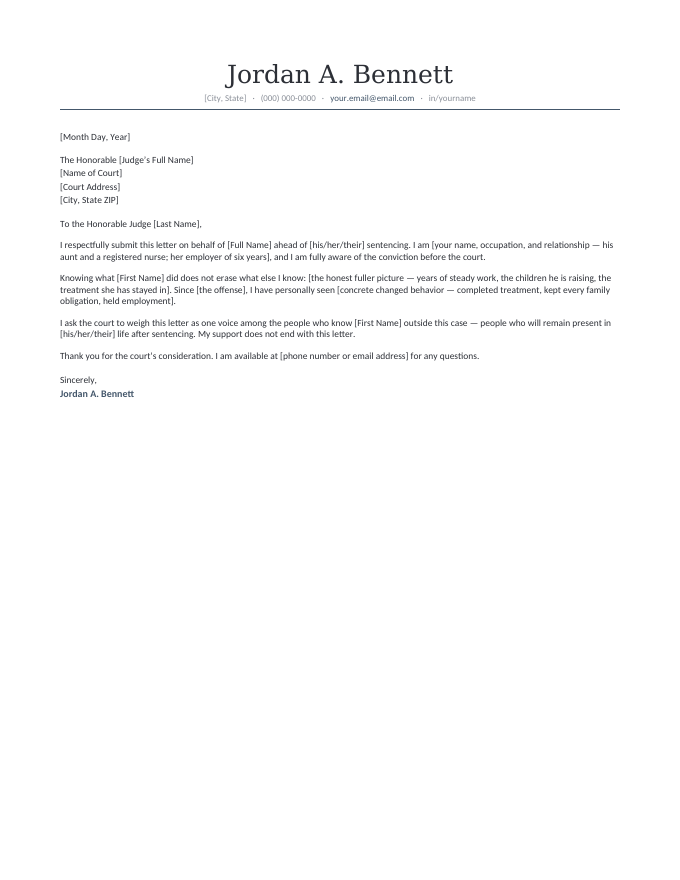
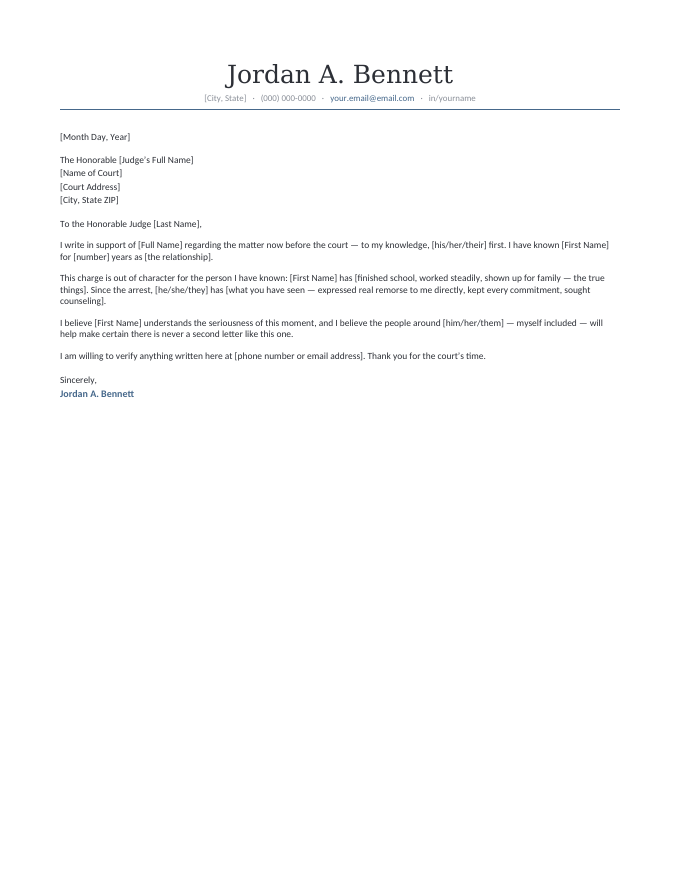

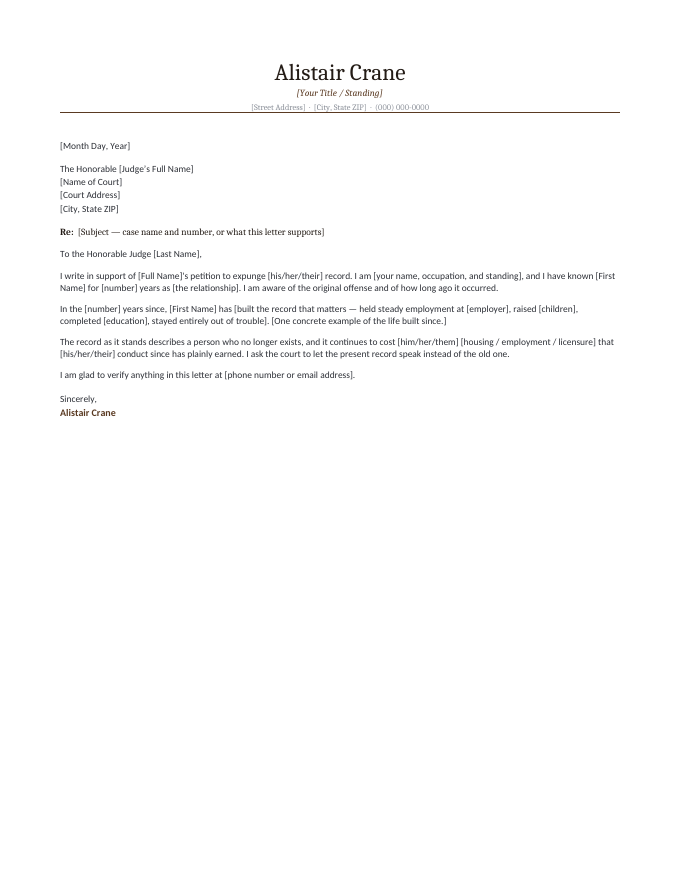
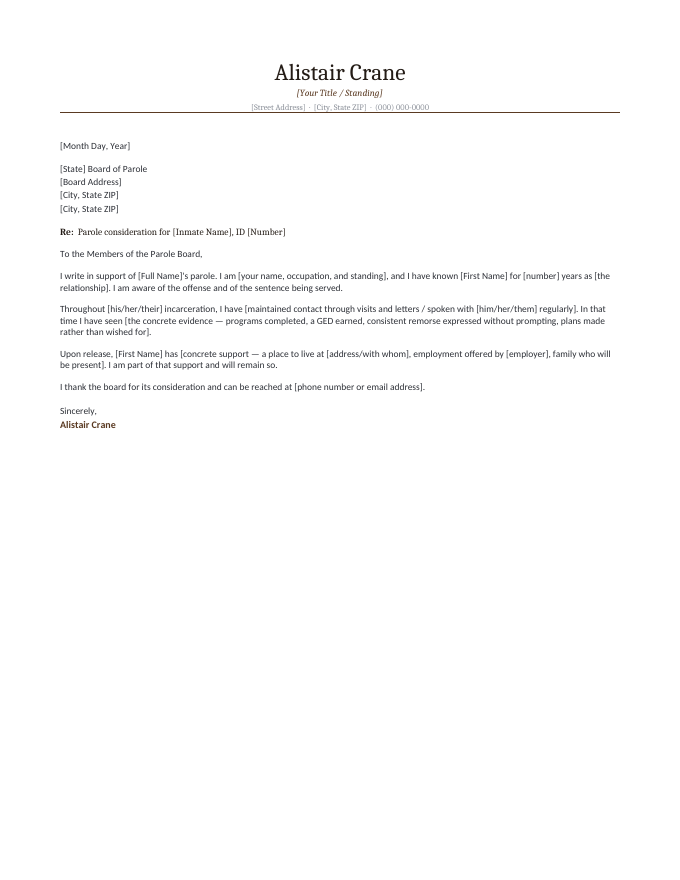
Court reference letter sample — the letter inside the template.
[Month Day, Year]
The Honorable [Judge’s Full Name]
[Name of Court]
[Court Address]
[City, State ZIP]
To the Honorable Judge [Last Name],
My name is [Full Name], and I am [your occupation and standing — a teacher of 22 years, a small-business owner, a veteran]. I write on behalf of [Defendant’s Full Name], whom I have known for [number] years as [the relationship]. I am aware of the matter before the court, and I offer this letter with that knowledge.
The [First Name] I know is [name the qualities you have genuinely seen]. I have watched [him/her/them] [a concrete, verifiable example — hold steady employment, care for family, contribute to community].
I do not write to excuse anything; I write so the court can see the whole person alongside the case. [First Name] has my continued support, and I believe [he/she/they] [what you genuinely believe — will meet the court’s expectations, has the people around them to do right].
I respectfully thank the court for its time. I can be reached at [phone number or email address] should any verification be needed.
Sincerely,
Eleanor Whitfield
Acknowledge, then testify.
Judges read character letters for one thing: information about the person that the case file can’t contain. The letters that get weight share three habits — and the ones that backfire share three mistakes:
- Acknowledge the offense plainly — a letter pretending the case doesn’t exist tells the judge the writer is either uninformed or unserious.
- Establish your standing — occupation, years known, capacity. Judges weigh the witness before the testimony.
- Never argue the law — suggesting the sentence, disputing the facts, or criticizing the process gets letters set aside entirely.
Route the finished letter through the defense attorney rather than mailing it to the courthouse — counsel knows the deadline, the format the court prefers, and whether your letter helps the strategy.
From template to the attorney's hands.
- Download the version that fits the moment — general, sentencing, or first offense.
- Fill the brackets honestly: your standing, the years known, and only observations you could repeat under oath.
- Sign and date it, then send it to the defense attorney — they submit it to the court correctly and on time.
Court character letter FAQ
How do I address a character letter to a judge?
Should I mention the crime in the letter?
Who makes the best character witness for court?
Does the letter need to be notarized or sworn?
What does a judge look for in a character reference letter?
What should I not put in a character letter for court?
Is there a sample character reference letter for court in Word or PDF?
Character Reference Letters for Court · Updated September 2026
These are writing templates, not legal advice — for questions about your specific matter, ask the attorney or professional handling it. See our disclaimer.