





Character Reference Letter for Court From a Family Member
Judges know a family letter is partial, and they read it anyway — for the one thing only family can provide: a lifetime of firsthand knowledge. The three letters here, from a parent, a sibling, and a spouse, use that honestly: they acknowledge the charge, tell one or two specific scenes from the person's life, describe what has changed since the arrest, and ask the Court respectfully. No excuses, no arguing the case. Printed in full below, free in Word and Google Docs.
Parent, sibling, spouse — each with the credibility a family letter needs.
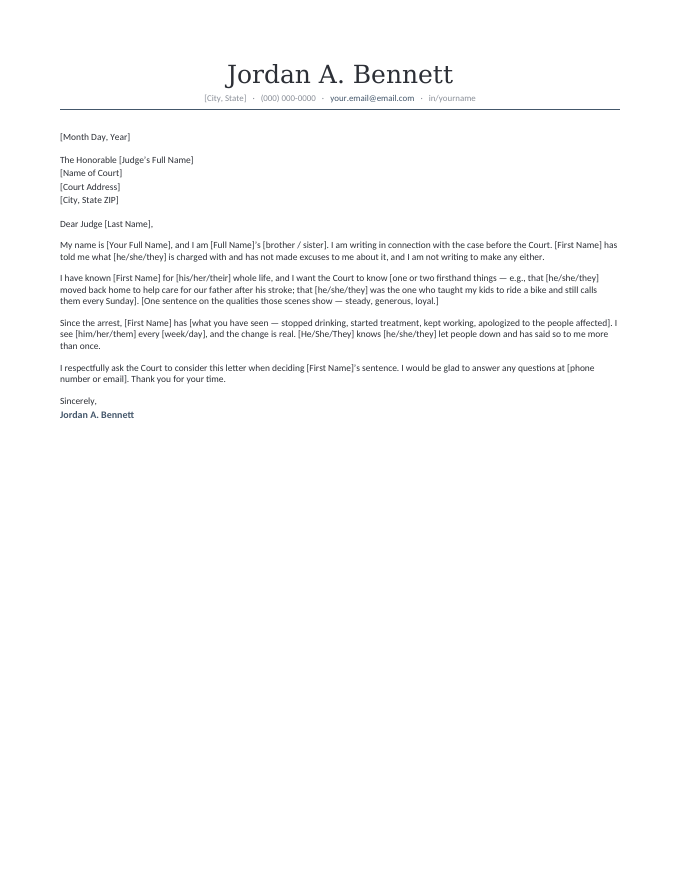
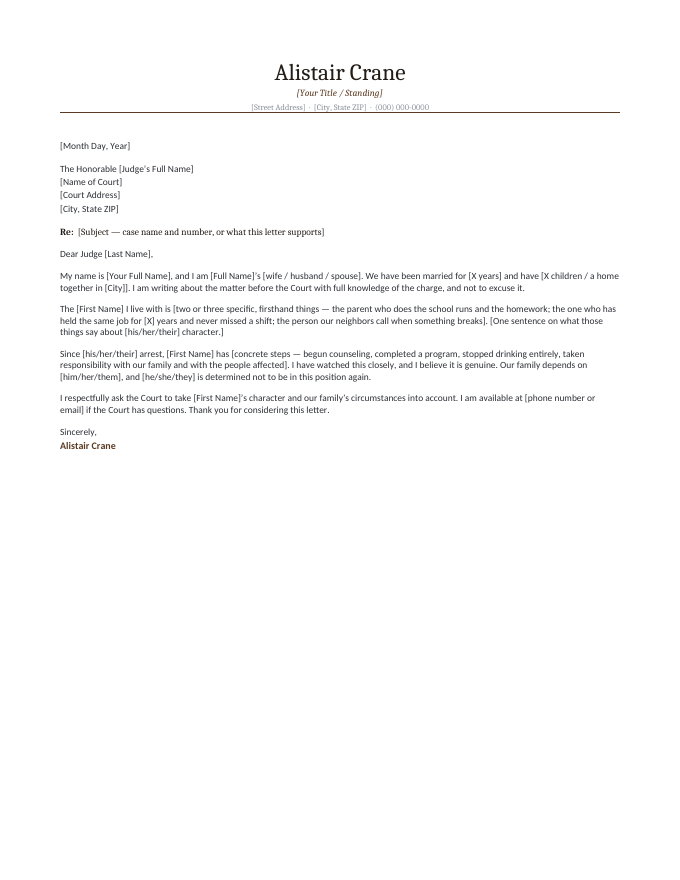
Every version acknowledges the charge in one sentence and spends the rest on what only family has seen. Navy, steel, and filing letterheads.
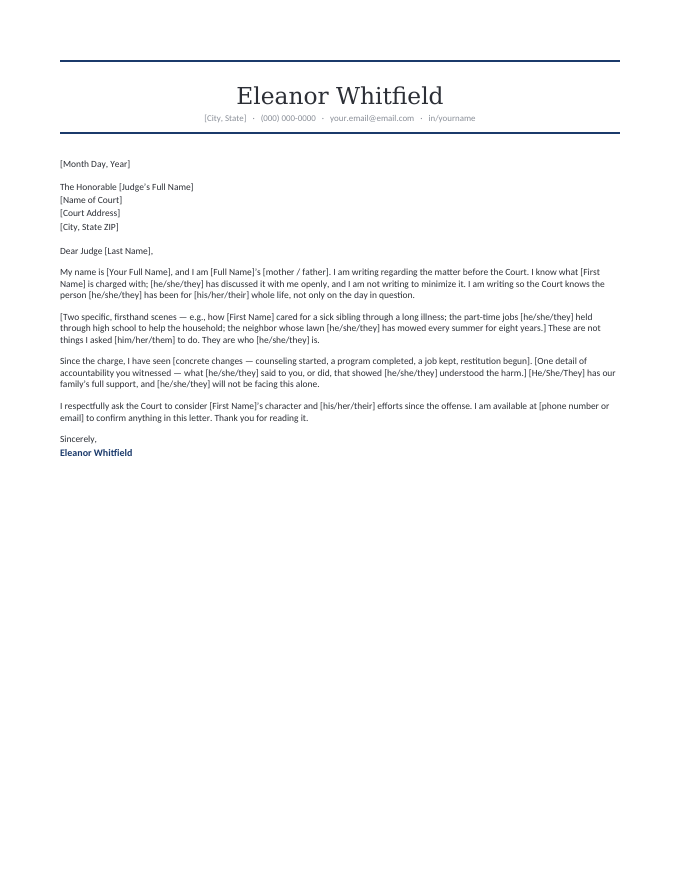
A parent's character letter to the judge, in full.
[Month Day, Year]
The Honorable [Judge’s Full Name]
[Name of Court]
[Court Address]
[City, State ZIP]
Dear Judge [Last Name],
My name is [Your Full Name], and I am [Full Name]’s [mother / father]. I am writing regarding the matter before the Court. I know what [First Name] is charged with; [he/she/they] has discussed it with me openly, and I am not writing to minimize it. I am writing so the Court knows the person [he/she/they] has been for [his/her/their] whole life, not only on the day in question.
[Two specific, firsthand scenes — e.g., how [First Name] cared for a sick sibling through a long illness; the part-time jobs [he/she/they] held through high school to help the household; the neighbor whose lawn [he/she/they] has mowed every summer for eight years.] These are not things I asked [him/her/them] to do. They are who [he/she/they] is.
Since the charge, I have seen [concrete changes — counseling started, a program completed, a job kept, restitution begun]. [One detail of accountability you witnessed — what [he/she/they] said to you, or did, that showed [he/she/they] understood the harm.] [He/She/They] has our family’s full support, and [he/she/they] will not be facing this alone.
I respectfully ask the Court to consider [First Name]’s character and [his/her/their] efforts since the offense. I am available at [phone number or email] to confirm anything in this letter. Thank you for reading it.
Sincerely,
Eleanor Whitfield
How to write a character letter for court as a family member.
A judge discounts a family letter for bias — unless it earns credibility in four ways:
- Acknowledge the charge, once. ’I know what my son is charged with, and I am not writing to minimize it.’ Without this sentence the letter is dismissed as blind loyalty.
- Give a lifetime, in two scenes. The years caring for a sick parent; the part-time jobs through school; the neighbor’s lawn mowed every summer. Specific, dated, and things you saw.
- Show accountability you witnessed. What they said to you after the arrest, the program they entered, the job they kept, the restitution begun.
- Ask respectfully and offer contact. ’I respectfully ask the Court to consider…’ and a phone number. Never suggest a sentence.
Give the letter to the defense attorney, who submits it with the sentencing packet. For a DUI specifically, the DUI page has a family version written for that charge; for custody cases, the child custody page covers family court; the court hub has the friend, employer, and formal letters.
From download to signed letter.
- Download the letter for your relationship — parent, sibling, or spouse — and open it in Word or Google Docs.
- Fill the brackets with two firsthand scenes and the specific steps since the arrest. Keep the acknowledgment of the charge; it’s what makes the letter credible.
- Sign and date it, add your phone number, and give it to the defense attorney.
Family Member reference FAQ
Can a family member write a character letter for court?
How do I write a character letter for my brother or sister for court?
How do I write a character letter for court as a mother or father?
Can a wife or husband write a character letter for court?
Should a family letter mention the charge?
Where do I send the letter?
Family Member reference letter sample & templates · Updated September 2026
These are writing templates, not legal advice — for questions about your specific matter, ask the attorney or professional handling it. See our disclaimer.