





Child Custody Reference Letters
In a custody matter the court's only question is the child's wellbeing \u2014 and the letters that help are the ones written by people who have actually watched the parent and child together, often and recently. Three vantages: the family friend inside the home, the neighbor with the daily view, and the professional who sees many families and can rank what they see.
The views a family court can use.
Each letter leads with how often and how recently you see the parent and child together \u2014 the credential that matters most in a custody letter.
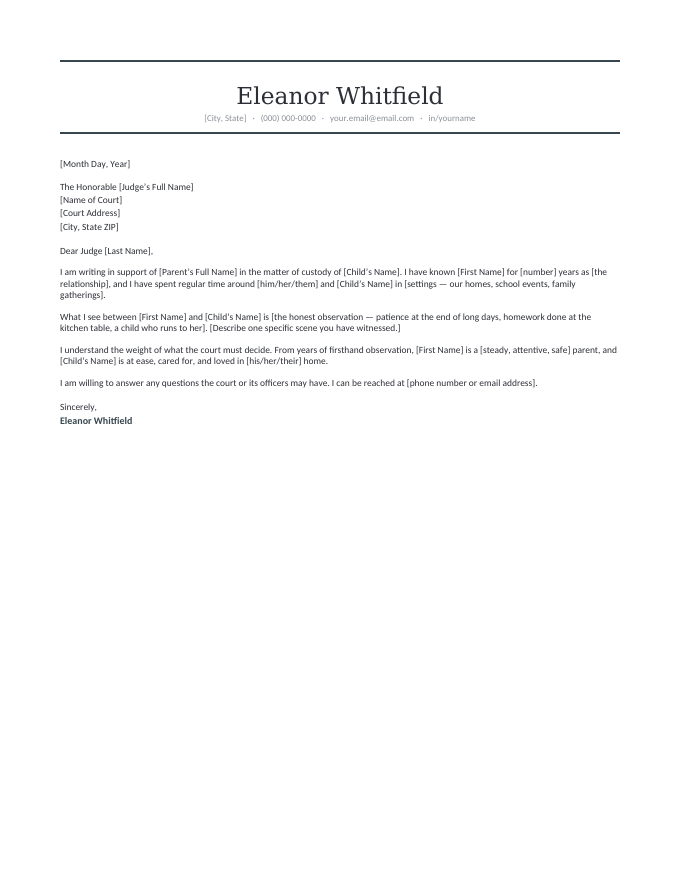
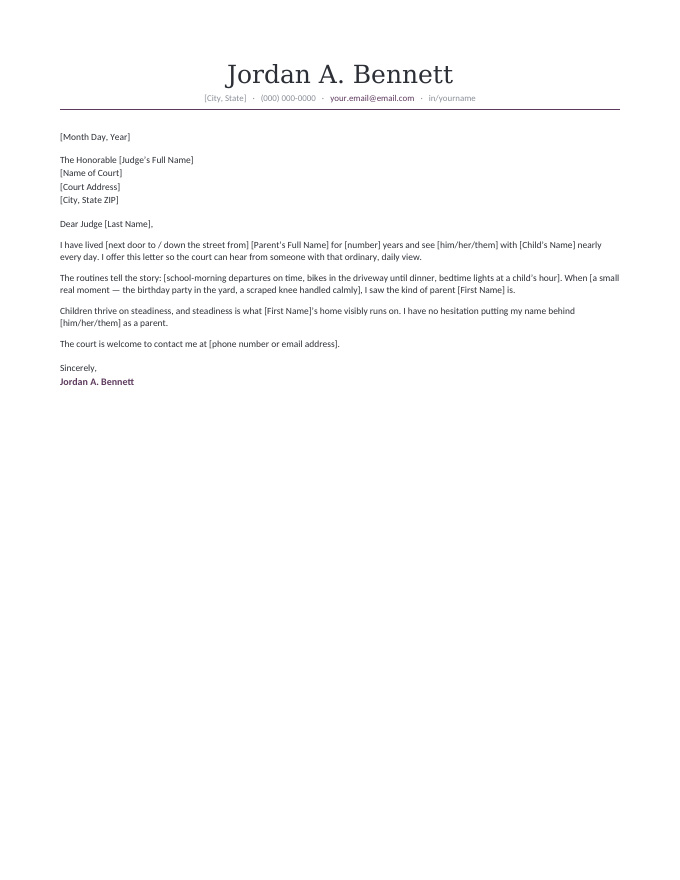
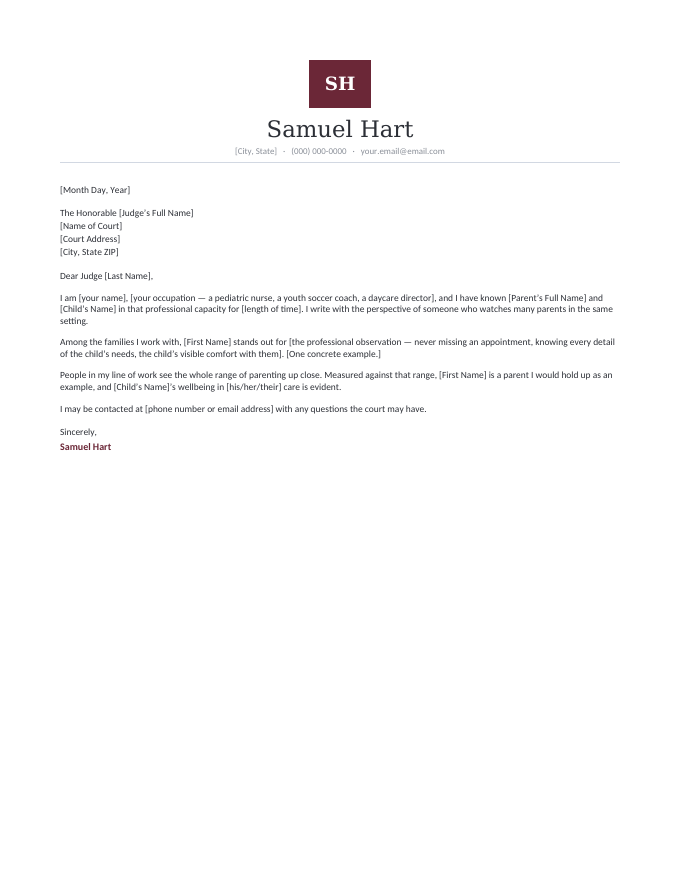
Child custody reference letter sample — the letter inside the template.
[Month Day, Year]
The Honorable [Judge’s Full Name]
[Name of Court]
[Court Address]
[City, State ZIP]
Dear Judge [Last Name],
I am writing in support of [Parent’s Full Name] in the matter of custody of [Child’s Name]. I have known [First Name] for [number] years as [the relationship], and I have spent regular time around [him/her/them] and [Child’s Name] in [settings — our homes, school events, family gatherings].
What I see between [First Name] and [Child’s Name] is [the honest observation — patience at the end of long days, homework done at the kitchen table, a child who runs to her]. [Describe one specific scene you have witnessed.]
I understand the weight of what the court must decide. From years of firsthand observation, [First Name] is a [steady, attentive, safe] parent, and [Child’s Name] is at ease, cared for, and loved in [his/her/their] home.
I am willing to answer any questions the court or its officers may have. I can be reached at [phone number or email address].
Sincerely,
Eleanor Whitfield
The child is the subject, not the parent.
Custody letters go wrong when they become testimonials about the parent’s virtues — or worse, attacks on the other parent. Courts read for something narrower and more useful:
- Parent-and-child scenes — what you have personally watched between them: patience, routines, the child’s ease. Scenes, not conclusions.
- Frequency and recency — “nearly every day for six years” is the strongest sentence a custody letter can contain.
- Nothing about the other parent — disparagement reliably backfires; write only about the home you know.
Send the finished letter through the parent’s attorney — family courts differ on how and when letters are received, and counsel will place it correctly.
Three careful steps.
- Pick your vantage — family friend, neighbor, or professional — and download the letter.
- Fill the brackets with specific scenes you witnessed and exactly how often you see them.
- Sign, date, add contact information, and give it to the parent’s attorney to submit.
Custody letter FAQ
Who should write a custody reference letter?
What should the letter absolutely avoid?
How long should a custody reference letter be?
Should the letter go to the judge directly?
Child Custody Reference Letters · Updated September 2026
These are writing templates, not legal advice — for questions about your specific matter, ask the attorney or professional handling it. See our disclaimer.