



Adoption Reference Letter Templates
A home-study reference is one of the happier letters a person gets to write \u2014 and one of the most consequential, because the social worker reading it is building a picture of a child's future home. Three templates: the close friend who has watched the applicants with children for years, the family member who knows the household from inside, and the professional whose work trained their eye.
What the caseworker is hoping to read.
Each letter answers the home study's real questions \u2014 stability, warmth, readiness \u2014 with observed scenes rather than assurances.
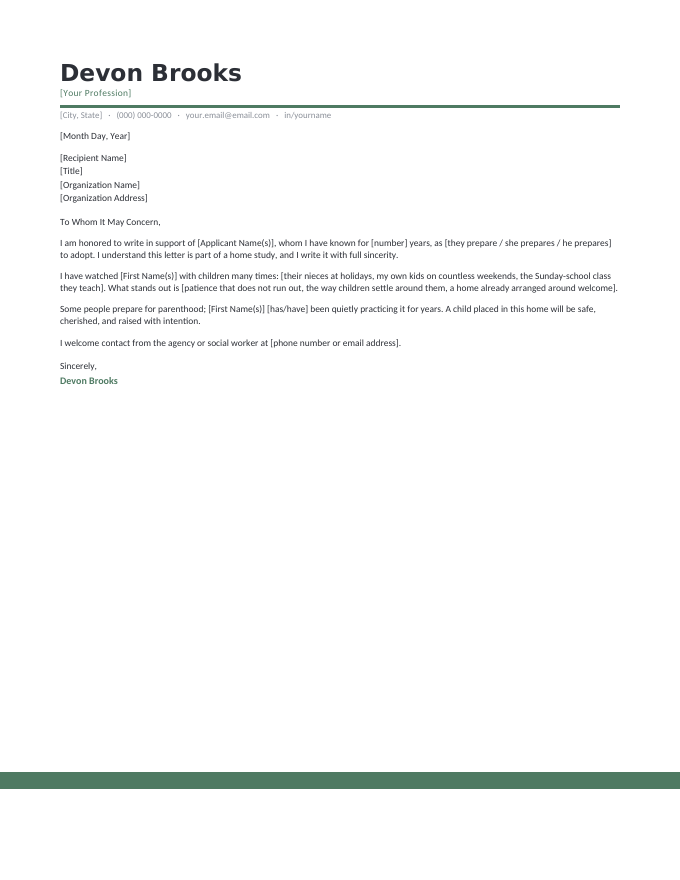
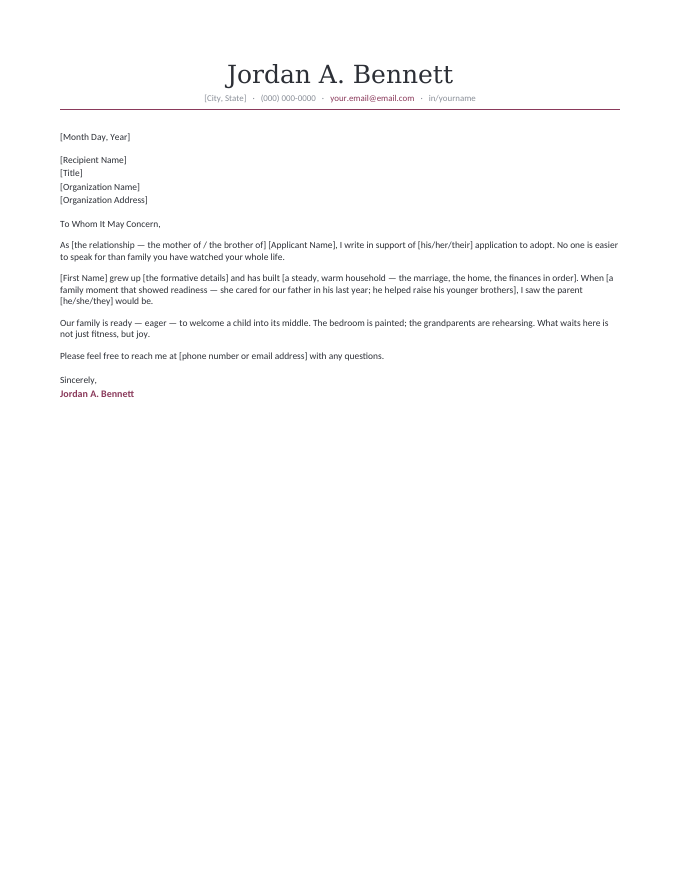
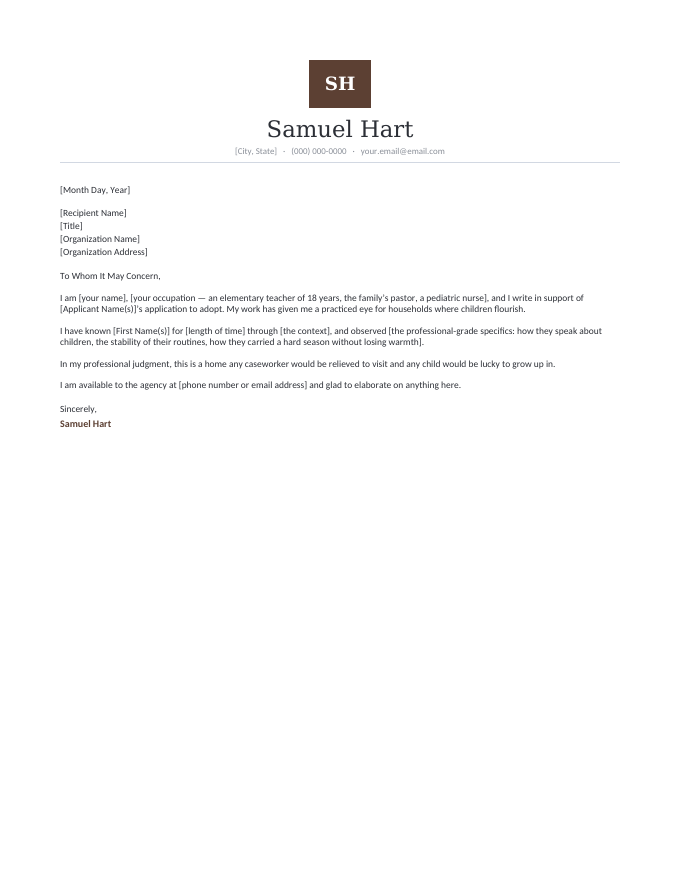
Adoption reference letter sample — the letter inside the template.
[Month Day, Year]
[Recipient Name]
[Title]
[Organization Name]
[Organization Address]
To Whom It May Concern,
I am honored to write in support of [Applicant Name(s)], whom I have known for [number] years, as [they prepare / she prepares / he prepares] to adopt. I understand this letter is part of a home study, and I write it with full sincerity.
I have watched [First Name(s)] with children many times: [their nieces at holidays, my own kids on countless weekends, the Sunday-school class they teach]. What stands out is [patience that does not run out, the way children settle around them, a home already arranged around welcome].
Some people prepare for parenthood; [First Name(s)] [has/have] been quietly practicing it for years. A child placed in this home will be safe, cherished, and raised with intention.
I welcome contact from the agency or social worker at [phone number or email address].
Sincerely,
Devon Brooks
Stability, warmth, and the truth.
Agencies read reference letters alongside interviews and home visits — your letter’s job is to corroborate with things only a friend or family member sees:
- The applicants around children — actual scenes: patience that holds, kids who settle near them, a home already arranged around welcome.
- How the household weathers stress — a hard season handled without losing warmth tells a caseworker more than any calm Sunday.
- Honest completeness — these letters are relied on; write the enthusiasm you genuinely have, and only that.
Answer any specific questions the agency’s form asks (some send a questionnaire), keep it to a page, and return it promptly — home studies wait on slow references more than anything else.
Three steps, returned promptly.
- Pick your vantage — friend, family, or professional — and download the letter.
- Fill the brackets with real scenes: the children you’ve watched them with, the household’s steadiness, the preparations already made.
- Sign with contact information and return it to the agency or social worker by their deadline.
Adoption reference FAQ
Who do adoption agencies want references from?
What questions is my letter really answering?
Should I mention weaknesses or hard seasons?
How fast should I return it, and to whom?
Adoption Reference Letter Templates · Updated September 2026