





How to Write a Resignation Letter
A resignation letter has one required sentence and three polite ones. This guide gives you all four, in order, with the format, who to address it to, when to hand it over, whether it needs a signature, and what to leave out — plus a complete sample you can copy and three templates with the letter already inside. Call it a letter of resignation if your handbook does; it's the same document.
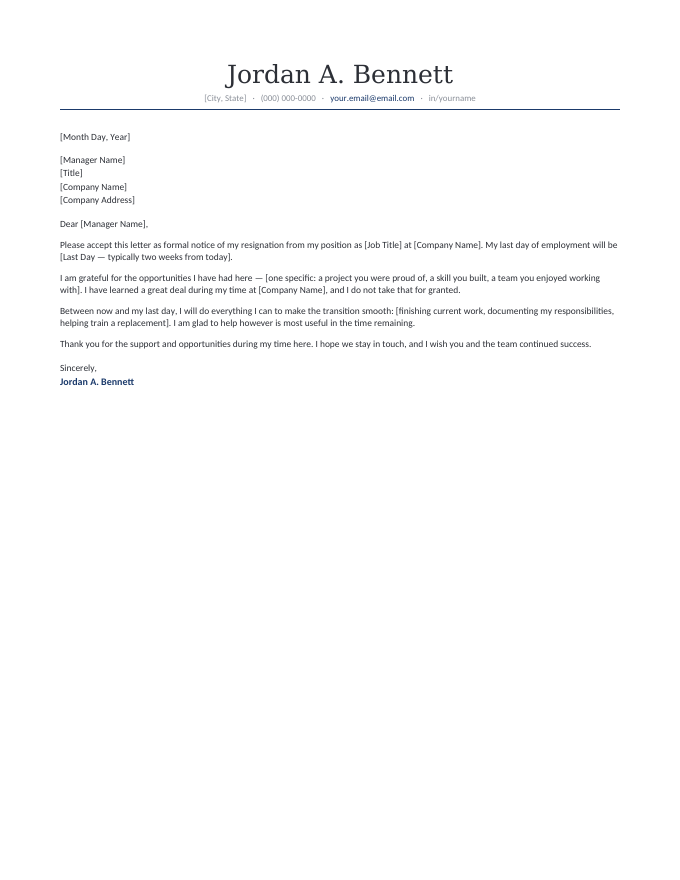
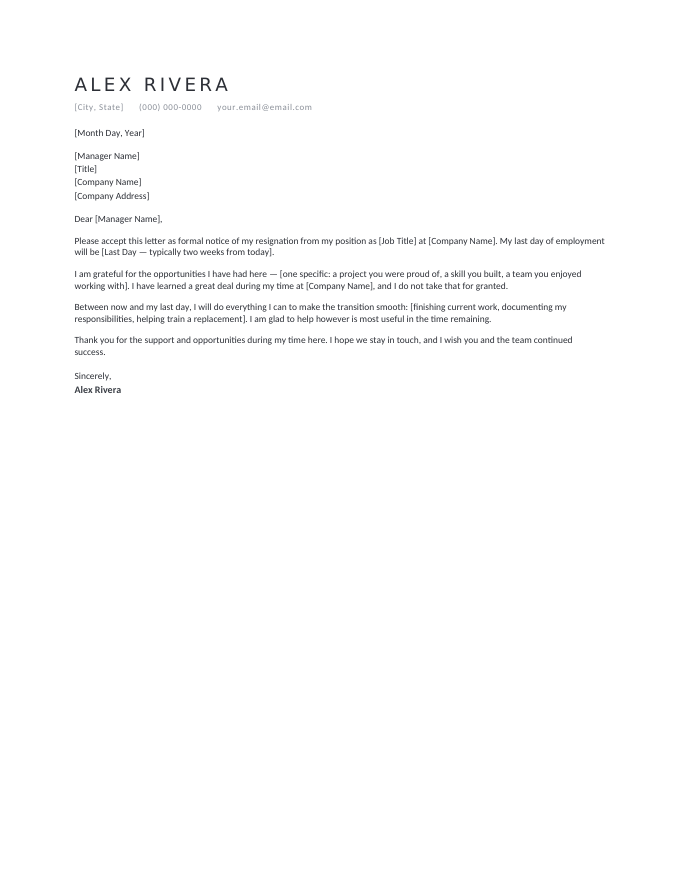
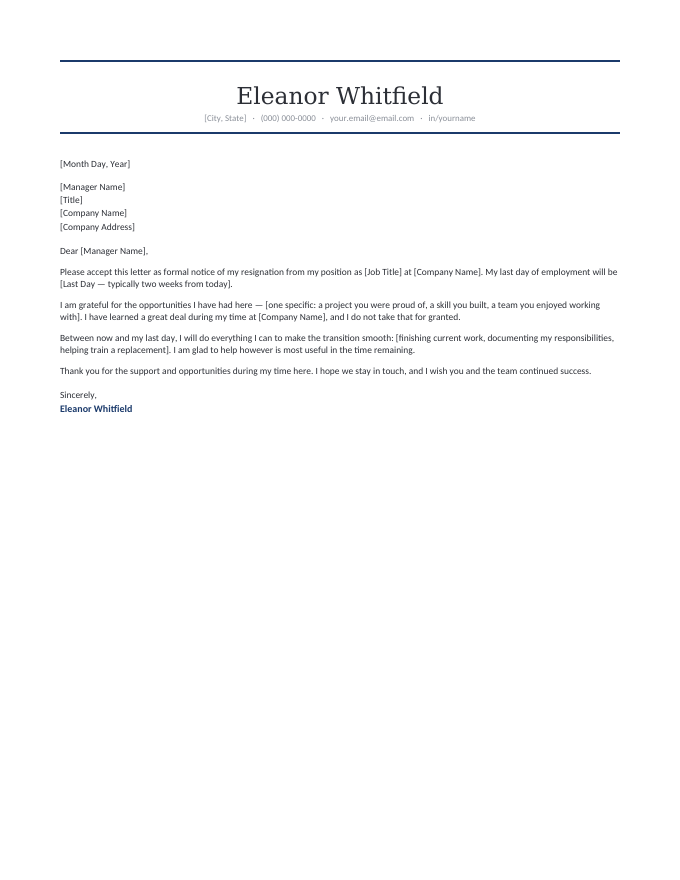
Three templates with the standard letter already written.
Every rule below is already applied inside these. Copy one to Google Docs or download the Word file and you are editing a correct letter, not writing one.
What a resignation letter is — and what it's for.
A resignation letter is the written record that you are leaving and when. That’s its entire legal job: HR files it, payroll works from its date, and your final paycheck, benefits, and reference are all keyed to the sentence that says ’my last day will be [date].’ Everything else in the letter is courtesy — valuable courtesy, because the person filing it is often the person answering your reference call in two years — but courtesy.
It is not the place for grievances, negotiation, or the story of why. Have those conversations in person. The letter should be the most boring document you write this year: short, dated, grateful, clean. ’Letter of resignation’ and ’resignation letter’ are the same thing; use whichever your handbook uses.
Format: the four things every resignation letter contains.
Open any of the twenty-six samples on the examples page and you’ll find the same four moves, in order. They are the format.
- The statement and the date. ’Please accept this letter as formal notice of my resignation from my position as [Job Title] at [Company Name]. My last day of employment will be [date].’ Two sentences, first paragraph, no preamble. This is what gets filed.
- One line of thanks. Specific beats effusive: a project, a skill, a person. ’I’m grateful for the opportunities I’ve had here — especially [X].’ If you’re leaving unhappily, one neutral sentence of thanks still belongs; it costs nothing and reads as class.
- A transition offer. ’Between now and my last day I will [finish current work, document my responsibilities, help train a successor].’ Concrete and bounded — not a promise to be available forever.
- A civil close. ’Thank you for the support during my time here. I wish you and the team continued success.’ Then ’Sincerely,’ and your name.
Add a fifth element only when the situation calls for it: one clause of reason (a move, a new job, health), or the sentence a hostile-workplace or health letter needs on the record. The reason pages carry those versions.
Layout
Standard business letter: your name and contact at the top, the date, the manager’s name, title, company, and address, the salutation, three or four short paragraphs, the sign-off, your typed name. 10.5–12 pt, one page, left-aligned. Every template on this site is that layout with the letter already inside.
Who to address it to, and when to give it.
Who to address a resignation letter to
Your direct manager, by name — ’Dear [Manager Name],’ — because they’re the person who needs to plan around your departure and the person whose relationship you’re preserving. Copy HR if your handbook says to, or if you want a second dated record (usually a good idea). In small organizations or where your manager is the problem, address HR or the owner directly. For a board, the chair; for a school, the principal (copy the district if required); for a church, the pastor or elders per the bylaws.
When to give it
After you’ve told your manager in person or by call — the letter should confirm a conversation, not start one — and the same day. Two weeks before your last day is the U.S. custom; your contract or handbook may require more (30 days is common for nurses, teachers, and salaried roles; 90 for physicians). Give the notice your contract requires and the letter should cite it. If you must leave immediately, say so in the first sentence and skip the apology tour — the immediate letter shows how.
Does it need to be signed?
A typed name is sufficient for an emailed or uploaded letter, and that’s how most resignations are delivered now. Sign by hand only if you’re printing it or your employer asks for a wet signature. What matters to HR is the date and the sender — an email from your work account is a signature in practice.
Email, attachment, or paper.
Email is now the standard channel: it creates the dated record automatically and reaches HR in one forward. Either write the letter as the email body (the email templates are built for that) or send a three-line email with the letter attached as a PDF — not both at full length. Subject line: ’Resignation — [Your Name].’ Print and sign only if your workplace files paper, or if you want the gesture; deliver it by hand after the conversation.
What not to say
- Grievances, names, or incidents — the letter is a record, not a case. If something needs saying, one factual sentence (see the hostile-workplace letter) and the rest in an exit interview.
- The new employer’s name, title, or salary.
- Conditions or negotiations (’I would stay if…’). Decide before you write; if a counter-offer comes, handle it in conversation.
- Apologies beyond one, jokes, or anything sarcastic. Nobody has ever regretted a boring resignation letter.
A complete resignation letter, annotated by the four moves.
[Month Day, Year]
[Manager Name]
[Title]
[Company Name]
[Company Address]
Dear [Manager Name],
Please accept this letter as formal notice of my resignation from my position as [Job Title] at [Company Name]. My last day of employment will be [Last Day — typically two weeks from today].
I am grateful for the opportunities I have had here — [one specific: a project you were proud of, a skill you built, a team you enjoyed working with]. I have learned a great deal during my time at [Company Name], and I do not take that for granted.
Between now and my last day, I will do everything I can to make the transition smooth: [finishing current work, documenting my responsibilities, helping train a replacement]. I am glad to help however is most useful in the time remaining.
Thank you for the support and opportunities during my time here. I hope we stay in touch, and I wish you and the team continued success.
Sincerely,
Jordan A. Bennett
Resignation letter FAQ
How do I write a simple resignation letter?
What should I not say in a resignation letter?
How do I professionally say I quit?
Is it better to quit or resign?
Who should I address my resignation letter to?
When should I give my resignation letter?
Does a resignation letter need to be signed?
Can I resign by email?
Do I have to give a reason?
Should I write a resignation letter if I was asked to resign?
How to write a resignation letter · Updated September 2026