




Bunco Rules: How to Play (Free Printable PDF)
Everything a first-timer needs and everything a host argues about: setup, scoring, when the round ends, who moves where, prizes, and the rule tweaks for groups of 4, 8, 16 or 24. Start with the one-page sheet, then read on for the details.
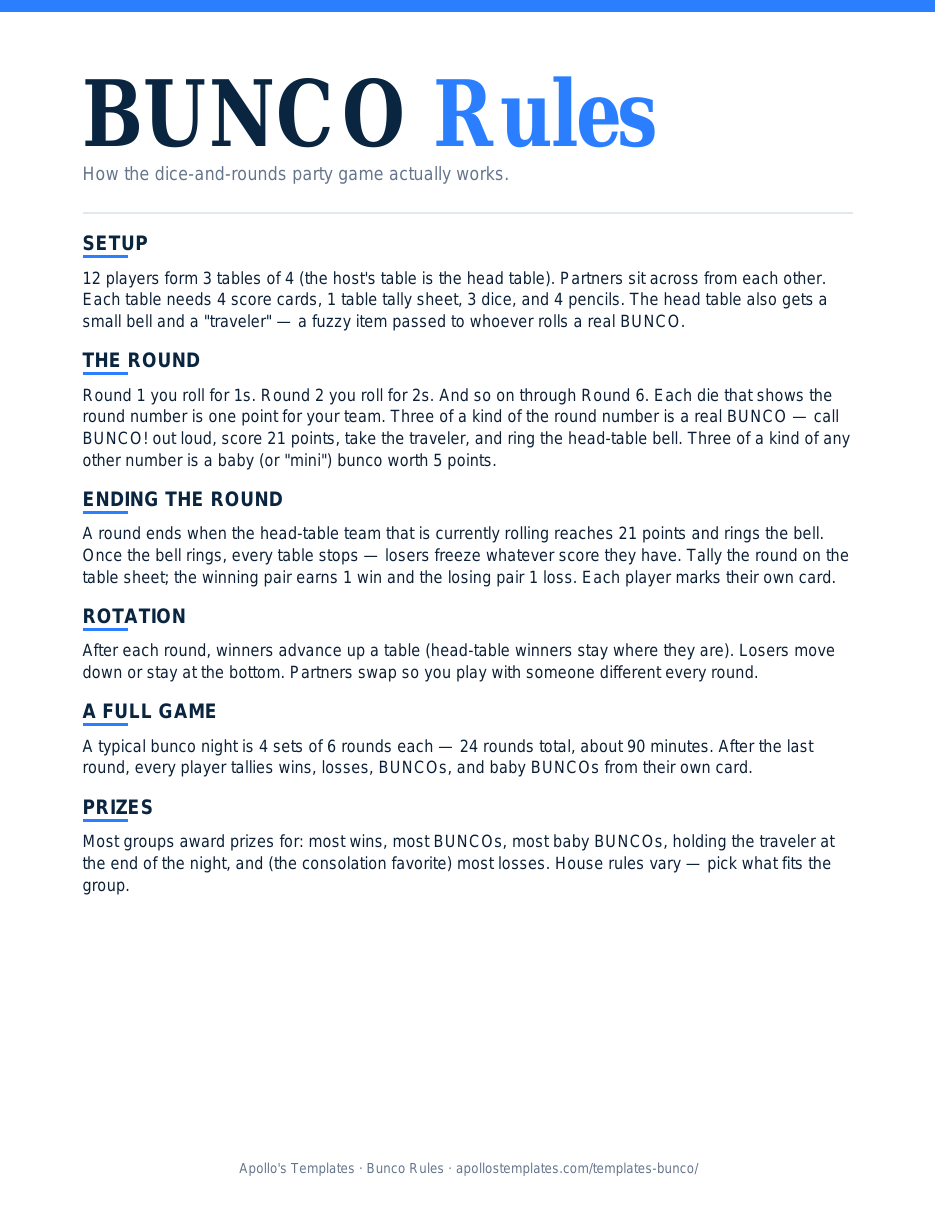
The one-page bunco rules sheet (free PDF)
Six short sections on a single US Letter page. Print one per table so nobody has to ask what a baby bunco is.
Hosting a themed night? Each of the 11 themed kits includes this same rules sheet in its own colors: Spring Bunco Kit, Summer Beach Bunco Kit, Cozy Autumn Bunco Kit, Halloween Bunco Kit, Christmas Bunco Kit, Valentine's Bunco Kit, Red, White & Bunco Kit, Boot Scootin' Bunco Kit, Thanksgiving Bunco Kit, Easter Bunco Kit, St. Patrick's Day Bunco Kit.
Bunco setup: 12 players, 3 tables, 3 dice
Players and tables
Bunco is a 12-player dice game. Players sit at three tables of four, and the two people sitting across from each other are partners for the round. The host’s table is the head table. Any multiple of four works the same way: eight players use two tables, sixteen use four, and so on.
What each table needs
Three dice, four pencils, four personal score cards (one per player) and one table tally sheet that one player at the table keeps for both pairs. The tally records the round’s points; the score card records each player’s wins, losses, BUNCOs and baby buncos for the whole night.
Head table only: the bell and the traveler
The head table keeps a small bell, rung when that table reaches 21 to end the round for everyone, and the traveler: a fuzzy die, a stuffed animal, or anything soft enough to toss, passed to whoever rolls a BUNCO. Whoever is holding the traveler when the last round ends usually wins a prize.
How to play bunco, round by round
Roll for the round number
The round number is the target. In round 1 everyone rolls for 1s, in round 2 for 2s, and so on through round 6. You roll all three dice at once. Every die that shows the round number scores one point for your team, and you keep rolling as long as you score. A roll that scores nothing ends your turn and the dice pass clockwise.
Bunco scoring rules
| The roll | What it scores |
|---|---|
| One die shows the round number | 1 point per die |
| Two dice show the round number | 2 points |
| Three of a kind of the round number | BUNCO — 21 points, take the traveler |
| Three of a kind of any other number | Baby bunco — 5 points |
| No die shows the round number | 0 — pass the dice clockwise |
A BUNCO is three of a kind of the round number: three 3s in round 3. Call it out, score 21 for your team, and take the traveler. A baby bunco (some groups say mini bunco) is three of a kind of any other number and scores 5. Both go on your personal score card at the end of the round.
When the round ends
The head table controls the clock. When either pair there reaches 21 points, the bell rings and every table stops mid-roll. At each table the pair with more points wins the round. Winners mark a win on their score cards, losers mark a loss. Ties are settled by a single roll-off: each pair rolls once for the round number and the higher count wins.
Rotation: winners up, losers down, partners swap
Winners move up one table, except head-table winners, who stay. Losers move down one table, except bottom-table losers, who stay. At every table partners swap so nobody plays with the same person twice in a row. If your group forgets who goes where, the rotation tracker in the club pack maps all 24 rounds on one sheet.
A full game
Six rounds make a set. A standard night is four sets, 24 rounds, about 90 minutes of dice. After the last round each player totals the tally bar on their card: wins, losses, BUNCOs, baby buncos.
Bunco rules for 4, 8, 12, 16 and 20+ players
12 players (the standard game)
Three tables of four, head table rings the bell. Everything on this page assumes twelve unless it says otherwise.
11 players: the ghost
The empty seat gets a ghost card. The ghost scores zero and never rolls, but holds the seat so rotation still works; the ghost’s human partner plays normally. The host kit includes a printable ghost card with a line for the ghost’s name.
8 players
Two tables. One is the head table. Winners move up to it, losers move down to the other, partners swap. Identical otherwise.
16, 20 and 24 players (large groups and fundraisers)
Add a table for every four players and number them 1 (head) through 4, 5 or 6. Winners move toward table 1, losers move toward the last table. Large groups need more table tally sheets (one per table) and take longer to rotate, so many hosts play three sets instead of four. For a fundraiser, set the pay-in at the door, keep prizes to the standard five, and put one confident scorekeeper at the head table.
4 players
One table. Partners swap every round so all three pairings come up over the night, and the round ends at 21 like normal. Play six rounds per set.
2 players and couples bunco
Two people play head-to-head: take turns rolling for the round number, first to 21 wins the round, six rounds make a set. Couples bunco is the twelve-player game with six couples; most groups split the couples up so partners change every round, which is more social and keeps the scoring fair.
Bunco variations: snake eyes, traveling, prizes, kids and fundraisers
Snake eyes
Rolling three 1s in any round except round 1 wipes out your team’s points for that round. A gentler version applies it only to two 1s and costs 5 points. It is not part of the base game; if your group uses it, say so before the first roll.
The traveler
Whoever rolls a BUNCO takes the traveler from whoever has it. When the night ends, the person holding it wins the traveler prize. Some groups keep a second traveler for baby buncos.
Prizes, pay-ins and money rules
Most clubs collect a pay-in and divide the pot into five prizes: Most Wins, Most BUNCOs, Most Baby BUNCOs, Traveler, and Most Losses as the consolation. Ties split the prize or go to a roll-off. Themed nights often trade cash for themed prizes. If money makes your group uncomfortable, a wrapped-gift exchange in the same five categories works just as well.
Bunco rules for kids
Kids from about eight up can play the full game. Simplify by dropping baby buncos, playing three sets, and using candy as markers and prizes. Younger kids do well with a grown-up scorekeeper at each table and a louder bell.
Three-set nights and speed bunco
Short on time? Play three sets (18 rounds) and leave set 4 blank on the score card. Speed bunco ends every round on a timer instead of the head table’s 21, which keeps a large room moving.
No-partner bunco
Every player scores alone; the top two at each table move up. It removes the partner swap and works for groups whose numbers change week to week.