
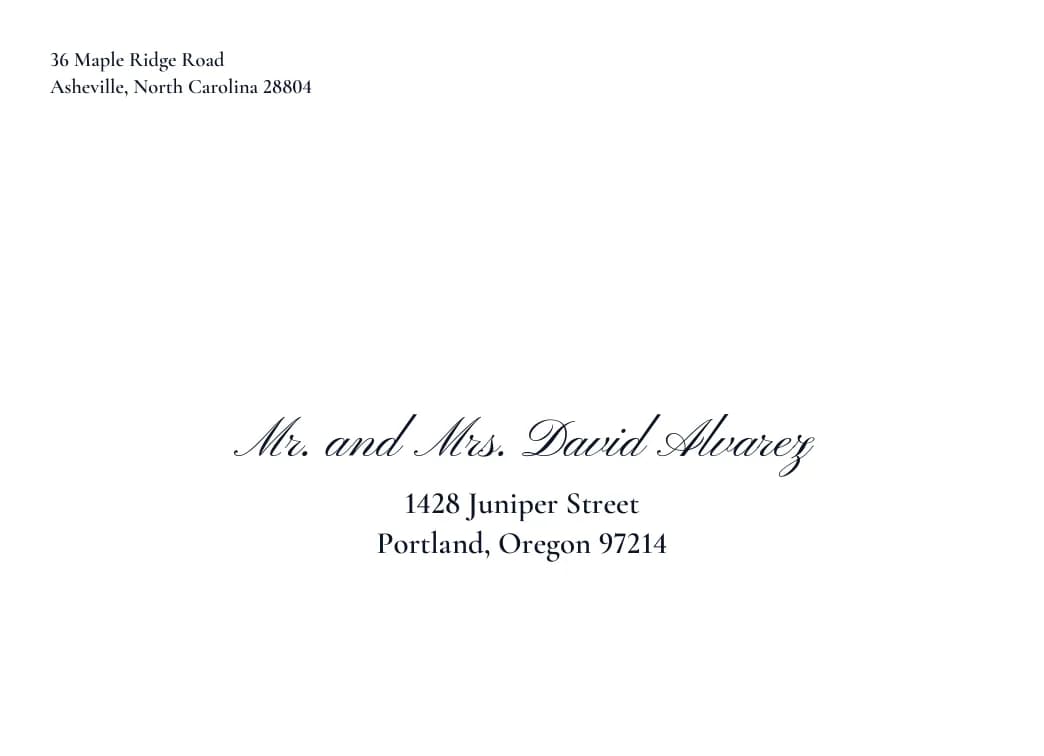
Traditional form
Mr. and Mrs. David Alvarez
1428 Juniper Street
Portland, Oregon 97214
Inner envelope: Mr. and Mrs. Alvarez



Write each guest's full name with their title, then the street, city and state, with words like Street and Apartment spelled out on a formal envelope. Name everyone who is invited: anyone not named is understood not to be. The formatter below does the wording for you, and every case is written out further down.
Choose who the envelope is for and type their names. You'll see every correct way to word it, on an envelope drawn to scale. Add guests to a list, then download them all as envelopes, labels or a spreadsheet.
Type abbreviations if that’s quicker: “St” and “OR” are spelled out for you.
Add guests one at a time, then print them all at once.
Type a guest and an address to turn these on.
Envelopes print one to a page at 5.25 x 7.25 in; pick that paper size and 100% scale. Labels fit Avery 5160 sheets. Print one on plain paper first and hold it behind the envelope or sheet to check it lines up.
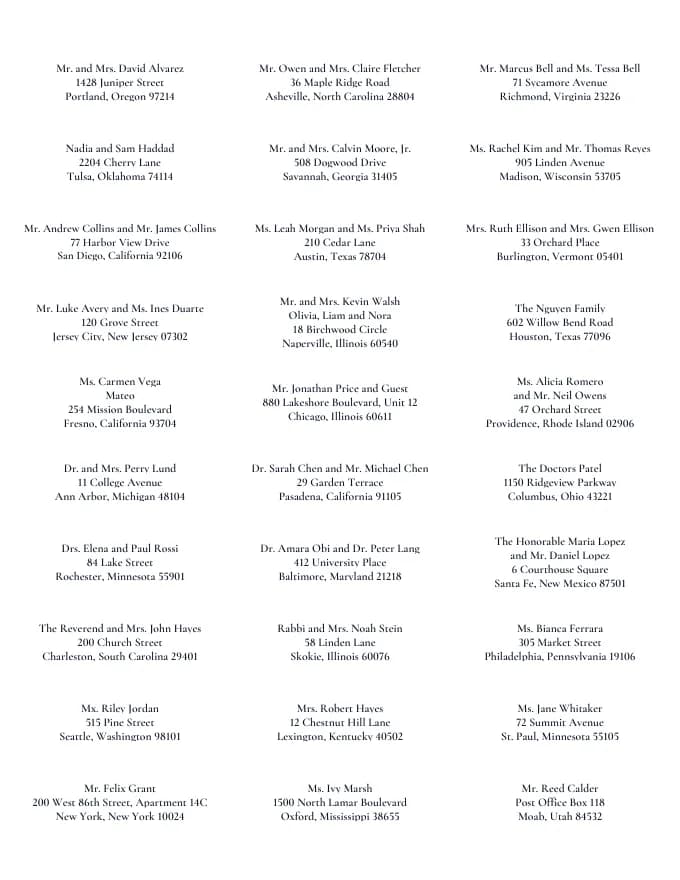
Every line in the PDFs stays editable, so you can fix a spelling without starting over. Need to print a blank sheet or a different label size? The address label maker and the return address label maker handle those.
Addressing looks like a thicket of special cases, but most of them come from five habits. Customs vary by family, faith and region, so treat these as common practice, and let a guest’s own preference win over any of them.
The traditional form names one spouse in full behind “Mr. and Mrs.” Many couples prefer to see both first names. When one spouse uses Ms. or Mx., write each name out in full: “Mr. and Ms. John Kelly” is the one form the Emily Post Institute calls incorrect.
Each person gets a full name, joined with “and.” The order is yours to choose unless one person holds a higher title, and a long pair breaks onto two lines before the “and.”
The same rules apply: use the titles and surnames the couple use themselves, and put either name first, alphabetically or starting with the person you know best.
One invitation goes to the shared address. Guides differ on the layout: each name on its own line is the most common choice, and one line joined with “and” is also accepted. A couple who live apart can each get their own.
Children who are invited are named, oldest first. With an inner envelope, their first names go there under the parents; with one envelope, they follow on the next line. “The Walsh Family” is read as everyone in the household, so use it only if you mean everyone.
Children 18 and older usually get their own invitation, even at their parents’ address.
One invitation goes to the guest you know. If you know the partner’s name, use it, which is warmer and makes the place card easier. If you don’t, “and Guest” works.
A doctor’s title goes first, whichever spouse holds it. When both are doctors and share a surname, “The Doctors” is the most formal form and “Drs.” with both first names is the friendlier one. “Doctor” can be spelled out for a medical doctor; guides differ on academic doctors, so “Dr.” is the safe choice.
These titles lead the name and are written out. A judge is “The Honorable” on the outer envelope and “Judge” on the inner one. Officers are addressed by full rank, often with the branch after the name, and the higher rank goes first.
Enter the higher rank first. The tool can’t compare ranks, so the order you type stands.
Use the title the guest uses. Ms. suits any adult woman, Miss is usually for a girl under 18, and Mx. is a title anyone may use. A full name with no title is never wrong when you can’t find out.
Many widows prefer their own first name: Mrs. Eleanor Hayes. Ask a family member if you can.
Ms. with the surname she uses now; some women still prefer Mrs.
On a formal envelope, words like Street, Avenue, Apartment and the state name are spelled out, and the unit can stay on the street line. Abbreviations are fine on a casual envelope, and the Postal Service reads either.
APO, FPO and the AA, AE or AP code stay exactly as they are, so the mail gets routed.
The outer envelope carries the postage, the full names and the mailing address. The inner envelope, a tradition from when the outer one could arrive travel-worn, carries names alone: “Mr. and Mrs. Alvarez,” or simply “David and Laura” for close family. It’s also where children’s names and “and Guest” usually go.
Most couples now skip the inner envelope, and that’s entirely correct. It only changes one thing: the outer envelope has to name everyone who is invited, so children follow on the next line and “and Guest” follows the name. The formatter moves them for you when the inner envelope box is off.
Whose address. Traditionally it belongs to whoever is hosting, because that’s who the invitation comes from. In practice, use the address of whoever is keeping track of replies, whether that’s the couple or a parent. The reply envelope or RSVP postcard goes to the same place, and the save the dates can use it too.
Where it goes. The back flap is the traditional place, often with no names, just the address. The top-left corner of the front is where mail in general carries it, and it’s the safer choice if a piece has to come back, since sorting machines read the front. Either is accepted. The formatter can print it in the corner, or you can download return address labels for the flap.
Handwriting has always been the traditional choice, and it’s still the warmest one, though a hundred envelopes is a long evening; split the list with someone whose writing you like. Printing directly on the envelope looks closest to calligraphy and costs almost nothing. Labels are the quickest, and clear ones nearly disappear on white or ivory.
Whichever you choose, keep the address itself easy to read. A flowing script suits a name, but the numbers and street are what the Postal Service has to read, which is why the formatter’s script option sets only the names in script. Dark ink on a light envelope is the safe combination, and it’s worth addressing one test envelope before you start on the good ones.