





How to Play Sudoku (Rules, Method and a Free Rules Sheet)
Sudoku has one rule and a method that scales from a first easy puzzle to the evil tier. This page explains both in plain words, names the mistakes that stall beginners, and hands you a two-page printable rules sheet with a starter puzzle and its answer.
The sudoku rules sheet, free PDF
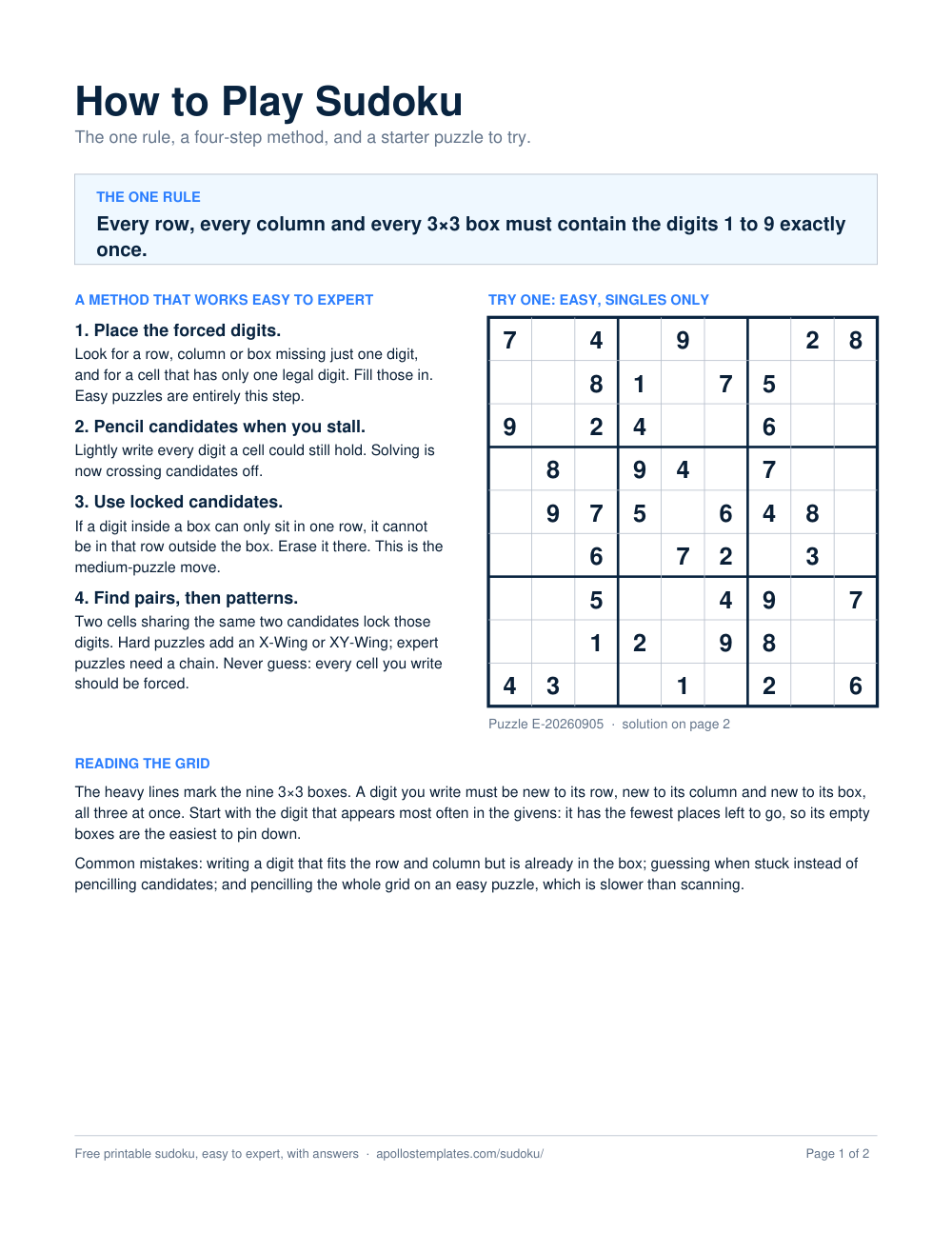
Two pages: the rule, the four-step method and an easy starter puzzle on page one; the starter's solution on page two. Laminate it for a classroom wall or fold it into a puzzle book.
Sudoku has exactly one rule
Every row, every column and every 3×3 box must contain the digits 1 to 9 exactly once.
That is the whole game. The grid is nine rows by nine columns, divided by heavy lines into nine boxes of three by three. Some cells arrive filled in; those are the givens and never change. Your job is to fill the empty cells so that no row, column or box repeats a digit. A properly made puzzle has exactly one way to do that, which is why every puzzle on this site is checked for a single solution before it prints: with one solution, there is never a choice to make, only a digit you have not found yet.
The digits are not added, multiplied or ordered. They are nine different symbols, and the puzzle would work identically with letters or shapes. A digit you write has to be new to three things at once: its row, its column and its box. Most beginner errors come from checking two of the three.
A four-step method that works from easy to expert
Place the forced digits
Scan each row, column and 3×3 box for a unit missing just one digit, and for any cell that has only one legal digit left. Fill those in. Easy puzzles are entirely this step; no pencil marks needed.
Pencil candidates when you stall
Lightly write every digit a cell could still hold. From here, solving is crossing candidates off as each new placement rules them out.
Use locked candidates
If a digit inside a box can only sit in one row of that box, it cannot appear in that row anywhere outside the box. Erase it there and a new forced digit usually appears. This is the one move that makes a puzzle medium.
Find pairs, then patterns
Two cells in a unit that share the same two candidates lock those digits to themselves; remove them from the rest of the unit. Hard puzzles add an X-Wing, XY-Wing or Swordfish; expert puzzles need a chain. Never guess: every digit you write should be forced.
The tiers on this site are named for these steps. Easy is step one alone. Medium adds step three. Hard adds the X-Wing family in step four, and Expert needs a chain. Because each tier requires exactly one new idea, you can learn them in order without ever hitting a puzzle that needs something you have not seen.
The rules sheet and the first puzzles to try
The rules sheet, page one
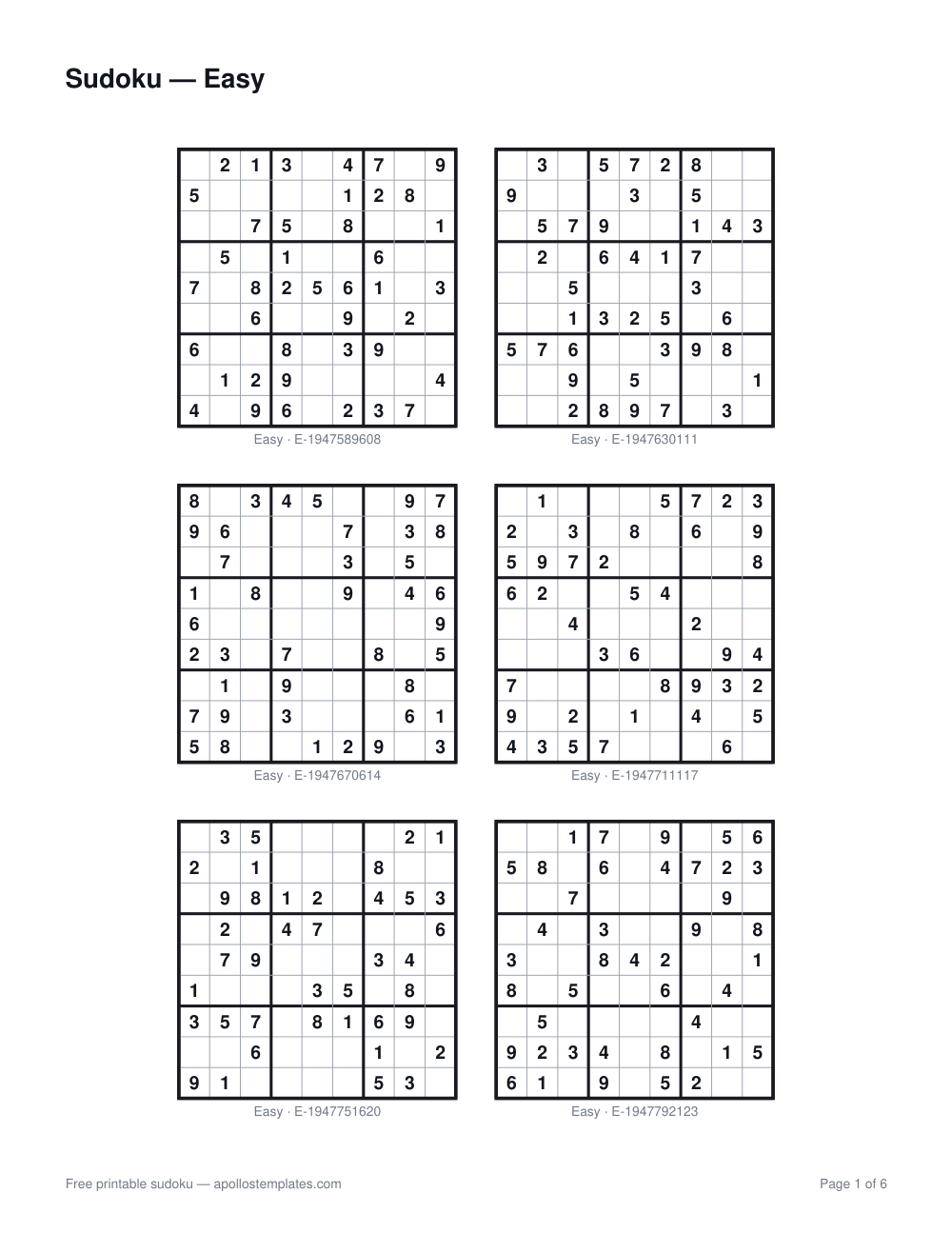
An easy puzzle, six per page
Solving a first cell by scanning
Pick the digit that appears most often among the givens; say it is 5, showing in six of the nine boxes. Look at one of the three boxes without a 5. Every row that already has a 5 rules out that whole row inside the box, and every column with a 5 rules out that column. Cross those out and, on an easy puzzle, one cell is usually left. That cell is a 5. This is a hidden single: the digit has exactly one place it can go in that box.
The other scan is the naked single: pick an empty cell and list which digits are already in its row, column and box. If eight of the nine are taken, the ninth is the answer. Alternate the two scans, digit by digit and box by box, and an easy puzzle empties out without a single pencil mark. When both scans stop finding anything, that is the moment for step two, and on a medium puzzle the locked candidate will be waiting in whichever box has the fewest empty cells.
Common mistakes, in order of how often they happen: writing a digit that fits the row and column but is already in the box; guessing when stuck instead of pencilling; pencilling the whole grid on an easy puzzle, which is slower than scanning; and erasing a wrong digit without erasing the candidates you crossed off because of it.
Sudoku rules for children, and where the advanced techniques live
A child learns the same rule on a smaller grid: 1 to 4 on a 4×4 with two-by-two boxes, or 1 to 6 on a 6×6 with boxes three wide and two tall. The kids sudoku pages are organised by age from four to ten and print puzzles that finish by scanning alone, so nothing on this page beyond step one is needed until the full 9×9.
This site is the print side of sudoku. For the full technique library with animated examples, from locked candidates through X-Wings, XY-Wings, Swordfish and chains, our sister site PuzzleFuel plays the same daily puzzle on screen with a hint engine that names the next move. Learn a technique there, then print a hard pack here to practise it on paper.
Every printable sudoku on this site
Every sudoku template on this site prints the same technique-graded 9×9 puzzle — only the frame around it changes. Pick the one that matches the occasion, or start from a blank sudoku template and write your own.