





Military Character Reference Letters
The services ask about character before they teach anything else \u2014 and for enlistment files, moral waivers, and academy applications, letters from the adults who watched a young person grow carry real weight. Three templates: the enlistment character letter, the waiver letter that addresses a record honestly, and the academy or officer-candidate recommendation.
Enlistment, waiver, and the academy.
Each is written for its reader \u2014 the recruiter's file, the waiver authority weighing a second chance, the admissions board choosing future officers.
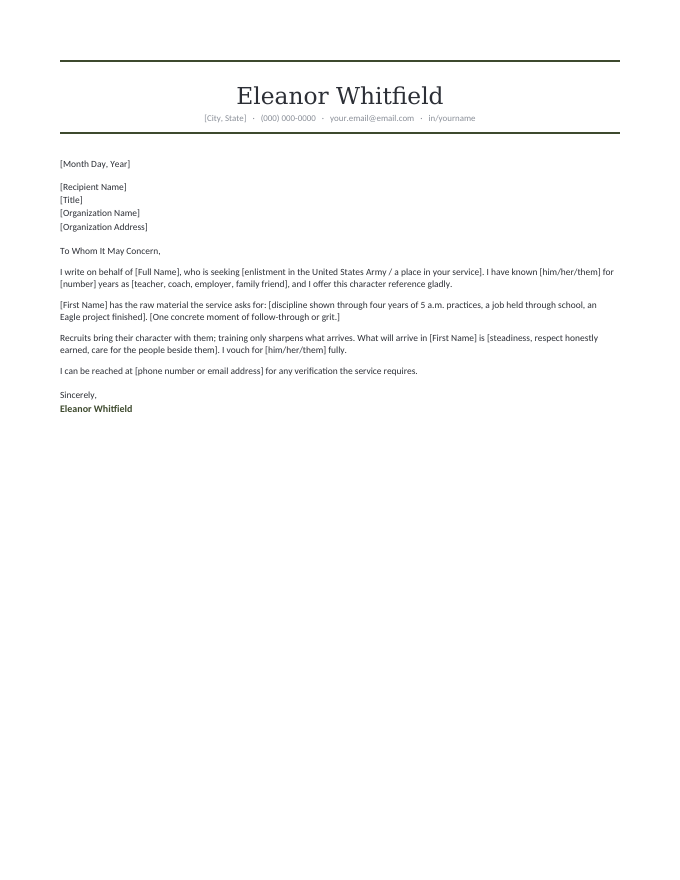
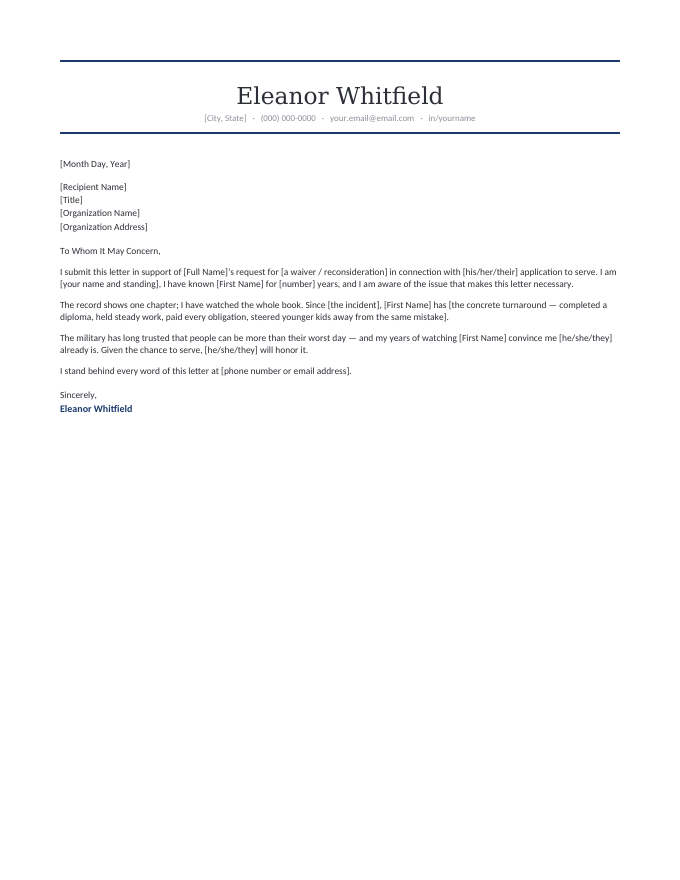
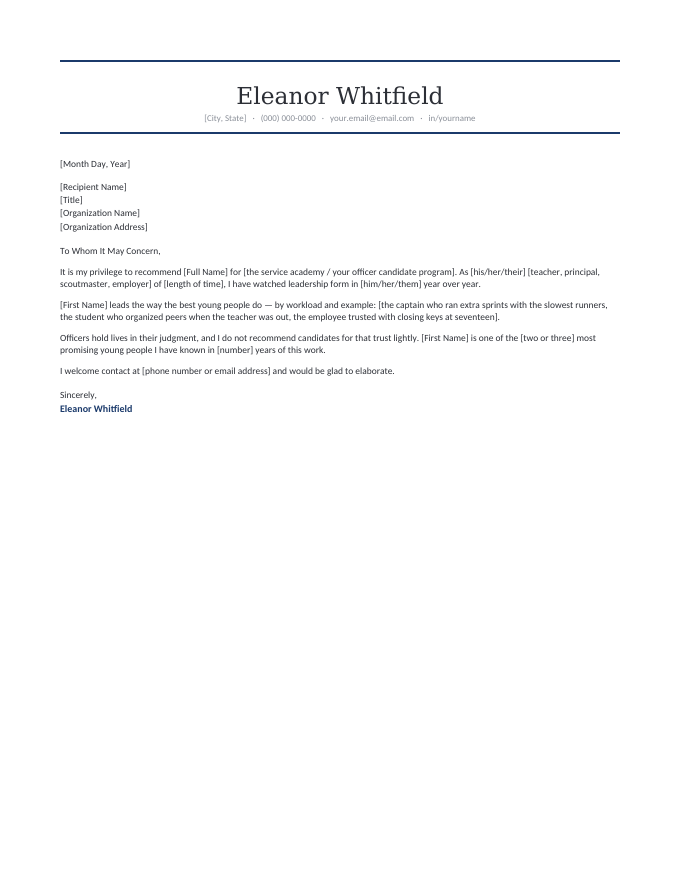
Military reference letter sample — the letter inside the template.
[Month Day, Year]
[Recipient Name]
[Title]
[Organization Name]
[Organization Address]
To Whom It May Concern,
I write on behalf of [Full Name], who is seeking [enlistment in the United States Army / a place in your service]. I have known [him/her/them] for [number] years as [teacher, coach, employer, family friend], and I offer this character reference gladly.
[First Name] has the raw material the service asks for: [discipline shown through four years of 5 a.m. practices, a job held through school, an Eagle project finished]. [One concrete moment of follow-through or grit.]
Recruits bring their character with them; training only sharpens what arrives. What will arrive in [First Name] is [steadiness, respect honestly earned, care for the people beside them]. I vouch for [him/her/them] fully.
I can be reached at [phone number or email address] for any verification the service requires.
Sincerely,
Eleanor Whitfield
Character arrives before training.
Military reviewers read character letters the way they read everything — for evidence over enthusiasm. The letters that help share three habits:
- Discipline with receipts — four years of 5 a.m. practices, a job held through school, the finished Eagle project. Sustained effort is the currency.
- Standing stated plainly — teacher of 20 years, employer, coach. Reviewers weigh how many young people you’ve watched before this one.
- For waivers: full awareness — name the issue, then document the turnaround with dates. A waiver letter that dodges the record helps nobody.
Ask the applicant’s recruiter or admissions contact where the letter goes and in what format — each service and program has its own file, and the letter helps most when it lands inside it correctly.
Three steps to the file.
- Choose the door — enlistment, waiver, or academy — and download the letter.
- Fill the brackets with years, roles, and concrete moments of follow-through; for waivers, the honest before-and-after.
- Sign with your title and contact info, and route it through the recruiter or admissions contact.
Military letter FAQ
Who should write a military character reference?
What is a moral waiver letter, exactly?
How is an academy recommendation different?
Does format matter — letterhead, length, address?
Military Character Reference Letters · Updated September 2026