





Immigration Reference Letter Templates
Immigration cases ask a specific question \u2014 good moral character \u2014 and letters from citizens and neighbors are real evidence toward the answer. These three templates carry complete letters: the general character statement, the citizenship-application letter, and the community-member letter, each closing with the truth affirmation immigration files expect.
The letters immigration files actually use.
Each states your own status and standing, the years of firsthand knowledge, and concrete detail \u2014 then affirms its truth, because these letters are relied on.
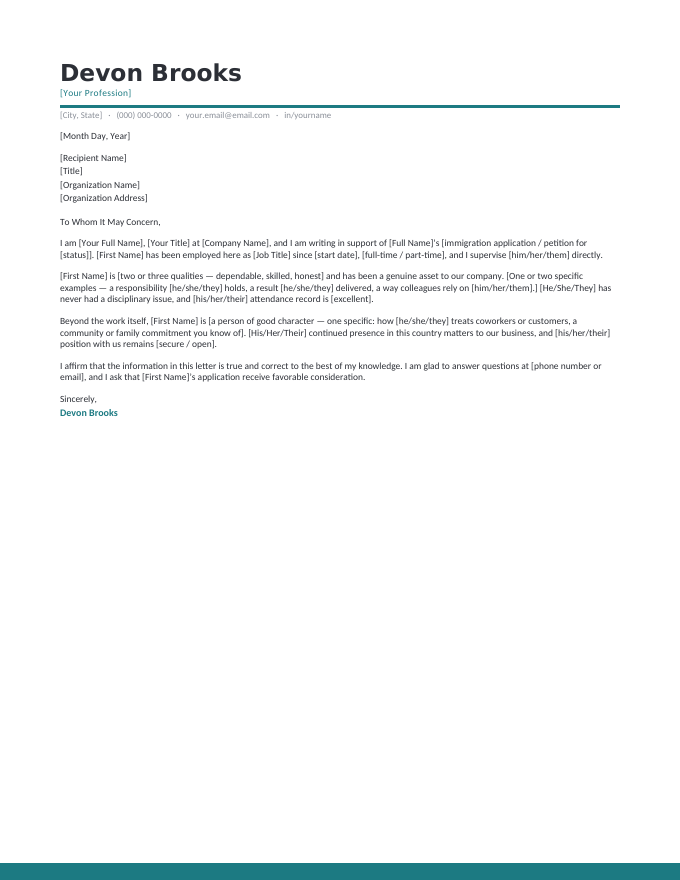
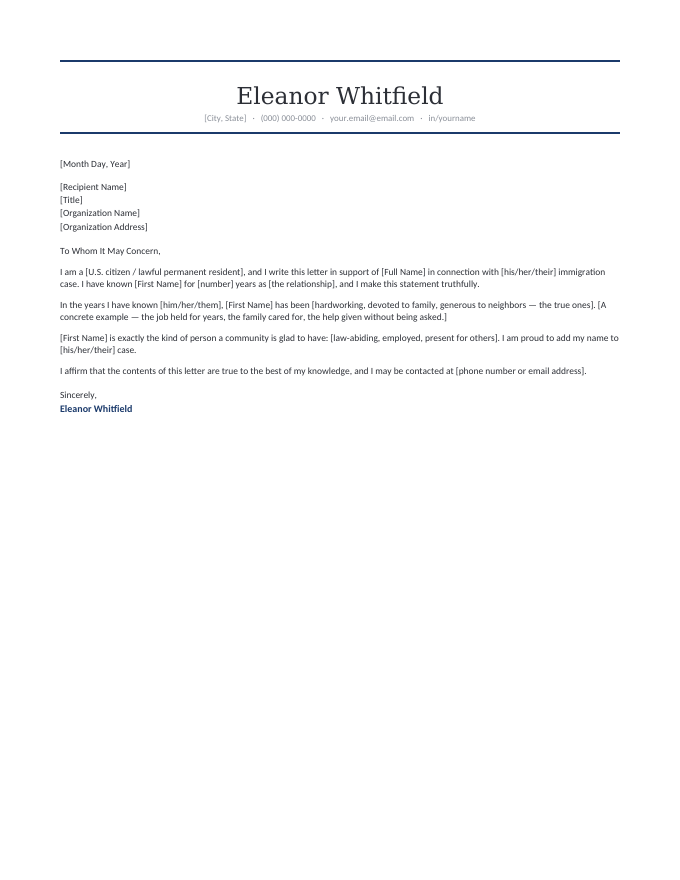
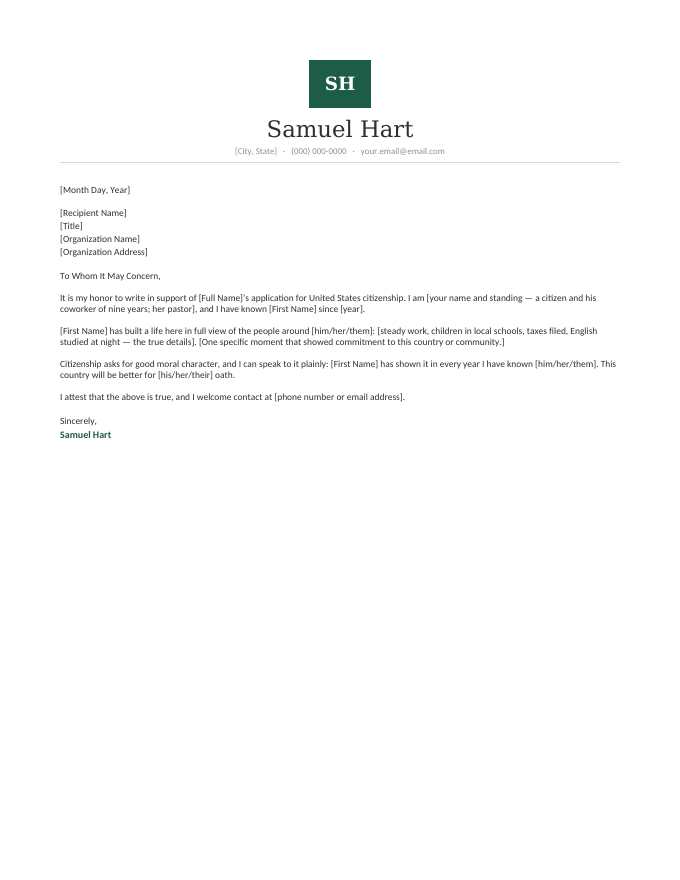
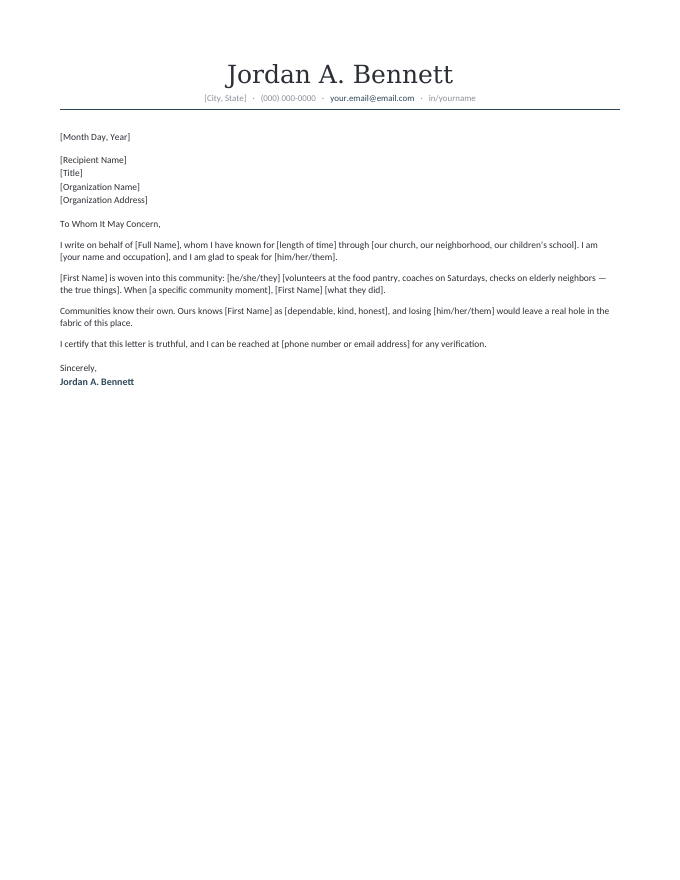
Immigration reference letter sample — the letter inside the template.
[Month Day, Year]
[Recipient Name]
[Title]
[Organization Name]
[Organization Address]
To Whom It May Concern,
I am a [U.S. citizen / lawful permanent resident], and I write this letter in support of [Full Name] in connection with [his/her/their] immigration case. I have known [First Name] for [number] years as [the relationship], and I make this statement truthfully.
In the years I have known [him/her/them], [First Name] has been [hardworking, devoted to family, generous to neighbors — the true ones]. [A concrete example — the job held for years, the family cared for, the help given without being asked.]
[First Name] is exactly the kind of person a community is glad to have: [law-abiding, employed, present for others]. I am proud to add my name to [his/her/their] case.
I affirm that the contents of this letter are true to the best of my knowledge, and I may be contacted at [phone number or email address].
Sincerely,
Eleanor Whitfield
Facts, standing, and an oath-like close.
Officers and immigration judges read supporting letters with a specific filter — they’re looking for statements a real person is putting their name to, not form letters. Three habits separate the letters that get weight:
- State your own status — citizen or permanent resident, occupation, how you know the applicant. The witness comes before the testimony.
- Concrete life detail — the job held for years, the children in local schools, the neighbor helped. Details an officer could verify beat any adjective.
- Affirm truthfulness — each template closes with an affirmation line; some filings want it notarized, so ask the attorney handling the case.
Write only what you know firsthand and keep the tone factual — an immigration letter is closer to testimony than to a greeting card, and reads best that way.
From download to the case file.
- Choose the letter that matches the filing — general character, citizenship, or community support.
- Fill the brackets with facts you can stand behind: your status, years known, and verifiable specifics.
- Sign and date it, then give it to the applicant or their immigration attorney — they’ll say if notarization is wanted.
Immigration letter FAQ
Who can write an immigration reference letter?
Does the letter need to be notarized?
What counts as evidence of good moral character?
Can the letter be in my native language?
Can an employer write an immigration reference letter?
What should an immigration reference letter include?
Immigration Reference Letter Templates · Updated September 2026
These are writing templates, not legal advice — for questions about your specific matter, ask the attorney or professional handling it. See our disclaimer.