Apollo's Templates
HomeTo-Do List TemplatesHow to write a to-do list
A short guide

How to Write a To-Do List That Works

Most to-do lists fail the same way: everything goes on, nothing comes off, and by Thursday the page is a record of guilt. The fix is not a better app. It is four moves — capture everything, choose three, give them a slot, review on a fixed day — and a handful of named methods that are each one of those moves done well. Here are six, with the free template that fits each.

Six methods

Pick the move your list is missing.

1

Capture everything first, on one page

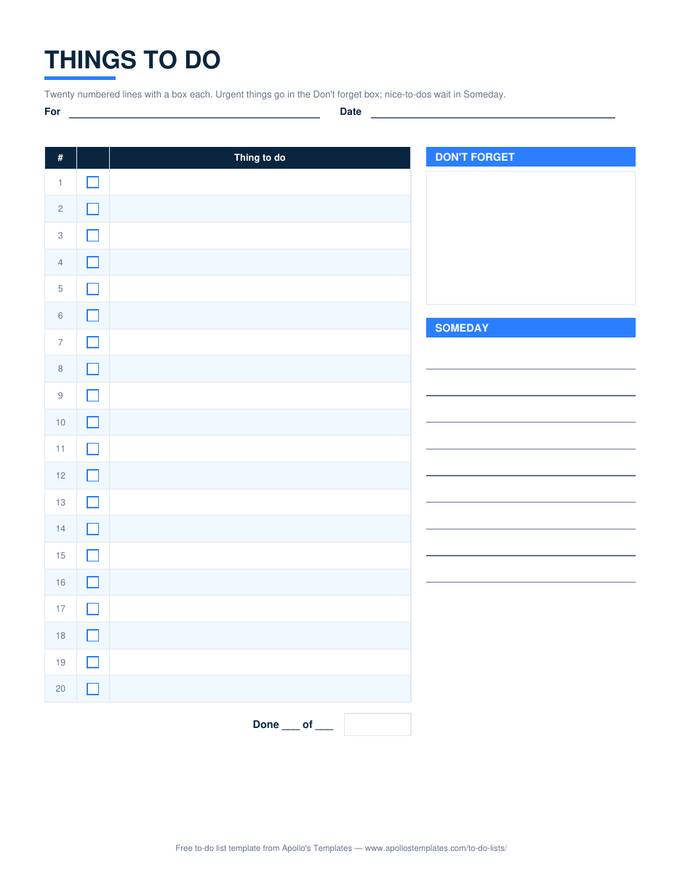
The list that fails is the one written from memory at 9 p.m. Start by getting every open loop out of your head onto a single numbered page — errands, calls, the thing you promised in March — without sorting. The point is not to do them; it is to stop them interrupting. A numbered things to do page with a Someday column is the simplest capture tool there is, and the ADHD list’s brain-dump box is the same idea for people whose interruptions are louder.
Things to do list
Things to do list with twenty numbered checkbox lines beside a don't-forget box and a someday list
2

Choose three (or 1-3-5)

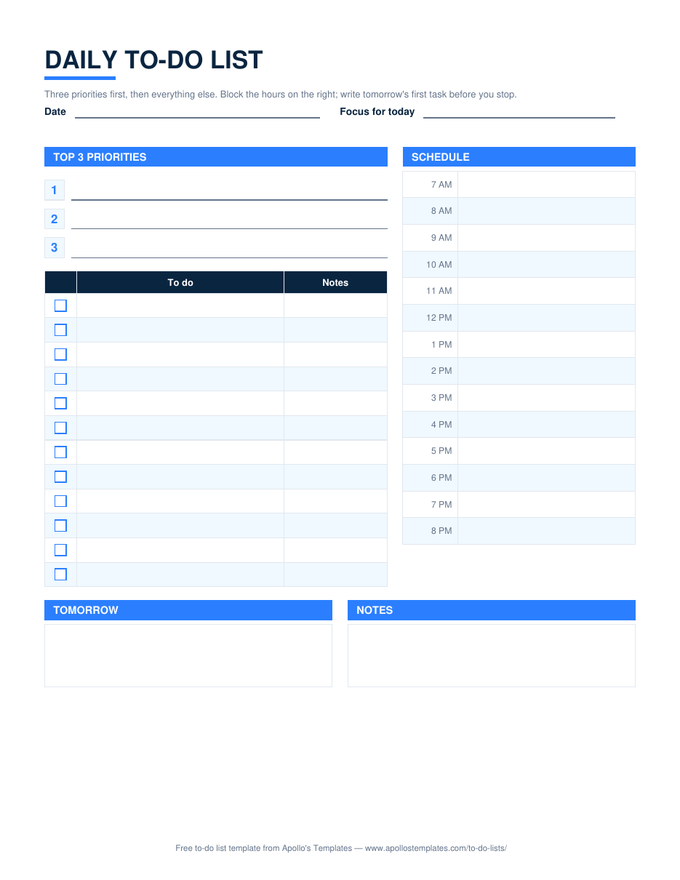
A list of twelve equal items is a list with no plan. Pick the three that would make today a good day and write them somewhere separate from the rest — the Top 3 block on the daily list. The 1-3-5 rule is the same move with more shape: one big task, three medium, five small, nine items and no more. Either way, the discipline is the cap, not the count. Finishing three beats listing ten.
Daily to-do list with Top 3
Daily to-do list with three numbered priority lines, a checkbox task list, an hourly schedule column from 7 AM to 8 PM, and tomorrow and notes boxes
3

Sort by urgent and important

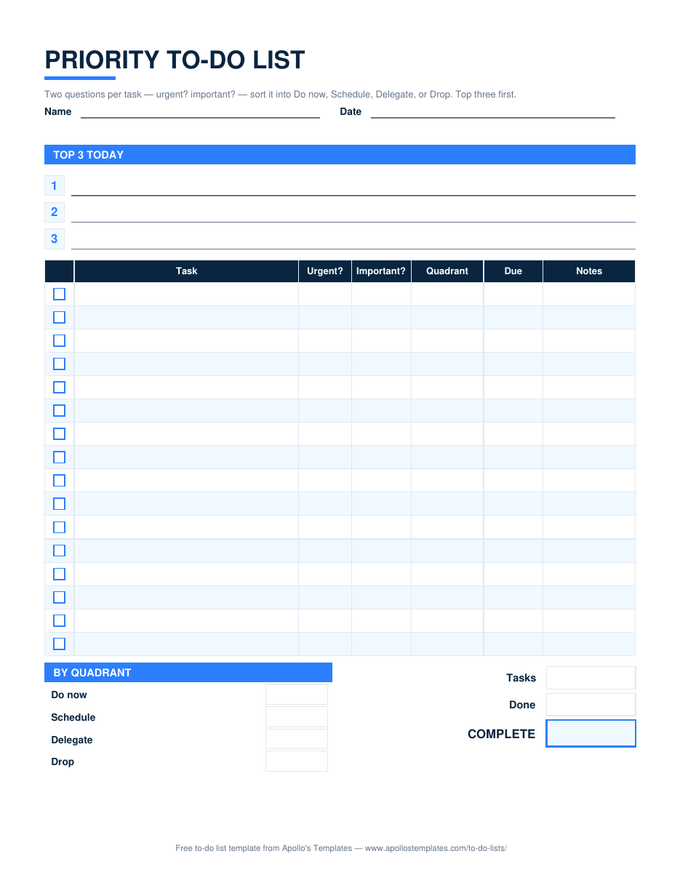
Two questions per task: is it urgent, and is it important? Yes and yes gets done now; important but not urgent gets a date (this is where the good work lives, and where it dies if you skip this step); urgent but not important gets handed off; neither gets dropped. Eisenhower’s four boxes are the paper version; the priority to-do list asks the two questions as dropdowns and sorts the task into its quadrant for you.
Priority list & Eisenhower matrix
Priority to-do list with three top-3 lines and a task table with urgent and important columns, a computed quadrant column, due and notes, plus by-quadrant counts
4

Give each task a slot

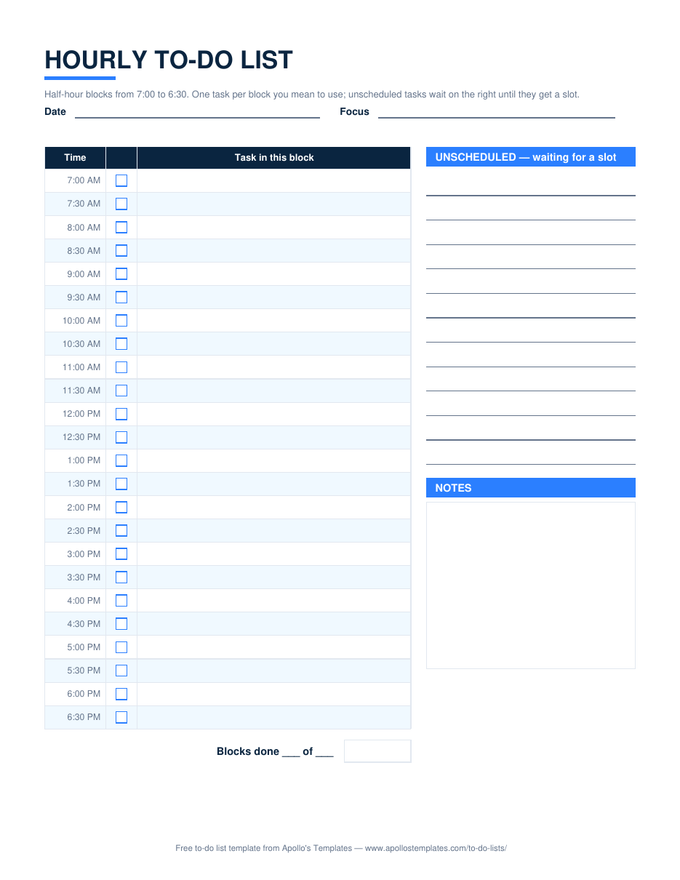
A task without a time is a hope. Time blocking means putting the day’s tasks into actual half-hour slots — and discovering, before 9 a.m., that five two-hour tasks do not fit in an eight-hour day. Block the deep work first, then the meetings, and leave two slots empty for whatever arrives. The hourly list is the sheet; the daily list’s hour column is the lighter version.
Hourly to-do list
Hourly to-do list with half-hour rows from 7:00 AM to 6:30 PM, a checkbox and task cell per block, an unscheduled list, and a notes box
5

Group what recurs into a checklist

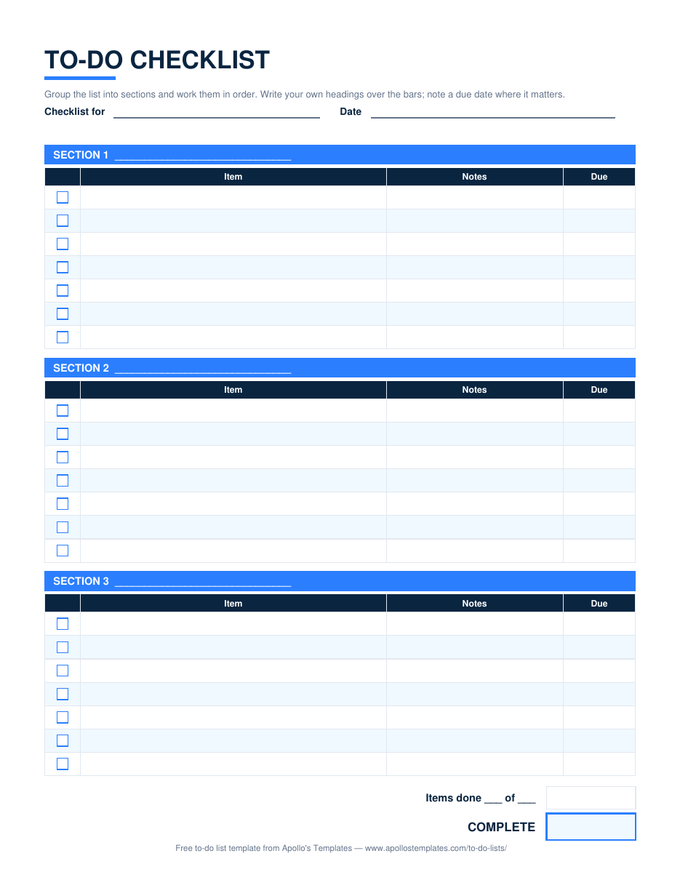
Some tasks are not tasks; they are procedures — opening the shop, packing for a trip, closing the month. Those belong on a checklist you reuse, grouped into sections and worked in order, not rewritten every time. Writing the checklist once, right after the first time you do the job, is the single biggest time saver on this page. The wedding and moving lists are checklists we wrote for you.
To-do checklist
To-do checklist with three section bars, each over a table of checkbox, item, notes, and due columns, and an items-done total
6

Review on a fixed day

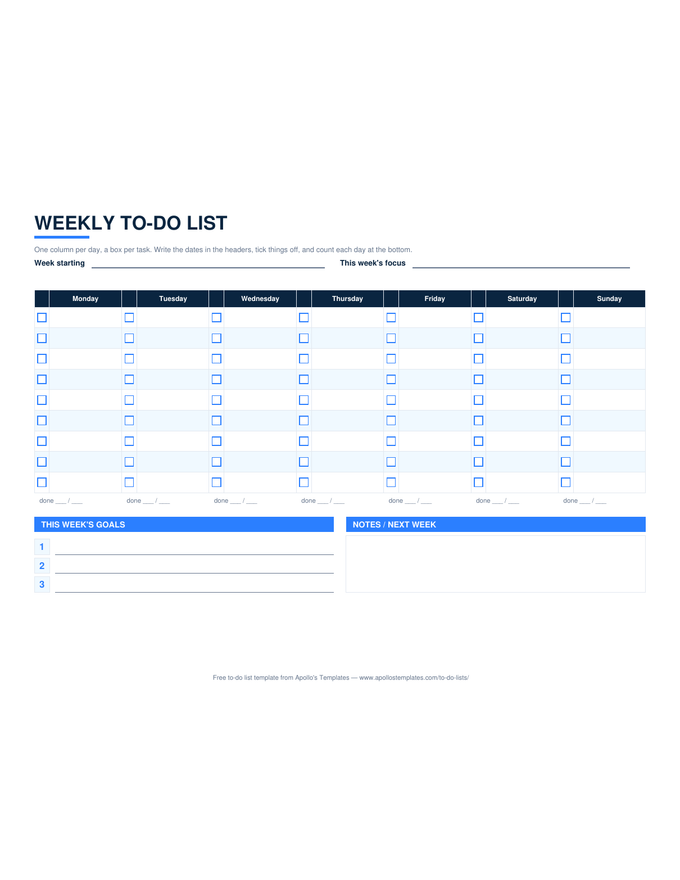
Lists decay without a review. Once a week, on the same day, look at everything unticked and decide: into next week’s goals, into Someday, or crossed out. The weekly list’s goals band and the monthly list’s carry-over box are built for this. A task copied forward three weeks running is the list asking whether it belongs on a list at all — answer it.
Weekly to-do list
Weekly to-do list in landscape with seven day columns, a checkbox beside each task line, a per-day done count, a goals block, and a notes box
For teams

When the list has more than one name on it.

Everything above is for one person. The moment a list has an owner column it becomes a different object — a task list — and the rules change: every row needs exactly one name, a status that includes Waiting (the column that hides blocked work), and a review that reads the list by person before it reads it by status. The task list, task tracker, and task management sheet are built for that, with the counting done in Excel and Google Sheets.

Whichever method you pick, keep the finished pages for a month. A stack of daily lists is the most honest record of where the time went, and it is the raw material for a better weekly one.

Start from a template
Free To-Do List Templates
Thirty-four lists in five formats.
Browse
See them filled in
To-Do List Examples
What each method looks like in use.
Browse
Print your own
To-Do List Maker
Type the tasks, pick a look, download a PDF.
Start

Frequently asked questions

What is the best way to write a to-do list?
Capture everything first, then choose. Write every task down without sorting (a things-to-do page or a brain-dump box), pick the three that would make today a good day, give those three a time slot, and leave the rest visible but unscheduled. The method names — top three, 1-3-5, Eisenhower, time blocking — are all variations on those four moves.
How many items should a daily to-do list have?
Three that matter and a handful that would be nice. The research on planning fallacy is consistent: people underestimate how long tasks take and overfill lists, and an unfinished list every day teaches you to ignore it. Three important tasks finished beats ten listed.
Should I use paper or an app?
Paper for the day, an app or a spreadsheet for the backlog. A printed page is always in view and cannot interrupt you; a spreadsheet can count, sort by due date, and turn overdue rows red. Most people who keep the habit for years do both: a daily sheet on the desk, a task list or tracker for the longer horizon.
What is the 1-3-5 rule?
A daily list of one big task, three medium ones, and five small ones — nine items with a built-in shape. It works because it forces you to name the one big thing and stops the small ones from crowding it out. The priority to-do list's Top 3 block is the same idea with the small tasks left off the page.
How often should I rewrite my to-do list?
Daily for the day's list, weekly for the plan. Rewriting a daily list by hand each morning is the review — it forces you to decide again whether each carried-over task belongs. The weekly list's goals band and the monthly list's carry-over box exist for the longer-cycle version of the same question.
Updated through September 2026